






















QUICK DELIVERY
Swift dispatch
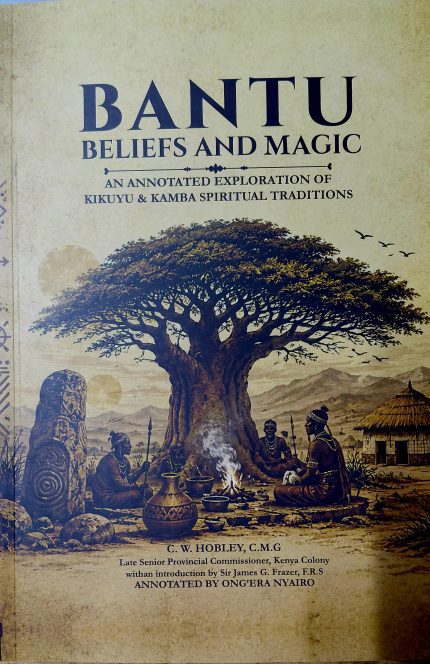
Bantu Beliefs and Magic is a remarkable exploration of the spiritual,cultural, and political traditions of the Agikuyu (Kikuyu) and Akamba peoples of Kenya. Written by C. W. Hobley in 1922, the book preserves a detailed record of indigenous life during a period of profound change under colonial rule. Drawing from years of research and conversations with elders, Hobley examines beliefs about God, ancestral spirits, sacred places, sacrifice, initiation rites, harvest ceremonies, and the customs that guided community life. These traditions reveal a rich worldview in which the spiritual and physical worlds were deeply connected.
The book also explores the role of magic, divination, healers, blacksmiths, curses, and protective rituals. Far from being isolated practices, these beliefs influenced social order, justice, health, and everyday decision-making within the community. Beyond religion and magic, Hobley documents systems of governance, councils of elders, customary law, age-set organizations, warfare, folklore, dances, and the influential role of women. His observations reveal societies with complex institutions and well-established methods of leadership and conflict resolution. Part anthropology, part history, and partcolonial-era record, Bantu Beliefs and Magic offers readers a rare window into precolonial East African life. It remains an important resource for anyone interested in African heritage, traditional belief systems, and the history of Kenya's indigenous communities.



As the title states, this is a book in which Captain HGC Swayne describes his travels through what came to be known as British Somaliland. Swayne was a British officer tasked with survey work in the protectorate that had just been established after the British government signed treaties with various Somali clans.
The book is primarily targeted at a home audience, particularly those who were drawn to accounts of travel through what was then called the 'uncivilized world,' and serves as a guide for those who dreamed of crossing the territory themselves. Beyond understanding the target audience, it is also important to note that the book was written at a time when racial hierarchy was accepted as respectable social science, with Europeans placed at the apex. As a result, you will encounter frequent racial connotations throughout.
Despite this, the book is essential reading for Africans, and especially Somalis. It provides important context for understanding the beginnings of colonization in the Horn of Africa, including the mindset of its agents. It also documents significant historical realities such as the extensive trade networks connecting the Horn of Africa to the wider world, the rich flora and fauna of the region, including species found nowhere else, and the culture, daily lives, and inter-communal relations of the people, particularly with their Abyssinian and Oromo neighbors.
Among the more striking passages are accounts of intimate but historically significant encounters, notably Swayne's meeting with Ras Makonnen, Governor of Harar and father of the future Ethiopian Emperor Haile Selassie. Swayne documents the meeting in detail, including the Ethiopians' ambitions to extend their borders to either the Red Sea or the Indian Ocean.
This is an important document for anyone from East Africa, and especially the Horn, who needs a historical backdrop to understand what is happening in the region today.





Swift dispatch
No account yet?
Create an Account