Showing 241–252 of 252 results

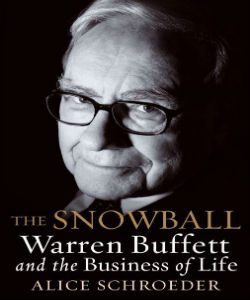
The Snowball: Warren Buffett and the ...

KShs4,800.00 KShs4,490.00
Here is THE book recounting the life and times of one of the most respected men in the world, Warren Buffett. The legendary Omaha investor has never written a memoir, but now he has allowed one writer, Alice Schroeder, unprecedented access to explore directly with him and with those closest to him his work, opinions, struggles, triumphs, follies, and wisdom. The result is the personally revealing and complete biography of the man known everywhere as "The Oracle of Omaha.”Although the media track him constantly, Buffett himself has never told his full life story. His reality is private, especially by celebrity standards. Indeed, while the homespun persona that the public sees is true as far as it goes, it goes only so far. Warren Buffett is an array of paradoxes. He set out to prove that nice guys can finish first. Over the years he treated his investors as partners, acted as their steward, and championed honesty as an investor, CEO, board member, essayist, and speaker. At the same time he became the world’s richest man, all from the modest Omaha headquarters of his company Berkshire Hathaway. None of this fits the term "simple.” When Alice Schroeder met Warren Buffett she was an insurance industry analyst and a gifted writer known for her keen perception and business acumen. Her writings on finance impressed him, and as she came to know him she realized that while much had been written on the subject of his investing style, no one had moved beyond that to explore his larger philosophy, which is bound up in a complex personality and the details of his life. Out of this came his decision to cooperate with her on the book about himself that he would never write. Never before has Buffett spent countless hours responding to a writer’s questions, talking, giving complete access to his wife, children, friends, and business associates—opening his files, recalling his childhood. It was an act of courage, as The Snowball makes immensely clear. Being human, his own life, like most lives, has been a mix of strengths and frailties. Yet notable though his wealth may be, Buffett’s legacy will not be his ranking on the scorecard of wealth; it will be his principles and ideas that have enriched people’s lives. This book tells you why Warren Buffett is the most fascinating American success story of our time.

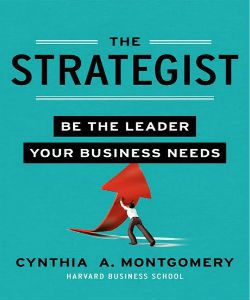
The Strategist: Be the leader your bu...

KShs3,999.00 KShs3,299.00
Based on an acclaimed professor's legendary strategy course at Harvard Business School, The Strategist offers a radically new perspective on a leader's most vital role. "Are you a strategist?" That's the first question Cynthia Montgomery asks the business owners and senior executives from all over the world who participate in her highly regarded executive education course. It's not a question they anticipate or care much about on opening day. But by the time the program ends, they cannot imagine leading their companies to success without being—and living the role of—a strategist. Over a series of weeks and months, Montgomery puts these accomplished executives through their paces. Using case discussions, after-hours talks, and participants' own strategy dilemmas, she illuminates what strategy is, why it's important, and what it takes to lead the effort. En route, she equips them to confront the most essential question facing every business leader: Does this company truly matter? In doing so, she shows that strategy is not just a tool for outwitting the competition; it is the most powerful means a leader has for shaping a company itself. The Strategist exposes all business leaders—whether they run a global enterprise or a small business—to the invaluable insights Montgomery shares with these privileged executives. By distilling the experiences and insights gleaned in the classroom, Montgomery helps leaders develop the skills and sensibilities they need to become strategists themselves. It is a difficult role, but little else one does as a leader is likely to matter more.  

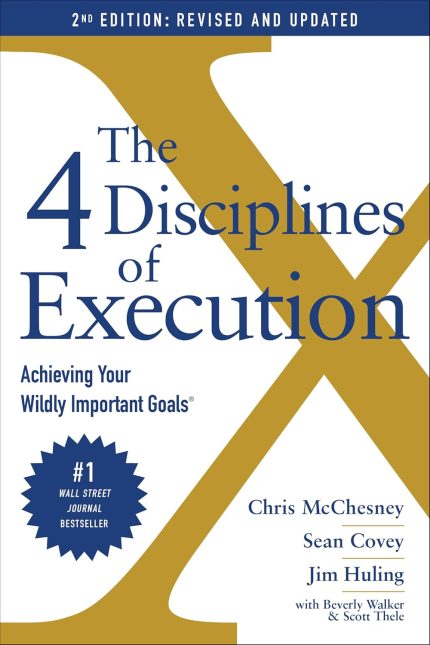
The 4 Disciplines of Execution by Sea...

KShs2,100.00 KShs1,890.00
An insightful new book from the multimillion-copy bestselling author Sean Covey and the Franklin Covey organization based on their work with hundreds of thousands of employees and large companies to unveil the essential disciplines proven to help businesses and individuals realize their most important goals. Do you remember the last major initiative you watched die in your organization? Did it go down with a loud crash? Or was it slowly and quietly suffocated by other competing priorities? By the time it finally disappeared, it’s likely no one even noticed. What happened? The "whirlwind” of urgent activity required to keep things running day-to-day devoured all the time and energy you needed to invest in executing your strategy for tomorrow! The 4 Disciplines of Execution can change all that forever. The 4 Disciplines of Execution (4DX) is a simple, repeatable, and proven formula for executing on your most important strategic priorities in the midst of the whirlwind. By following The 4 Disciplines: • Focusing on the Wildly Important • Acting on Lead Measures • Keeping a Compelling Scoreboard • Creating a Cadence of Accountability leaders can produce breakthrough results, even when executing the strategy requires a significant change in behavior from their teams. 4DX is not theory. It is a proven set of practices that have been tested and refined by hundreds of organizations and thousands of teams over many years. When a company or an individual adheres to these disciplines, they achieve superb results—regardless of the goal. 4DX represents a new way of thinking and working that is essential to thriving in today’s competitive climate. Simply put, this is one book that no business leader can afford to miss.

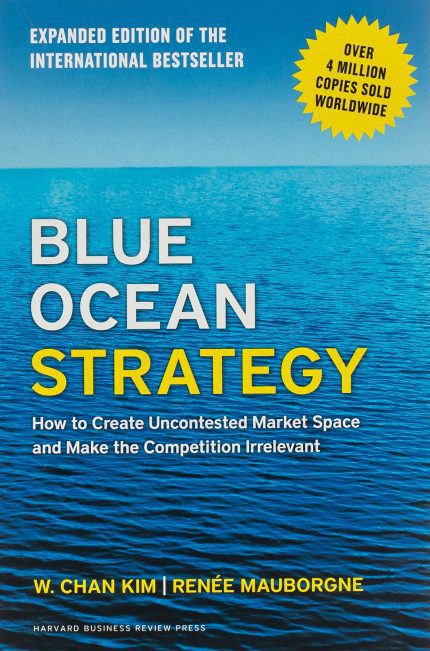
Blue Ocean Strategy by Renée Mauborgn...

KShs6,500.00 KShs5,500.00
The global phenomenon, embraced by business worldwide and now published in more than 40 languages. This international bestseller challenges everything you thought you knew about the requirements for strategic success. Since the dawn of the industrial age, companies have engaged in head-to-head competition in search of sustained, profitable growth. They have fought for competitive advantage, battled over market share, and struggled for differentiation. Yet, as this influential and immensely popular book shows, these hallmarks of competitive strategy are not the way to create profitable growth in the future. In the international bestseller Blue Ocean Strategy, W. Chan Kim and Renee Mauborgne argue that cutthroat competition results in nothing but a bloody red ocean of rivals fighting over a shrinking profit pool. Based on a study of 150 strategic moves (spanning more than 100 years across 30 industries), the authors argue that lasting success comes not from battling competitors, but from creating "blue oceans"—untapped new market spaces ripe for growth. Such strategic moves, which the authors call "value innovation,” create powerful leaps in value that often render rivals obsolete for more than a decade. Blue Ocean Strategy presents a systematic approach to making the competition irrelevant and outlines principles and tools any company can use to create and capture their own blue oceans. A landmark work that upends traditional thinking about strategy, this bestselling business book charts a bold new path to winning the future. "

Nudge by Richard H. Thaler and Cass R...

KShs2,890.00 KShs2,500.00
Every day, we make decisions on topics ranging from personal investments to schools for our children to the meals we eat to the causes we champion. Unfortunately, we often choose poorly. The reason, the authors explain, is that, being human, we all are susceptible to various biases that can lead us to blunder. Our mistakes make us poorer and less healthy; we often make bad decisions involving education, personal finance, health care, mortgages and credit cards, the family, and even the planet itself. Thaler and Sunstein invite us to enter an alternative world, one that takes our humanness as a given. They show that by knowing how people think, we can design choice environments that make it easier for people to choose what is best for themselves, their families, and their society. Using colorful examples from the most important aspects of life, Thaler and Sunstein demonstrate how thoughtful "choice architecture” can be established to nudge us in beneficial directions without restricting freedom of choice. Nudge offers a unique new take—from neither the left nor the right—on many hot-button issues, for individuals and governments alike. This is one of the most engaging and provocative books to come along in many years.

How The Mighty Fall by Jim Collins

KShs3,990.00 KShs3,190.00
Brief Summary Decline can be avoided. Decline can be detected. Decline can be reversed. Amidst the desolate landscape of fallen great companies, Jim Collins began to wonder: How do the mighty fall? Can decline be detected early and avoided? How far can a company fall before the path toward doom becomes inevitable and unshakable? How can companies reverse course? In How the Mighty Fall, Collins confronts these questions, offering leaders the well-founded hope that they can learn how to stave off decline and, if they find themselves falling, reverse their course. Collins' research project—more than four years in duration—uncovered five step-wise stages of decline: Stage 1: Hubris Born of Success Stage 2: Undisciplined Pursuit of More Stage 3: Denial of Risk and Peril Stage 4: Grasping for Salvation Stage 5: Capitulation to Irrelevance or Death By understanding these stages of decline, leaders can substantially reduce their chances of falling all the way to the bottom. Great companies can stumble, badly, and recover. Every institution, no matter how great, is vulnerable to decline. There is no law of nature that the most powerful will inevitably remain at the top. Anyone can fall and most eventually do. But, as Collins' research emphasizes, some companies do indeed recover—in some cases, coming back even stronger—even after having crashed into the depths of Stage 4. Decline, it turns out, is largely self-inflicted, and the path to recovery lies largely within our own hands. We are not imprisoned by our circumstances, our history, or even our staggering defeats along the way. As long as we never get entirely knocked out of the game, hope always remains. The mighty can fall, but they can often rise again"

The Everything Store by Brad Stone

KShs1,800.00 KShs1,590.00
Amazon.com started off delivering books through the mail. But its visionary founder, Jeff Bezos, wasn't content with being a bookseller. He wanted Amazon to become the everything store, offering limitless selection and seductive convenience at disruptively low prices. To do so, he developed a corporate culture of relentless ambition and secrecy that's never been cracked. Until now. Brad Stone enjoyed unprecedented access to current and former Amazon employees and Bezos family members, giving readers the first in-depth, fly-on-the-wall account of life at Amazon. Compared to tech's other elite innovators--Jobs, Gates, Zuckerberg--Bezos is a private man. But he stands out for his restless pursuit of new markets, leading Amazon into risky new ventures like the Kindle and cloud computing, and transforming retail in the same way Henry Ford revolutionized manufacturing. THE EVERYTHING STORE will be the revealing, definitive biography of the company that placed one of the first and largest bets on the Internet and forever changed the way we shop and read.

Good to Great by Jim Collins

KShs3,290.00 KShs3,090.00
The Challenge Built to Last, the defining management study of the nineties, showed how great companies triumph over time and how long-term sustained performance can be engineered into the DNA of an enterprise from the very beginning. But what about the company that is not born with great DNA? How can good companies, mediocre companies, even bad companies achieve enduring greatness? The Study For years, this question preyed on the mind of Jim Collins. Are there companies that defy gravity and convert long-term mediocrity or worse into long-term superiority? And if so, what are the universal distinguishing characteristics that cause a company to go from good to great? The Standards Using tough benchmarks, Collins and his research team identified a set of elite companies that made the leap to great results and sustained those results for at least fifteen years. How great? After the leap, the good-to-great companies generated cumulative stock returns that beat the general stock market by an average of seven times in fifteen years, better than twice the results delivered by a composite index of the world's greatest companies, including Coca-Cola, Intel, General Electric, and Merck. The Comparisons The research team contrasted the good-to-great companies with a carefully selected set of comparison companies that failed to make the leap from good to great. What was different? Why did one set of companies become truly great performers while the other set remained only good? Over five years, the team analyzed the histories of all twenty-eight companies in the study. After sifting through mountains of data and thousands of pages of interviews, Collins and his crew discovered the key determinants of greatness — why some companies make the leap and others don't. The Findings The findings of the Good to Great study will surprise many readers and shed light on virtually every area of management strategy and practice. The findings include: Level 5 Leaders: The research team was shocked to discover the type of leadership required to achieve greatness. The Hedgehog Concept (Simplicity within the Three Circles): To go from good to great requires transcending the curse of competence. A Culture of Discipline: When you combine a culture of discipline with an ethic of entrepreneurship, you get the magical alchemy of great results. Technology Accelerators: Good-to-great companies think differently about the role of technology. The Flywheel and the Doom Loop: Those who launch radical change programs and wrenching restructurings will almost certainly fail to make the leap. "Some of the key concepts discerned in the study,” comments Jim Collins, "fly in the face of our modern business culture and will, quite frankly, upset some people.” Perhaps, but who can afford to ignore these findings? "Some of the key concepts discerned in the study," comments Jim Collins, "fly in the face of our modern business culture and will, quite frankly, upset some people." Perhaps, but who can afford to ignore these findings?"

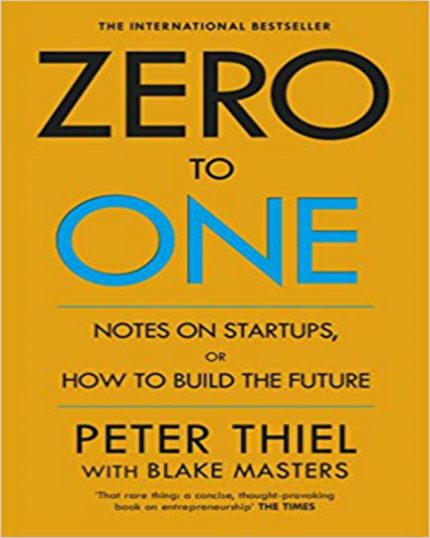
Zero to One by Peter Thiel

KShs2,000.00 KShs1,790.00
If you want to build a better future, you must believe in secrets. The great secret of our time is that there are still uncharted frontiers to explore and new inventions to create. In Zero to One , legendary entrepreneur and investor Peter Thiel shows how we can find singular ways to create those new things. Thiel begins with the contrarian premise that we live in an age of technological stagnation, even if we’re too distracted by shiny mobile devices to notice. Information technology has improved rapidly, but there is no reason why progress should be limited to computers or Silicon Valley. Progress can be achieved in any industry or area of business. It comes from the most important skill that every leader must master: learning to think for yourself. Doing what someone else already knows how to do takes the world from 1 to n, adding more of something familiar. But when you do something new, you go from 0 to 1. The next Bill Gates will not build an operating system. The next Larry Page or Sergey Brin won’t make a search engine. Tomorrow’s champions will not win by competing ruthlessly in today’s marketplace. They will escape competition altogether, because their businesses will be unique. Zero to One presents at once an optimistic view of the future of progress in America and a new way of thinking about innovation: it starts by learning to ask the questions that lead you to find value in unexpected places.

The Lean Startup by Eric Ries

KShs2,800.00 KShs2,690.00
Most startups fail. But many of those failures are preventable. The Lean Startup is a new approach being adopted across the globe, changing the way companies are built and new products are launched. Eric Ries defines a startup as an organization dedicated to creating something new under conditions of extreme uncertainty. This is just as true for one person in a garage or a group of seasoned professionals in a Fortune 500 boardroom. What they have in common is a mission to penetrate that fog of uncertainty to discover a successful path to a sustainable business. The Lean Startup approach fosters companies that are both more capital efficient and that leverage human creativity more effectively. Inspired by lessons from lean manufacturing, it relies on "validated learning,” rapid scientific experimentation, as well as a number of counter-intuitive practices that shorten product development cycles, measure actual progress without resorting to vanity metrics, and learn what customers really want. It enables a company to shift directions with agility, altering plans inch by inch, minute by minute. Rather than wasting time creating elaborate business plans, The Lean Startup offers entrepreneurs - in companies of all sizes - a way to test their vision continuously, to adapt and adjust before it’s too late. Ries provides a scientific approach to creating and managing successful startups in a age when companies need to innovate more than ever.  

The Personal MBA by Josh Kaufman

KShs2,900.00 KShs2,490.00
Brief Summary Master the fundamentals, hone your business instincts, and save a fortune in tuition. The consensus is clear: MBA programs are a waste of time and money. Even the elite schools offer outdated assembly-line educations about profit-and-loss statements and PowerPoint presentations. After two years poring over sanitized case studies, students are shuffled off into middle management to find out how business really works. Josh Kaufman has made a business out of distilling the core principles of business and delivering them quickly and concisely to people at all stages of their careers. His blog has introduced hundreds of thousands of readers to the best business books and most powerful business concepts of all time. In The Personal MBA, he shares the essentials of sales, marketing, negotiation, strategy, and much more. True leaders aren't made by business schools-they make themselves, seeking out the knowledge, skills, and experiences they need to succeed. Read this book and in one week you will learn the principles it takes most people a lifetime to master. " " " ISBN:2147483647 Author:Josh Kaufman

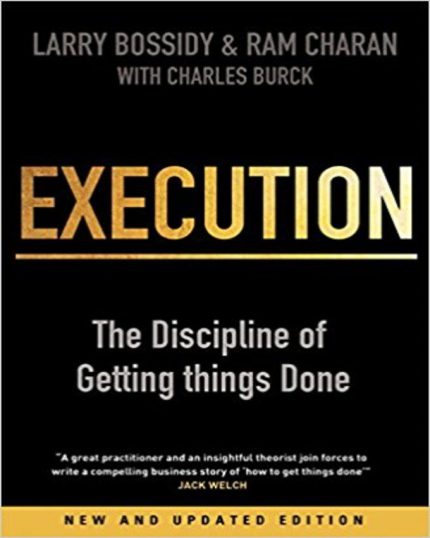
Execution The Discipline of Getting T...

KShs4,000.00 KShs3,500.00
"Execution may very well be the best business book of the year, and one of the most useful to have come around in a long time. This smart and pithy book focuses on a simple though vexing challenge: How can the leaders of an organization exhort their people to deliver on the most important goals?....It's rare to find a book like this that blends smart practice with intelligent articulation of how to get things done. Do yourself a favor. Buy it." --The Boston Globe "Making all of the moving parts of an organization function smoothly together is just plain hard work. By describing how he has done it, Mr. Bossidy has come up with a valuable and practical management guide that is must-reading for everyone who cares about business." --The New York Times "If you want to be a CEO--or if you are a CEO and want to keep your job--read Execution and put its principles to work." --Michael Dell, chairman and CEO, Dell Computer Corp. "A how-to book for the can-do boss....If even half the corporations in America pondered their suggestions, the economy would be in much better shape. Moreover, Bossidy and Charan boast an impressive enough track record that anyone who wants to stay sharp at the helm will welcome their assistance." --BusinessWeek"