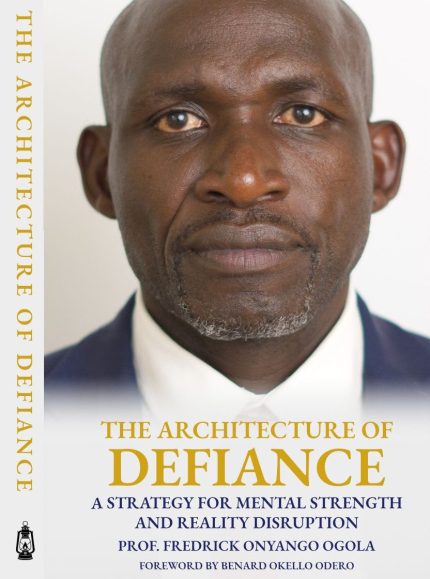
Fredrick Onyango Ogola grew up in a one-room house in Kibera, one of thirteen people sharing a single room, and went on to lecture on the global stage in New `York City, the global capital of Finance and Economics, among the world’s leading economists.The distance between those two places, he writes, has nothing to do with miles, it is psychological and mental. It’s crossed through what he calls “the valley of death”: the wilderness between who you are and who you have to become, the stretch every real ambition must travel before it can be reached, the route less travelled.
In The Architecture of Defiance, Ogola turns that crossing into ten laws of mental strength and a practical method he calls reality disruption – the deliberate work of unmaking the assumptions that keep ordinary people locked out of extraordinary outcomes. He doesn’t hide the hardest stretches of that wilderness: a career-defining dismissal, the death of his wife, an arrest a custody battle that emptied his savings. Alongside his own story, he draws on champions, executives, and heads of state to show that defiance isn’t rebellion, it’s justice, prudence, courage, and temperance, aimed precisely at whatever door has been called closed.
Part memoir, part field manual, this is a book for anyone building something meant to outlast them; a carcer, an institution, or simply a more capable version of themselves.