Showing 101–120 of 2172 results

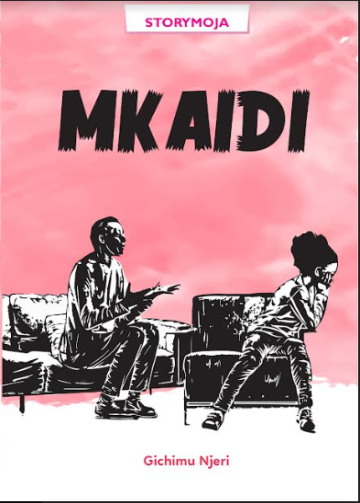
Mkaidi by Gichimu Njeri

KShs500.00
Vumilia amepata fursa ya kujiunga na chuo kikuu baada ya kufua dafu katika mtihani. Baba yake, Bwana Hamaki, anataka asomee kozi ya udaktari. Baba anaamini kuwa madaktari wana mishahara minono na hadhi kubwa katika jamii. Vumilia naye ana mtazamo tofauti kuhusu kozi anayotaka kusoma. Anataka kozi inayohusiana na sanaa. Baada ya vuta n'kuvute kwa muda, Vumilia anajikuta katika njiapanda kuhusu iwapo atafuata matakwa ya baba ama ndoto zake mwenyewe. Je, Vumilia akimkaidi baba yake na kufuata ndoto zake, atakuwa na uhusiano gani kati yake na familia yake? Ni nani atakayemlipia Vumilia karo?

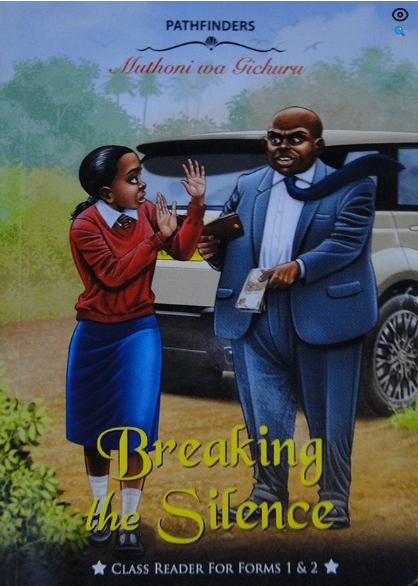
Breaking The Silence by Muthoni wa Gi...

KShs790.00 KShs600.00
Breaking the Silence is an emotional recollection of Wanjiku's despicable plight. She is a victim of a most atrocious act of brutality. Amidst the persistent threats, money, political power, and the manipulative schemes employed to silence her, her pursuit for justice is as agonising as is her trauma.

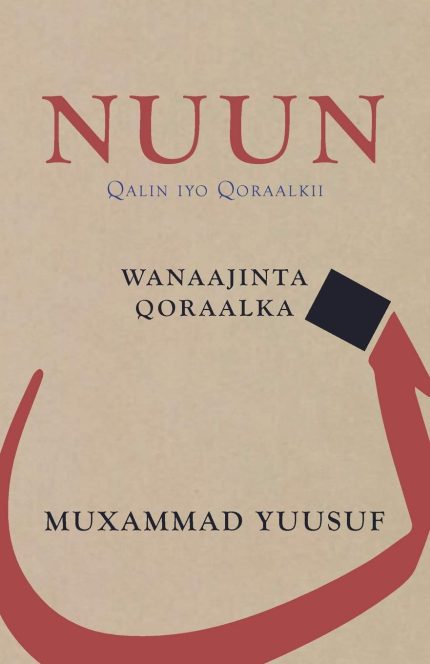
Nuun: Qalin iyo Qoraalkii (Somali Edi...

KShs2,700.00 KShs2,500.00
Hadalkana sar weedhiisa Una saaf qofkii waaya Ha ka tegin sarbeebtiisa Hana gelin sursuur oodan Hana lumin sargoyntiisa Hana liqin sangaabtiisa Ha ku saxan badheedhkiisa Runta sogordoh haw yeelin Ha suldaarin dooddiisa Sisibaa wadaaggiisa Sababee abbaartaada Hana badin su'aashiisa Sarrifkiyo tilmaantiisa Saddex erey halkii dooni Soddon yaanay kaa qaadan Siddi-qabaxi yay raacin Sare haw dhig-dhigin luuqda Gacantana ha saydh-saydhin Hana odhan wax sawliila.

The Fish I Couldn’t Swallow: St...

KShs650.00
  1. 9 unforgettable love stories from Port Harcourt to New York - about love that didn't fight back.

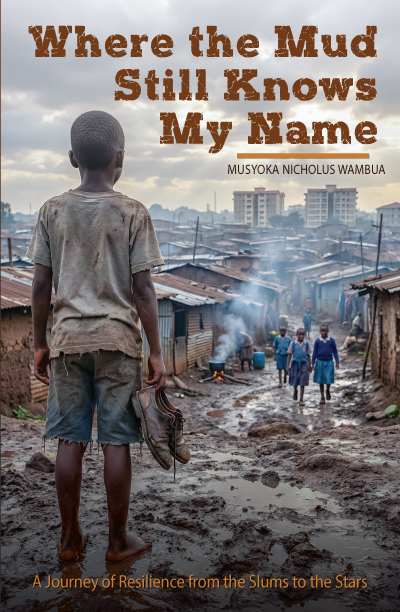
Where the Mud Still Knows My Name

KShs1,300.00 KShs1,000.00
Where the Mud Still Knows My Name is a moving coming-of-age novel that traces the life of Juma, a boy born and raised in the unforgiving slums of Mtoni Mwisho. The story unfolds through a non-linear structure, weaving together present-day success, haunting memories, vivid flashbacks, and symbolic dreams to reveal how poverty, resilience, and hope shape a human life. The novel opens in the present, where Juma lives in a quiet, well-planned estate after completing his master’s degree. Surrounded by comfort and stability, he is unexpectedly unsettled by small luxuries such as running water and a full fridge. News of unrest in his former neighborhood pulls him back emotionally, triggering memories of a childhood marked by hunger, muddy paths, overcrowded iron-sheet houses, poor sanitation, and daily survival. Through flashbacks, the reader is immersed in slum life: children removing sandals during rain to walk through mud, families sharing a single room without privacy, long queues for water and medical care, and meals limited to ugali, sukuma, and occasional matumbo. Despite these hardships, the slum pulses with life—talent, laughter, friendship, and unspoken dreams. Football prodigies, gifted mathematicians, dancers, and singers emerge, many of them silenced by poverty before their potential can fully bloom. School becomes Juma’s refuge. Though hampered by hunger, torn uniforms, overcrowded classrooms, and broken desks, education offers him a fragile but powerful escape. Encouraged by devoted teachers and driven by his mother’s sacrifices, Juma resists the pull of crime, drugs, and illegal shortcuts that claim many of his peers. Political rallies, violent demonstrations, and broken public systems reveal how neglected communities are exploited and abandoned, deepening the cycle of despair. As Juma advances to university, he faces a new struggle—fitting into a world that exposes his background through accent, clothing, and quiet hunger. With discipline, solitude, and the guidance of a mentor, he perseveres. His eventual academic success, however, is bittersweet. Graduation brings pride and tears, but also sharp reminders of friends lost to poverty, illness, and broken systems. The novel comes full circle as Juma returns quietly to the slum, not as a savior, but as a servant. He supports children’s homes, helps families anonymously, and walks the same muddy paths that shaped him. Through his mother’s weathered hands and the unchanged struggles around him, Juma learns that true success lies not in escape, but in responsibility. The story ends with a powerful reflection: while Juma rises from the mud, he carries it with him forever. The mud becomes both a memory and a teacher—reminding readers that dignity can grow in the harshest conditions, and that hope, when nurtured, can outlive even the deepest poverty. Where the Mud Still Knows My Name is an emotional, educative, and inspiring novel for high school readers worldwide, exploring resilience, moral choice, social inequality, and the enduring power of education.

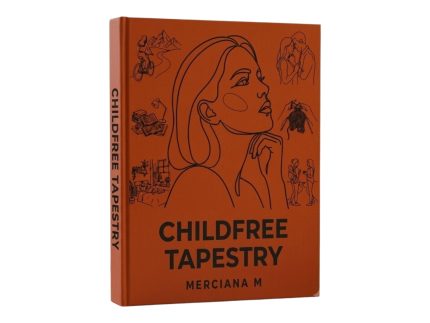
CHILDFREE TAPESTRY BY MERCIANA

KShs1,000.00 KShs850.00

CHILDFREE TAPESTRY is a raw collection of short stories that explores the hidden dimensions of childfree life, pulling back the curtain on deep-seated societal views, and unspoken realities of childfree life.

From parentified childhoods and the secret grace of silent medical battles to the fierce solidarity of marriages standing strong against intrusive mothers-in-law, these stories reveal characters who boldly claim their truth. They confront the well-meaning myths of the village, harsh judgment of friends, and pressure of family, refusing to let society dictate their path. This book doesn't villainize parenthood, nor does it sugarcoat the childfree choice.

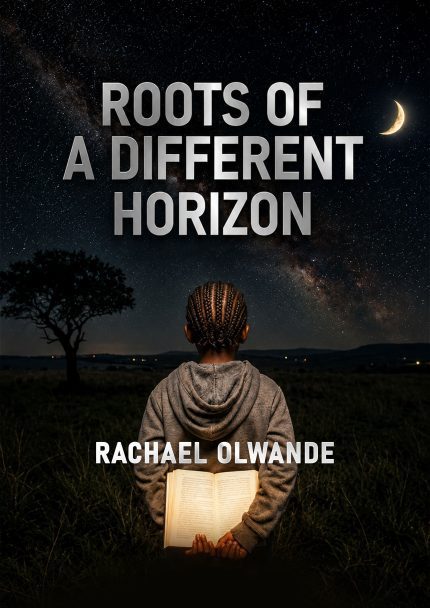
ROOTS OF A DIFFERENT HORIZON

KShs750.00
Nyala Achieng refuses to let poverty and low expectations define her future. In a struggling village school, she fights for a university dream against all odds. Roots of a Different Horizon is a moving story of resilience, maternal sacrifice, and the power of education to change a life.

SALT AND DUST

KShs950.00
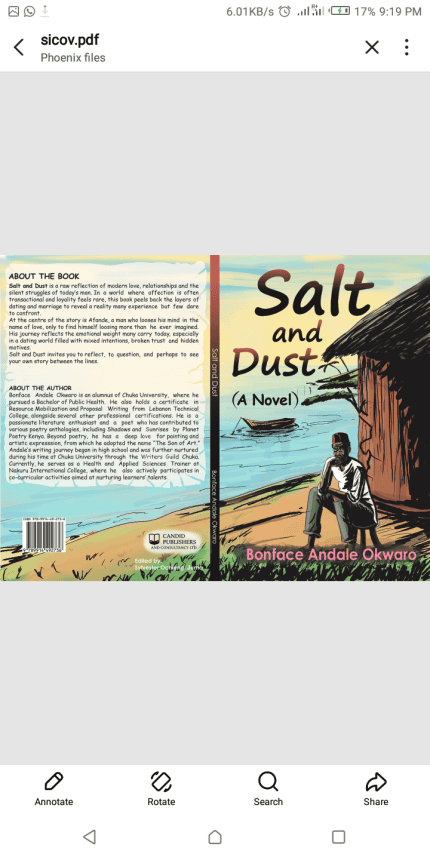
_Salt and Dust_ is a raw reflection of modern love, relationships, and the silent struggles of today's men. In a world where affection often feels transactional and loyalty is rare, the book peels back the layers of dating and marriage to reveal a reality many experience but few dare to confront. At the center of the story is Afande, a man who loses his mind in the name of love, only to find himself losing more than he ever imagined. His journey reflects the emotional weight many carry today, especially in a dating world filled with mixed intentions, broken trust, and hidden motives. _Salt and Dust_ invites you to reflect, to question, and perhaps to see your own story between the lines._Salt and Dust_ is a raw reflection of modern love, relationships, and the silent struggles of today's men. In a world where affection often feels transactional and loyalty is rare, the book peels back the layers of dating and marriage to reveal a reality many experience but few dare to confront. At the center of the story is Afande, a man who loses his mind in the name of love, only to find himself losing more than he ever imagined. His journey reflects the emotional weight many carry today, especially in a dating world filled with mixed intentions, broken trust, and hidden motives. _Salt and Dust_ invites you to reflect, to question, and perhaps to see your own story between the lines.

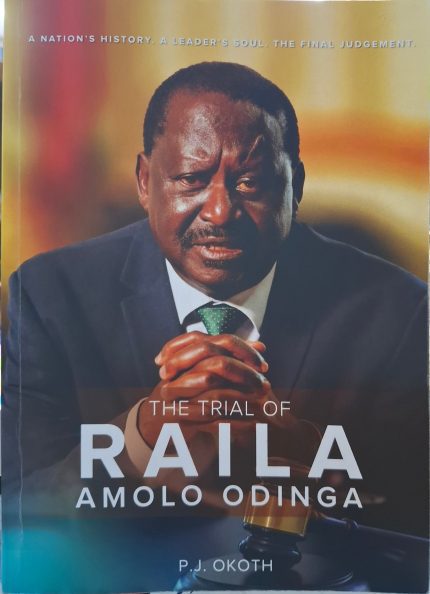
The Trial of Raila Amolo Odinga by Ok...

KShs2,500.00 KShs2,250.00
A speculative fiction that places former Kenyan Prime Minister Raila Amolo Odinga on trial in a celestial courtroom. The book weaves Kenya's turbulent political history with divine judgment, exploring the moral complexity of resistance, the costs of leadership, and whether a leader should be judged by his failures or by the hope he inspired. Drawing on the tradition of Ali Mazrui's The Trial of Christopher Okigbo, Rider Haggard's ancestral spiritualism from his book Montezuma’s Daughter, the Book of Enoch, and Kenya's own intellectual heritage, the work bridges the hard ground of history with the speculative sky of myth. It is also deeply personal - born from the author's exhaustion with earthly politics and his journey from public health administration to writing. The Origin: A Whisper in the Night The book was conceived in October 2020, during a moment of profound weariness. The author, a dental surgeon and hospital CEO, was bent over hospital plans while his wife observed: "You grow thin. You barely touch my food. You don't sleep. And you look sad and stressed." The endless night hours reviewing systems, writing blueprints, only to have operational chaos and political constraints shred them before dawn—"public service" had become a theater of constraints. His predecessor had chosen him as deputy not for lineage or loyalty, but for his willingness to build. Together and in their individual styles fought political interference, the erosion of institutional autonomy, and the relentless pressure to compromise professional standards. He witnessed boards, informal media, and an unhinged gatekeeper used as inquisitions, data-free accusations of "inefficiency," and the manufacturing of narratives to remove competent workers and leaders. The weight of it all - the fight to keep "jungle medicine" out of modern care, the exhausting battle to protect the radiotherapy project a renowned medical Professor had birthed, the noble vision of a sickle cell institute reduced to public relations, the bruising fights—finally broke him. Fearing for his mental health, he decided to step down. And in that space between exhaustion and liberation, the book was born: "I want to write a book. The Trial of Raila Amolo Odinga. To be tried in heaven, outside the compromised consciousness of the world." Part One: The Earthly Crucible Traces Raila's formation through personal and political trials: denied baptism at Maseno (1945), passport refusal (1962), education in East Germany, family bankruptcy, brother's suicide (1975), public shaming of his family (1978), torture and detention in Nyayo House (1982), mother's death while imprisoned, wife's eviction (1988), and the loss of his firstborn son Fidel. Despite these scars, he emerges as a visionary architect: building NDP, merging with KANU's "Rainbow Coalition," creating ODM, championing the "No" vote against the 2005 Draft Constitution, delivering the 2010 Constitution as Prime Minister, establishing Devolution (47 counties), and executing controversial "Handshakes" with Presidents Kenyatta and Ruto. Introduces Tom Mboya - the brilliant technocrat whose 1969 assassination by Nahashon Njenga represents Kenya's "original sin"—and Njenga himself, a man reduced to a single infamous act. Raila's death is strategic: he commands a 72-hour burial to prevent his funeral from becoming a political battlefield. Part Two: The Celestial Summons The Council of Principalities debates how to judge Raila's soul. Uriel proposes an unprecedented solution: let Tom Mboya prosecute (arguing the case for rational institution-building) and let Nahashon Njenga defend (arguing the context of desperate struggle). The structure echoes Mazrui's Trial of Christopher Okigbo—putting a figure in a cosmic dock where the verdict matters less than the questions the trial compels. The celestial setting, inspired by the Book of Enoch and the Book of Adam and Eve (introduced to the author by a doctor friend), creates an Empyrean Court where ancestors and angels debate. From Haggard's Montezuma's Daughter, the author absorbed the lesson that the dead do not simply die—they journey, testify, and wait on the shores of the living to be summoned. Like Haggard the author used his story to tell the history of Kenya. Part Three: The Trial Archangel Michael presides. Charges: (1) cultivating perpetual agitation, (2) engaging in Faustian bargains, (3) failing to build enduring institutions, (4) raising hopes without delivering. Raila pleads not guilty. Prosecution witnesses include: the Ghost of 2007 (violence's collateral damage), the Spirit of the 2010 Constitution (used as cudgel, not covenant), a Luo Youth (hope without prosperity), Kalonzo Musyoka (loyal critic), the Spirit of Internal Party Democracy (top-down rule via Councils of Elders), Charles Njonjo (system's hypocrisy exposed), Mirugi Kariuki (tribal survival over principle), Peter Okondo (system's fatal finality), and the Essence of Economic Stability. Defense witnesses include: Jaramogi (unjust system requires defiance), the Second Liberation (Raila as midwife), ODM as liberation vehicle, Dedan Kimathi (same war against oppression), Ronald Ngala (fulfiller of suppressed vision), Wangari Maathai (disruption as biological necessity), Bishop Muge (fellow truth-teller), Ali Mazrui ("performance artist of resistance"), and William Ochieng' (cautionary critique). These intellectual influences reflect the author's engagement with Kenya's scholarly tradition—Ochieng's forensic clarity, Mazrui's global synthesis, Taban's cultural diagnostics, Okot's metaphysical poetry, Mbaja's material witness, and Odhiambo's archival conscience. Part Four: The Verdict Before the verdict, a symphonic dissent erupts: Taban Lo Liyong accuses the court of “Western metaphysical imperialism”; Okot p'Bitek reframes Raila as a “geological event”—son of the Lake Goddess and Sun God; Luo and Luhya elders demand translation, not verdict. The nyatiti and eskuti rhythms fuse, creating a poly-rhythmic argument that challenges the court's epistemology. Michael integrates the dissent: "The objections are not overruled. They are absorbed into the court's new mandate." Mzee Francis Okoth Abuje (the author's father) testifies: "My vote was for the fragment of a dream he carried... conflicted loyalty was the purest form of patriotism." The Waiting Gallery: Kenyan presidents (Kenyatta, Moi, Kibaki, Uhuru, Ruto) watch silently, awaiting their own tribunals. The Judgment: · Raila: Not guilty of instigating violence; guilty of hypocrisy with context; not guilty of failing his destiny. Granted passage into light. · The Kenyan State: Guilty of structural violence, economic exclusion, political assassination, and perpetuating a system rewarding tribe over talent. Raila reflects: "I did not create the mountain. I simply refused to pretend it was not there." Part Five: The Author's Trial The author himself is tried by the intellectuals he summoned: · Taban Lo Liyong: Accuses him of "narrative imperialism"—trading jazz for symphony · William Ochieng': Accuses him of romanticizing history—"History is not a quarry for your metaphors. It is a graveyard." · Ali Mazrui: Says he forgot the global context—"He was one note in a global symphony of resistance" · Oyangi Mbaja: Confronts him in a Nyayo House cell—"You made a meal of our pain and called it literature" · Okot p'Bitek: Challenges his right to speak for the nyatiti—"You have cited the instrument. You have not played it." · Atieno Odhiambo: Offers the kindest diagnosis—"This book is not arrogance. It is haunting. The haunting of a boy who loved literature and was told to choose practicality." The critics offer a choice: write their rebuttals or leave a blank page. Okoth chooses the blank page—an invitation for readers to complete the story with their own truths. The Afterword: A Confession The author reveals the book's deeply personal origins: The Haunting of Abandoned Passion: "You did literature only up to Form Three. You dropped it because the sciences consumed your list of subjects. You sacrificed your passion for a profession. You wanted to take history alongside your sciences at A-level, but they rejected it. Unusual combination, they said. Not practical. Not viable. So you became a dentist. A good one. A public health specialist. A hospital administrator. You built systems. You saved lives. You served. But the ghost of that abandoned passion never left you." The Hospital as Battlefield: As Medical Superintendent of Naivasha Hospital during the 2007/08 post-election violence, the author treated the burned and broken jaws—Luo men with machete wounds while police watched from armored vehicles. He authorized the storage of 47 unclaimed bodies in the hospital mortuary. He was simultaneously a bureaucrat and prey—treating Raila's supporters while being marked as a supporter himself. The system he served was hunting him indirectly as a dissident. When the heat became too much, he did what many did: he left. Naivasha to Kisumu. Displacement as diagnosis. The Theological Critique: Mbaja challenges the author's "Waiting Gallery" for presidents—"Tell me: is this divine justice or celestial class privilege? On earth, the poor face instant judgement—in your heaven, the powerful get appointments. The same impunity that protected them in State House now protects them in your Empyrean... You accuse Raila of political compromise, yet your own heaven practices the ultimate compromise: admitting presidential guilt while postponing its consequences indefinitely." The Final Reckoning: The author acknowledges his influences—Mazrui's cosmic courtroom, Haggard's ancestral visitations, the intellectual traditions of Kenya—and thanks those who guided him: Dr. Jacton Omoto (whose relentless commitment moved him from intention to action), Dr. Kennedy Otieno (who introduced him to the Book of Enoch), and his wife Monica (whose deepening spiritual journey showed him the veil between worlds is thinner than materialism admits). Conclusion The book ends with a grey stone on the author's desk—worn by water and time—and a blank page for readers. The author's final words: "I left it there for you—for your father's name, for your scream, for the silence that follows violence, for the story that no archive recorded." He invites readers to fill the blank page with their own truths, noting that the book now belongs to the silences it created, the conversations it started, and the memories it made space for. Key Themes · Blueprint vs. Battlefield: Mboya's rational institution-building vs. Raila's defiant struggle · Tribalism vs. Nationhood: Whether Raila transcended or reinforced ethnic divisions · Institutional Failure: Personality cult vs. necessary wartime cohesion · Divine vs. Earthly Justice: The search for judgment beyond compromised institutions · Who Gets to Tell the Story: Citation vs. belonging; the ethics of representation · The Haunting of Abandoned Passion: The author's journey from a boy who loved humanities to a dentist who writes—and the ghost of that abandoned passion demanding to be fed · The Collateral Damage of Struggle: The author's lived experience as a hospital administrator during the 2007/08 violence—treating the wounded while the state watched · Celestial Class Privilege: The critique that even in heaven, the powerful get deferred judgments while the poor face instant reckoning The verdict: Raila's soul is burdened but justified; the Kenyan State is guilty; and the reader is invited to complete the story with their own truth. The book stands as a long letter from the shores of a story—a story that belongs to Kenya, but held gently enough to pass on. It is also a confession: the author did not write this book to try Raila. He wrote it to try himself. To see if the boy who loved literature still lives. To see if the page can hold not just the names of the forgotten dead, but the name of the forgotten self.

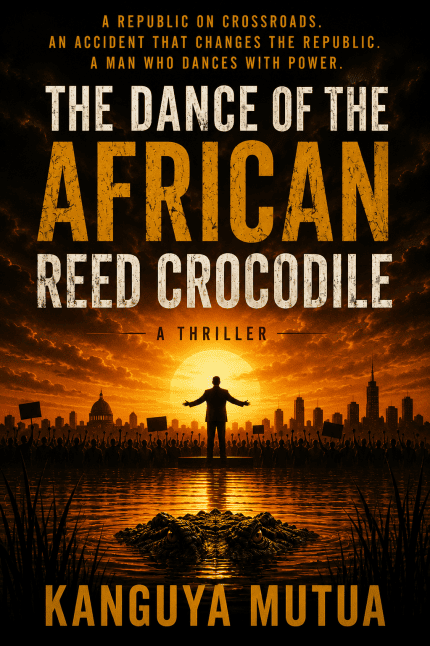
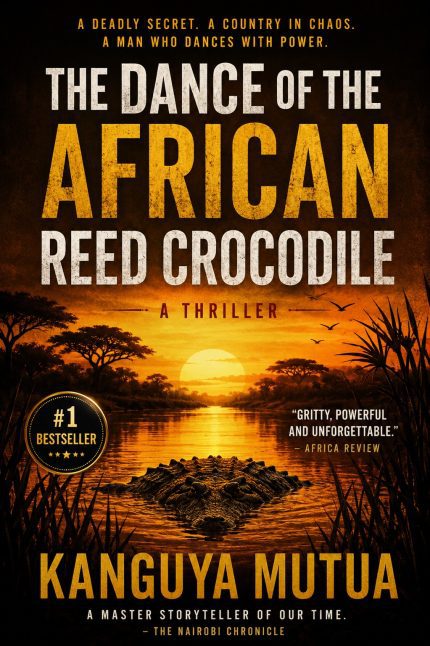
THE DANCE OF THE AFRICAN REED CROCODI...

KShs650.00 KShs550.00
The Dance of the African Reed Crocodile is a gripping political thriller set in the fictional Republic of Nyika. When an ordinary university lecturer challenges a nation built on corruption and inequality, he ignites a movement that shakes the foundations of power. As hope rises and danger closes in, one man must decide whether the price of truth is worth paying.

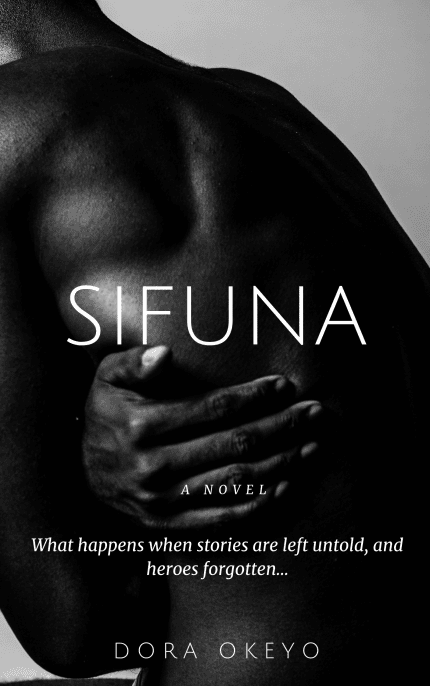
Sifuna by Dora Okeyo

KShs1,000.00 KShs650.00
It's been 22 years since his Father was assassinated. Baoya, now in his mid-thirties decides to vie for a Senatorial position in the upcoming elections in his county. His decision and plan of action is backed by his childhood friend Sifuna. His actions spur a media frenzy on speculations as to what led to his Father's assassination.

Beyond the Rice Fields by Naivo

KShs3,500.00
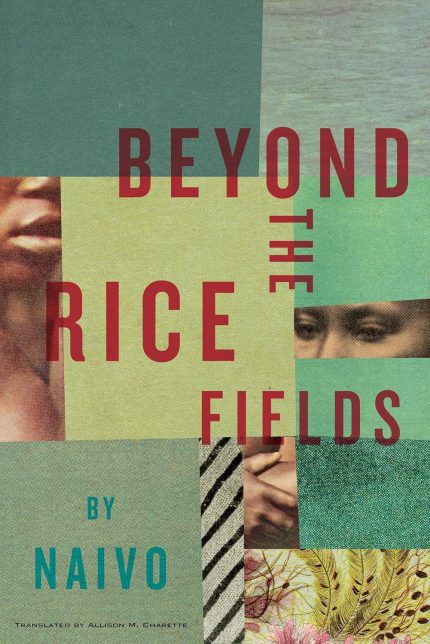
The first novel from Madagascar ever to be translated into English( Translated by Allison Charette), Naivo’s magisterial Beyond the Rice Fields delves into the upheavals of the nation’s past as it confronted Christianity and modernity, through the twin narratives of a slave and his master’s daughter. Fara and her father’s slave, Tsito, have been close since her father bought the boy after his forest village was destroyed. Now in Sahasoa, amongst the cattle and rice fields, everything is new for Tsito, and Fara at last has a companion. But as Tsito looks forward to the bright promise of freedom and Fara, backward to a dark, long-denied family history, a rift opens between them just as British Christian missionaries and French industrialists arrive and violence erupts across the country. Love and innocence fall away, and Tsito and Fara’s world becomes enveloped by tyranny, superstition, and fear. With captivating lyricism, propulsive urgency, and two unforgettable characters at the story’s core, Naivo unflinchingly delves into the brutal history of nineteenth-century Madagascar. Beyond the Rice Fields is a tour de force that has much to teach us about human bondage and the stories we tell to face―and hide from―ourselves, each other, our pasts, and our destinies.

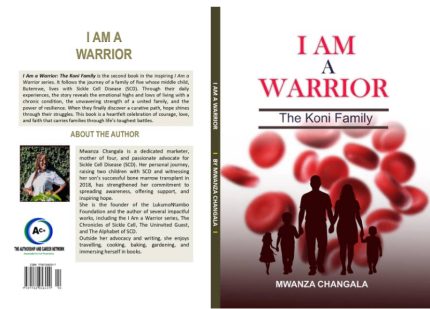
I am A Warrior: The Koni family by Mw...

KShs1,000.00
I Am a Warrior: The Koni Family is an inspiring fiction story that follows the journey of a loving and united family raising a child with sickle cell disease. Through painful crises, hospital visits, difficult decisions, and unwavering faith, the Koni family learns to face every challenge together. Their story highlights the importance of family support, accurate information, dedicated healthcare, and the resilience of children living with sickle cell disease. As hope emerges through advances in treatment, the family embarks on the life-changing journey of a bone marrow transplant (BMT). Their courage, perseverance, and unity lead to a future they once only dreamed of—a child free from sickle cell disease. This uplifting story reminds readers that while the journey with sickle cell disease is never easy, hope, love, and determination can light the way toward healing and new beginnings.

The Chronicles of SCD – The Uni...

KShs1,000.00
The Chronicles of Sickle Cell: The Uninvited Guest is a moving work of fiction inspired by real-life experiences of families living with sickle cell disease. It tells the story of two college sweethearts whose love leads to marriage and the dream of building a happy family together. Their world changes unexpectedly when sickle cell disease enters their home as an uninvited guest, bringing pain, uncertainty, and life-changing challenges. As they navigate hospital visits, emotional struggles, and moments of heartbreak, they learn that knowledge replaces fear, faith strengthens hope, and love grows stronger through every trial. Their journey reveals that although sickle cell disease can shake a family, it does not have to break it. This inspiring novel shines a light on the realities of sickle cell disease while celebrating the resilience of families, the power of community, and the courage to keep moving forward. It is a story of hope, compassion, and triumph that will touch the hearts of readers everywhere.

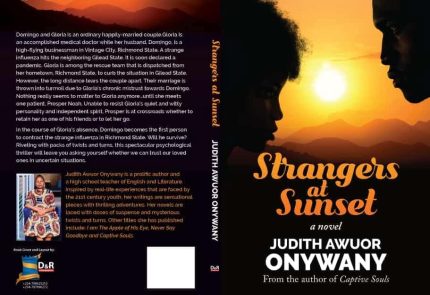
Strangers at Sunset

KShs500.00
Two young strangers meet one evening, in college. After a few years, they become an ordinary happily-married couple. Gloria is an accomplished medical doctor while her husband, Domingo, is a high-flying businessman. They both live in Vintage City, Richmond State. However, a strange influenza hits the neighboring Gilead State. It is soon declared a pandemic. Lives are disrupted. Gloria is among the rescue team that is dispatched from her hometown to curb the situation in Gilead State. The long distance tears the couple apart. Their marriage is thrown into turmoil due to Gloria’s chronic mistrust towards Domingo. Nothing really seems to matter to Gloria anymore…until she meets one patient, Prosper Noah. Unable to resist Gloria’s quiet and witty personality and independent spirit, Prosper is at crossroads whether to retain her as one of his friends or to let her go. While Gloria is away from home, Domingo becomes the first person in Richmond State to contract the strange influenza. Will he survive? Riveting with packs of twists and turns, this spectacular psychological thriller will leave you asking yourself whether we can trust fully our loved ones in uncertain situations.

THE DANCE OF THE AFRICAN REED CROCODILE

KShs1,049.00 KShs849.00
Can ordinary citizens change the destiny of a country, and their own? What happens when one anonymous viral article changes a nation already captured by merchants and politicians? The Dance of the African Reed Crocodile by KANGUYA MUTUA is a gripping literary and political novel set in the fictional Republic of Nyika, where an anonymous article written by a philosophy lecturer ignites a movement that challenges corruption, tribal politics and the old order. As ordinary citizens begin to believe that ideas matter more than personalities, one reluctant teacher is drawn into a journey that will test not only his convictions, but the future of an entire republic. A thought-provoking story about leadership, institutions, democracy and hope, this is a novel that asks a timeless question: Can a nation truly change when its people decide to take responsibility for its future?

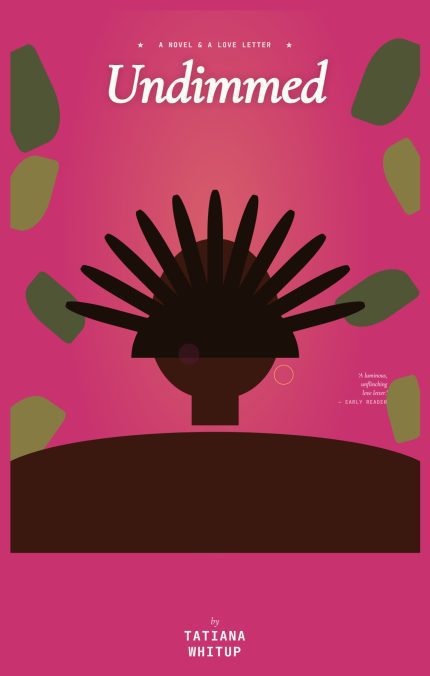
Undimmed: A Novel by Tatiana Whitup

KShs2,850.00 KShs2,500.00
UNDIMMED is a full-length Women-Fiction novel that follows seven women — across Nairobi, Nakuru, Kisumu, Lagos, London, and Kampala — as they each confront the lives they have been living and the lives they were made to live. It is a story about depression and grief, about marriage and motherhood, about ambition and identity, about the particular cost of performing strength for so long that you forget what it feels like to simply exist.

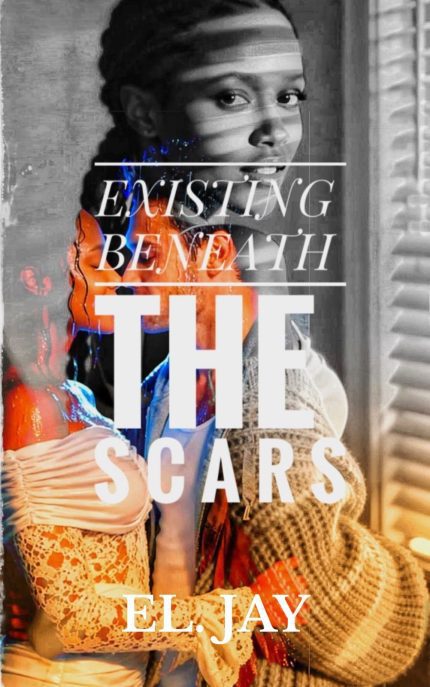
Existing Beneath The Scars by EL Jay

KShs2,000.00 KShs1,800.00
Born and raised in the shadows of domestic violence, Lorraine learned early how to navigate a world built on volatility. When she finally leaves home for work, she carries the invisible, heavy armor of her childhood trauma,unknowingly searching for sanctuary in a world she doesn't fully trust. Then she meets Ryan. To Lorraine, Ryan feels like "home." He is the anchor she has desperately craved, a promise of a different future. But when Ryan abruptly reveals he is moving on and that Lorraine is not part of his future plans, the fragile world she built shatters. The rejection slams the door on every ounce of hope she held for love, trust, and marriage, leaving her more guarded than ever before. Just as Lorraine resolves to live entirely behind her fortress, Alejandro enters her life. Armed with a gentle love, unwavering affection, and a kindness she has never known, he offers the peace she always wanted but never thought she deserved. Faced with a safety that feels terrifyingly unfamiliar, Lorraine is paralyzed. Can a heart that has only known how to fight and survive finally learn how to heal, surrender, and love Existing Beneath the Scars?

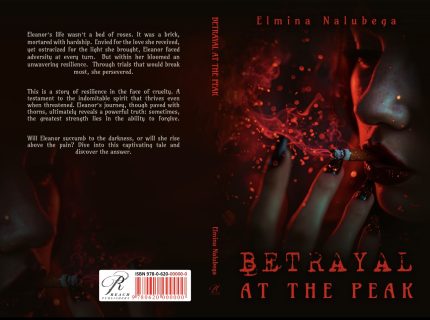
BETRAYAL AT THE PEAK

KShs1,060.00 KShs900.00
Betrayal at the Peak is a mystery and thriller novel that explores themes of resilience and forgiveness. The narrative centers on a protagonist named Eleanor, whose life is defined by hardship. Despite facing adversity, facing cruelty, and enduring a journey paved with thorns, she develops unwavering resilience and ultimate strength.