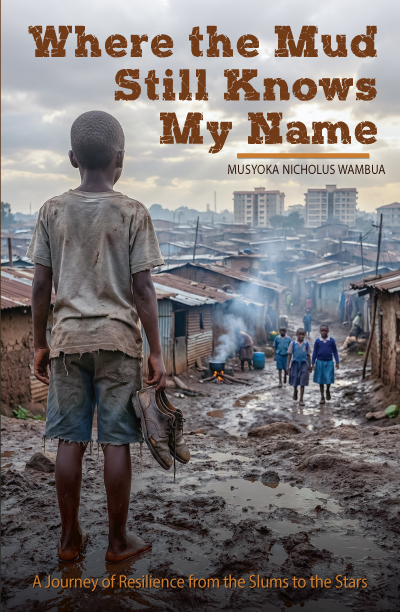
Where the Mud Still Knows My Name is a moving coming-of-age novel that traces the life of Juma, a boy born and raised in the unforgiving slums of Mtoni Mwisho. The story unfolds through a non-linear structure, weaving together present-day success, haunting memories, vivid flashbacks, and symbolic dreams to reveal how poverty, resilience, and hope shape a human life.
The novel opens in the present, where Juma lives in a quiet, well-planned estate after completing his master’s degree. Surrounded by comfort and stability, he is unexpectedly unsettled by small luxuries such as running water and a full fridge. News of unrest in his former neighborhood pulls him back emotionally, triggering memories of a childhood marked by hunger, muddy paths, overcrowded iron-sheet houses, poor sanitation, and daily survival.
Through flashbacks, the reader is immersed in slum life: children removing sandals during rain to walk through mud, families sharing a single room without privacy, long queues for water and medical care, and meals limited to ugali, sukuma, and occasional matumbo. Despite these hardships, the slum pulses with life—talent, laughter, friendship, and unspoken dreams. Football prodigies, gifted mathematicians, dancers, and singers emerge, many of them silenced by poverty before their potential can fully bloom.
School becomes Juma’s refuge. Though hampered by hunger, torn uniforms, overcrowded classrooms, and broken desks, education offers him a fragile but powerful escape. Encouraged by devoted teachers and driven by his mother’s sacrifices, Juma resists the pull of crime, drugs, and illegal shortcuts that claim many of his peers. Political rallies, violent demonstrations, and broken public systems reveal how neglected communities are exploited and abandoned, deepening the cycle of despair.
As Juma advances to university, he faces a new struggle—fitting into a world that exposes his background through accent, clothing, and quiet hunger. With discipline, solitude, and the guidance of a mentor, he perseveres. His eventual academic success, however, is bittersweet. Graduation brings pride and tears, but also sharp reminders of friends lost to poverty, illness, and broken systems.
The novel comes full circle as Juma returns quietly to the slum, not as a savior, but as a servant. He supports children’s homes, helps families anonymously, and walks the same muddy paths that shaped him. Through his mother’s weathered hands and the unchanged struggles around him, Juma learns that true success lies not in escape, but in responsibility.
The story ends with a powerful reflection: while Juma rises from the mud, he carries it with him forever. The mud becomes both a memory and a teacher—reminding readers that dignity can grow in the harshest conditions, and that hope, when nurtured, can outlive even the deepest poverty.
Where the Mud Still Knows My Name is an emotional, educative, and inspiring novel for high school readers worldwide, exploring resilience, moral choice, social inequality, and the enduring power of education.