Showing all 6 results

A Guide to Building Your House in Ken...

KShs1,500.00 KShs1,200.00
Building a house in Kenya is one of the biggest investments you will ever make — and one of the easiest to get wrong. Every year, thousands of Kenyan families pour their savings into a home, only to be defeated by land fraud, stalled half-built shells, runaway budgets, demolition orders, or defects that appear within months of moving in. The difference between a build that succeeds and one that fails is rarely money. It is knowledge. Written by a registered architect with three decades of practice across East Africa, A Guide to Building Your House in Kenya is the complete, plain-language manual that takes you from a bare plot to your Occupation Certificate — and beyond. Inside, you will learn how to: • Verify a title deed and sidestep the land-fraud traps that wipe out savings • Choose and vet your architect, engineer, quantity surveyor, and contractor • Navigate county planning, NCA registration, and building permits • Budget accurately — and why your true cost runs 140–160% of the construction figure • Specify the right materials and catch under-strength blocks, weak concrete, and missing ring beams • Manage your contractor with payment certificates, retention, and variation orders • Recognise the defects common in Kenyan homes before they become expensive • Reach Practical Completion, secure your Occupation Certificate, and protect your home for life Grounded in Kenyan law, KEBS standards, real KES costs, and county regulations — with a practical checklist closing every chapter. Whether you are a first-time homeowner, a diaspora investor building from abroad, or a professional entering the construction industry, this is the reference you will return to at every stage of your project. Build well.

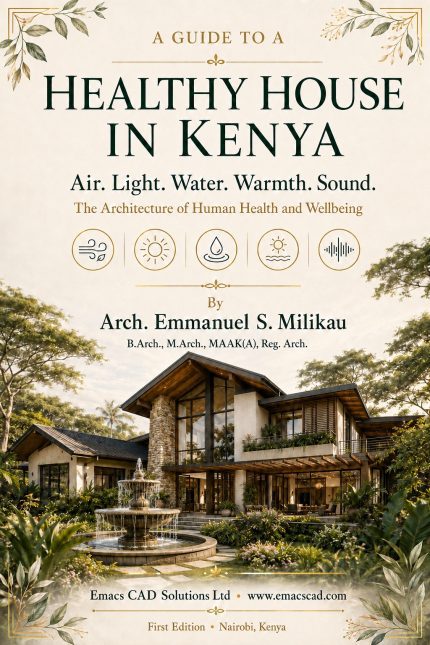
A Guide To A Healthy House In Kenya

KShs1,500.00 KShs1,200.00
A Guide to a Healthy House in Kenya Air. Light. Water. Warmth. Sound. — The Architecture of Human Health and Well-being Your house is not just shelter. It is an environmental machine that, every hour of every day, either protects your health or quietly erodes it — through the air you breathe, the light you receive, the water you store, the warmth you keep, and the noise you endure. And as architect Emmanuel S. Milikau argues in this landmark book, far too many Kenyan homes are making the people inside them sick. Drawn from three decades of practice and grounded in WHO guidance, KEBS and Kenya Building Code standards, and the realities of Kenyan climates, materials, and construction economics, A Guide to a Healthy House in Kenya re-frames the home as a health system built on five essential pillars: Air, Light, Water, Warmth, and Sound. For each, Milikau explains what the science says, what Kenyan buildings routinely get wrong, and — crucially — what can be fixed at the design table, on site, or after you've moved in, usually at little or no extra cost. This is not theory imported from London or Singapore. It is written from Nairobi, about the highland chill of Nakuru and Eldoret, the coastal heat of Mombasa, the cooking fumes of sealed kitchens, the ceiling damp of the wet season, and the traffic noise of the urban estate. Inside you'll find: • The Five Pillars framework, explained in plain language anyone can use • Room-by-room guidance for kitchens, bathrooms, and bedrooms • Practical, zero-energy strategies: cross-ventilation, the verandah, thermal mass, shading, the kitchen "one-meter rule" • Special chapters on children, the elderly, pregnancy, and biophilic design • Self-assessment checklists and a complete Healthy House Assessment Tool to score any home you're building, buying, renovating, or already living in Whether you are an architect future-proofing your designs, a developer or builder raising your standard, or a homeowner who simply wants a home that supports life rather than diminishing it, this book hands you the questions and principles the professionals use — before you commit to a single decision. Because, as the dedication reminds us: "A house that hurts you is not a home." About the Author: Arch. Emmanuel S. Milikau (B.Arch., M.Arch., MAAK(A), Reg. Arch.) is Managing Director of Emacs CAD Solutions Ltd in Nairobi, with 30 years' experience across Kenya, Tanzania, Uganda, Rwanda, Botswana, and Seychelles. He is also the author of A Guide to Building Your House in Kenya and its companion handbook.

A GUIDE TO A HEALTHY HOUSE – HA...

KShs1,000.00 KShs750.00
Is the house healthy? Now you can prove it — room by room, on site, in minutes. A Guide to a Healthy House in Kenya: The Companion Field Guide is the take-it-to-site handbook to Arch. Emmanuel S. Milikau's healthy-home framework. Where the main book explains why a home makes its occupants well or unwell, this field guide gives you the what and the how — in a format built for inspections, client walk-throughs, and design reviews. Everything is organised around the Five Health Pillars — Air, Light, Water, Warmth, and Sound — plus dedicated sections on kitchens and bathrooms, vulnerable occupants (children, the elderly, pregnancy, and disability), and biophilia and mental health. Each section gives you: • Quick-reference cards with the exact numbers, thresholds, and action levels • Inspection checklists for walking through a building • Score cards that turn a subjective impression into a defensible rating • Measurement logs for humidity, temperature, noise, and lux readings • Standards tables drawn from KEBS, WHO, the Kenya Building Code, and international best practice • Common-defects cards for spotting the problems you see most often It closes with a Master Assessment Tool — a complete Healthy House Score Card that produces a single, percentage-based building rating — and a consolidated Standards Reference for fast regulatory checks. Grounded entirely in Kenyan conditions — local climate zones, materials, construction methods, and real health risks from damp and mould to charcoal smoke and Rift Valley radon — this is the rare housing reference written for the East African context rather than imported wholesale from abroad. Written for architects, builders and contractors, home inspectors, property managers, surveyors, public-health and housing officers — and any homeowner who wants to know, with confidence, whether their home is helping or harming the people inside it. Carry it to every site visit. Use a pencil; reuse the forms. Make "healthy" something you can measure. Arch. Emmanuel S. Milikau (B.Arch., M.Arch., MAAK(A), Reg. Arch.) is a registered Kenyan architect and principal of Emacs CAD Solutions Ltd, Nairobi.

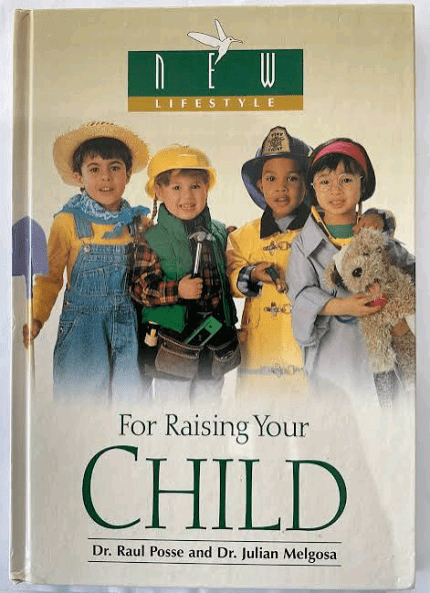
For Raising your Child

KShs2,500.00
  1. The authors of this book, experienced educators and parents, offer us all of the secrets to educating children, both at home and at school. They provide practical advice and describe how to educate our children at the different stages of their childhood. Nine fundamental topics are explored, beginning with Education in the Family, which teaches us the principles of the family relationship and its environment, and helps parents adopt a more efficient educational plan

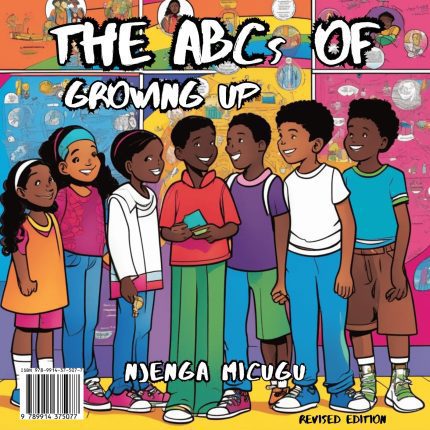
The ABCs of Growing Up [Revised Edition]

KShs1,500.00 KShs800.00
A Fun Guide to Understanding Bodies and Relationships for Kids Are you looking for a friendly and engaging guide to help your children navigate the essential topics of sex education? The ABCs of Growing Up is designed specifically for kids aged 11 to 16, addressing the questions they have about their bodies, feelings, and relationships in a fun and approachable way. This colorful book covers: ● Body Basics: Understand the diverse changes that happen during puberty. ● Feelings and Friendships: Learn how to build healthy friendships and understand emotions. ● Empowerment and Safety: Get vital information on personal boundaries and safety in a relatable manner.

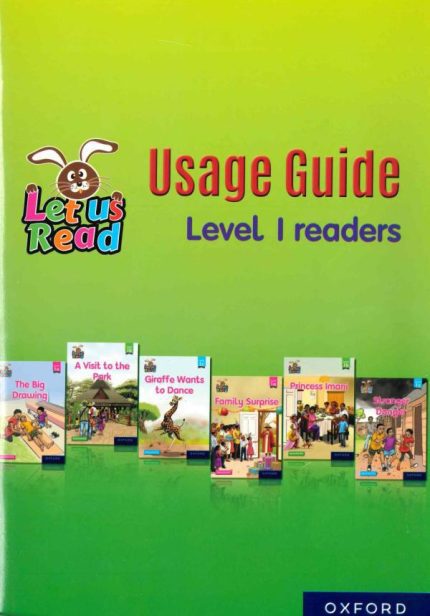
Let’s Read Usage Guide Level 1

KShs275.00
This Usage Guide supports Level I readers. It suggests strategies for using the readers for both guided and independent reading. n nThe Usage Guide provides: n
    n
  • Core competencies, Pertinent and Contemporary Issues (PCIs) and values brought out in each story.
  • n
  • Step-by-step guidance on how to use the readers to develop fluency and comprehension.
  • n
  • Suggestions for listening and speaking activities.
  • n
  • Suggestions for writing activities.
  • n
  • Suggestions for creative activities.
  • n
  • Suggestions for activities that can be done at home.
  • n
  • Answers to the activities in the readers.
  • n