Showing 81–100 of 124 results

A Season of Blood: Poems from Kenyan ...

KShs1,200.00 KShs990.00
The conditions that prisoners in Kenya endure are extremely barbaric. Every morning at 5 a.m., male prisoners are ordered out of the cells stark naked for internal body searches. The guards search their mouths and armpits, ears and nostrils. They pull, twist and squeeze their genitals. They order the prisoners to face the walls with their legs spread apart to examine their anuses for concealed weapons, money and other contraband. They use sharp sticks to probe the prisoner's rectums. In a sense, the guards are more interested in prisoners' buttocks than in the search. They make sexual remarks such as, "Look at this one, his buttocks are two mountains, it is difficult to mount him...and look at this one, his arsehole is sharped like a woman's vagina...This one has a soft arse like his mother..." After the brutal searches, the prisoners are beaten and kicked. These monstrous acts are repeated every morning. It is a humiliating and degrading. Maina was arrested on June 2, 1982 by dictator Moi's regime for the crime of thought. He was imprisoned for six years with hard labor. Despite the brutal isolation and censorship, physical and psychological torture, Maina made friends with a few prison guards who supplied him writing material and smuggled everything g he wrote out of prison and took it to Mumbi, his wife. The poems in this text were part of the written material smuggled out of prison. The themes of poems express the horrors of imprisonment, the brutality and viciousness of the Kenyan authoritarian regime, the intensification of the struggle for democracy.

From Home Guard to Mau Mau by Elisha ...

KShs1,000.00 KShs800.00
This is a fictional account of a young Kenyan man who is the trusted home guard and bodyguard of a white farmer. The fight to free Kenya of the colonialists rule is on, and the Mau Mau are the spearhead. The young man secretly joins the Mau Mau, but his loyalties are in conflict and each part of his life now involves betrayal of an other. The life story is one of survival, betrayal, anguish and vengeance.

Wars, Guns, and Votes: Democracy in D...

KShs2,500.00 KShs1,790.00
Wars, Guns, and Votes, Paul Collier investigates the violence and poverty in the small, remote countries at the lowest level of the world economy. An esteemed economist and a foremost authority on developing countries, Collier argues that the spread of elections and peace settlements in the world's most dangerous countries may lead to a brave new democratic world. In the meantime, though, nasty and long civil wars, military coups, and failing economies are the order of the day—for now and into the foreseeable future. Through innovative research and astute analysis, Collier gives an eye-opening assessment of the ethnic divisions and insecurites in the developing countries of Africa, Latin America, and Asia, where corruption is often firmly rooted in the body politic. There have been many policy failures by the United States and other developed countries since the end of the Cold War, especially the reliance on preemptive military intervention. But Collier insists that these problems can and will be rectified. He persuasively outlines what must be done to bring peace and stability: the international community must intervene through aid, democracy building, and a very limited amount of force. Groundbreaking and provocative, Wars, Guns, and Votes is a passionate and convincing argument for the peaceful development of the most volatile places on earth.

Beyond Politics: A conversation with ...

KShs1,899.00 KShs1,699.00
Brief Summary Beyond Politics: A conversation with Kiraitu Murungi by Njeri Rugene

Beyond Capitalism and Socialism in Ke...

KShs1,500.00 KShs1,299.00
Brief Summary Explores how Tanzania and Kenya, often regarded as paradigms of capitalist and socialist development in Africa, have responded to the challenges they face, such as population growth, mounting external debt and structural adjustment, by modifying their original approach to development.

Kenyan capitalists, the State, and de...

KShs2,000.00 KShs1,500.00
Brief Summary Himbara argues that the literature on Kenyan capitalism largely misses the mark because it either omits or misconceptualises as ""Asian capital"" the principal segment of the domestic bourgeoisie. He demonstrates the leading role that Kenya's Indian entrepreneurs have played in her development.

Scars Of A Nation: Survivor Of Kiamba...

KShs3,000.00 KShs2,000.00
Brief Summary A true Story about victims of the 2007/08 Post election Violence in Kenya, their suffering and the search for their Justice at The International Criminal Court in The Hague, Netherlands. The lies, intrigues, machinations and skullduggery during the ICC process. The author is a victim of the Kiambaa Church Massacre. Quote from the book: “Today, when you walk into the Kenya Assemblies of God Church in Kiambaa Eldoret, thirty-six graves are conspicuously visible. They stick out as a monument of that massacre - a powerful reminder of the consequences of prejudice, negative ethnicity, hate and the greed of a few individuals, who do not care that innocent citizens have to die from artificially generated conflicts, as long as this enables them to negotiate for political power, so as to satiate their individual greed, with ill-gotten wealth, and soothe their ego, with fame and prestige” In Naivasha “the attackers came to the home of Mr. Bernard Ndege, a man from the Luo tribe, and locked his entire family inside their house then set it ablaze and killed nine of his children and two wives” “having a President coming from your ethniccity is usually just a feel-good attitude only, and can be quite deceptive to think that one is privileged, because, it does not necessarily translate into tangible personal gains when ‘one of our own is the President’ Only a good governance system can guarantee equality for all” N/B Buy the book to support and encourage Kenyan authors.

Decolonization and Independence in Ke...

KShs4,500.00 KShs3,899.00
Brief Summary The main purpose of the book is to show that decolonisation does not only mean the transfer of alien power to sovereign nationhood; it must also entail the liberation of the worlds of spirit and culture, as well as economics and politics. The book also raises a more fundamental question, that is: How much independence is available to any state, national economy or culture in today's world? It asks how far are Africa's miseries linked to the colonial past and to the process of decolonization? In particular the book raises the basic question of how far Kenya is avoidably neo-colonial? And what does neo-colonial dependence mean? The book answers these questions by discussing the dynamic between the politics of decolonization, the social history of class formation and the economics of dependence. The book ends with a provocative epilogue discussing the transformation of the post-colonial state from a single-party to a multi-party system.

Equality in Kenya’s 2010 Consti...

KShs10,000.00 KShs8,999.00
Brief Summary "This book asks whether there is a coherent conception of equality in Kenya's 2010 Constitution and explores how competing and interrelated ideas of equality in it should be conceptualized, interpreted and applied. Making a significant contribution to the ongoing global conversations on the various understandings of equality, the book illuminates the many ways in which diverse equality guarantees clash, or are interrelated. It also sets out principled approaches on how they can be coherently interpreted to address the myriad inequalities in Kenya. Taking a comparative approach, the book considers how other jurisdictions including the United States, the United Kingdom, Canada, South Africa, India and Botswana have approached the conceptualization, interpretation and application of various equality concepts. The book focuses on important issues such as: - transformative constitutionalism in relation to the interpretation of Kenya's 2010 Constitution; - expanding the list of enumerated grounds for non-discrimination; - affirmative action; - accommodating religious and cultural diversity versus gender equality; - the interrelation between socio-economic rights and status-based equality"--

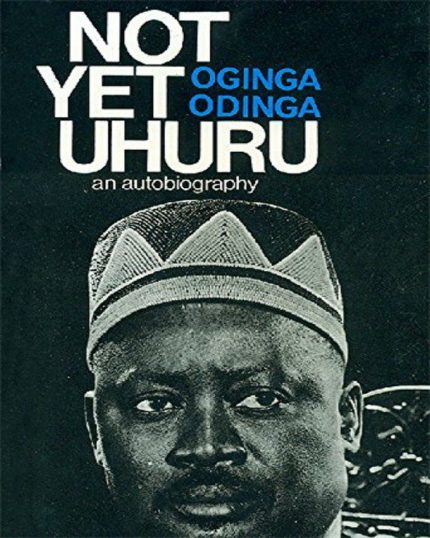
Not yet Uhuru by Jaramogi Oginga Odinga

KShs2,190.00
Not Yet Uhuru gives a vivid and authoritative account of the history of Kenya. In this autobiography, the author counters the Imperial British propaganda machine to distort the history of a nation. From the perspective of a man who was at the centre of the liberation struggle and the making of a new nation, Jaramogi Oginga Odinga deconstructs the fallacious and sloppy historical narratives peddled by propagandists, which are deliberately tailored to vilify the true national heroes and exalt villains. In this seminal literary work, Jaramogi lets his betrayal by Jomo Kenyatta off his chest. He lays bare his frustration with Kenyatta’s turn against fellow Kapenguria six members such as Bildad Kaggia into his primary casualties and enemies. Jaramogi accuses Kenyatta of becoming an Imperial Master stooge and thus justifies his decision to break ranks with the Kenyatta regime. In light of the nationalism spirit, vision, and mission, Jaramogi considered Kenyatta’s change of heart an unforgivable grand betrayal. Not Yet Uhuru is not an ordinary autobiography. It is Jaramogi’s historical gift to Kenyans, Africa in general, and historians the world over. This book is filled with prophetic anecdotes and laden with premonitions, which can stir us from our self-induced political stupor. Not Yet Uhuru demystifies the Kenyatta and Odinga families’ political feud, which has played out for over five decades. This book will help you understand why the sons of the two founding fathers of Kenyan continue to strive to outwit each other in the political arena.

The illusion of power by GG Kariuki H...

KShs3,000.00 KShs2,590.00
Brief Summary The Illusion of Power: Reflections on Fifty Years in Kenya Politics. Kariki's political participation dates from 1952, when he pledged an oath to the allegiance of the Gikuyu tribe, the Mau Mau movement and the cause of African unity. Post-independence, he gradually progressed to being a political insider, serving in the Kenyan African National Union (KANU) and the Kenyan Government. In 1983 he was expelled from KANU - the only political party. It is from this outsider-perspective, and in this climate of fear and uncertainty, without the desired freedom of association and access to political colleagues of the period of struggle, that he nevertheless here recounts his experiences of half a century in politics. He holds the belief that political evolution is inexorable; and that knowledge about, and reflection on the past is the only way of preventing the tragedy of yet another generation repeating that which they condemned in their predecessors.

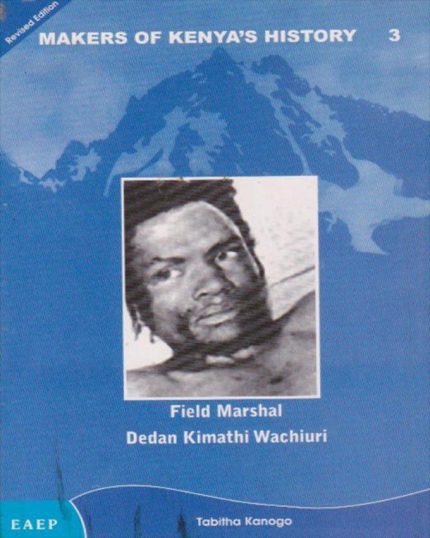
Makers Of Kenya’s History: Fiel...

KShs600.00 KShs450.00
Brief Summary Dedan Kimathi is a story of the man who is now almost universally accepted as the true symbol of Kenya's liberation struggle. A warrior and military strategist to boot, Dedan Kimathi rose through the ranks to become the overall leader of the Mau Mau freedom fighters. Since his death at the heart of the struggle, he has acquired, in the minds of many, legendary and mythical qualities.

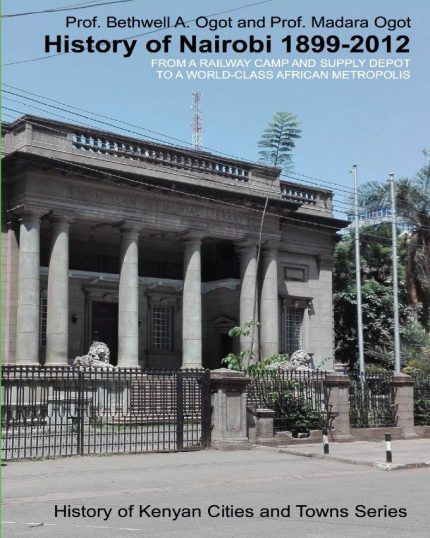
History of Nairobi 1899-2012 From a R...

KShs5,500.00 KShs4,990.00
Brief Summary History of Nairobi 1899-2012: From a Railway Camp and Supply Depot to a World-Class African Metropolis is the second book in the series, History of Kenyan Cities and Towns. The Series looks at the people and events that have shaped the cities’ and towns’ development and the broader impact they have had on Kenya’s development. History of Nairobi 1899- 2012 follows the City’s origins as a Railway camp in 1899 to 2012 when the Country ushered in the devolved system of government and the Nairobi City Council was replaced by the Nairobi City County. As the Capital City and the seat of National Government, the history of Nairobi also provides a narrative of Kenya’s political development from the early days of the colony to the promulgation of the new Constitution in 2010. Throughout the text, a large collection of photographs brings to life the evolution of the City in its formative 110 years. ISBN:9789914702033 Author:Bethwell A Ogot and Madara Ogot

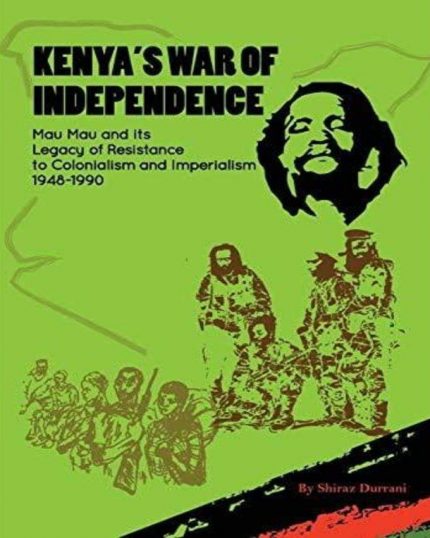
Kenyas War of Independence Mau Mau an...

KShs2,500.00 KShs1,890.00
Kenya's War of Independence restores Kenya’s stolen history to its rightful place, stripped of colonial interpretations. In this expanded and revised version of his 1986 booklet, Kimaathi, Mau Mau's First Prime Minister of Kenya, Durrani covers Mau Mau’s resistance to colonialism and neo-colonialism and reflects on its ideology, organisation and achievements. He sees Mau Mau in the larger context of Kenya’s war of independence and looks at the influence of organised, radical trade unions as the engine of resistance, linking economic with political demands of working people. Additional chapters document the post-independence resistance by the underground December Twelve Movement-Mwakenya. Durrani captures the dynamism of transition from colonialism to neo-colonialism: "Imperialism replaced colonialism, African elites replaced White Settlers, neo-colonial government replaced colonial government. Resistance changed from the War of Independence to War of Economic Independence. Worker and peasant resistance is evident once again. History is on the march”.

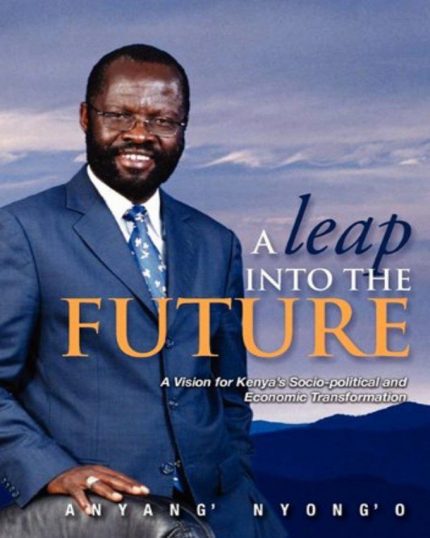
A Leap Into the Future by Anyang Nyongo

KShs1,890.00 KShs1,599.00
Brief Summary A Leap into the Future is a collection of speeches, essays and articles compiled during Prof. Anyang' Nyong'o's tenure in the Kenya government and soon afterwards (2002-2006). In this provocative collection, Prof. Nyong'o examines the challenges of development, analyses how pan-African and global partnerships could facilitate development, and invokes the visionary direction pointed out by prominent personalities in Kenya's political leadership to whom he pays tribute. Through the collection, the author projects his vision for socio-political and economic transformation of the Kenyan society in a bid to formulate an economic strategy capable of leap-frogging the country from the current quagmire of underdevelopment to development. Professor Anyang' Nyong'o is a renowned reformist and political scientist in Africa and is best known for his role in Kenya's "second liberation". He holds a doctorate degree in Political Science from the University of Chicago and has taught in universities in Kenya, Mexico and Ethiopia. Upon the re-introduction of multiparty politics in Kenya in 1991, he was involved in the founding of Forum for the Restoration of Democracy (FORD), which provided the premier opposition machinery in the run-up to the 1992 general elections. He was also involved in the formation of the National Rainbow Coalition (NARC), which defeated KANU, the party that had ruled Kenya for 24 years. In the subsequent NARC government, he became the Minister of Planning and National Development. Besides teaching, he is widely published in Africa and abroad. Prof. Nyong'o has also been at the frontline in championing the reform agenda in Africa, especially through the establishment of NEPAD. At the time of publication of this book, he was Secretary General of the Orange Democratic Movement (ODM). ISBN:9789966706263 Author:Anyang Nyongo

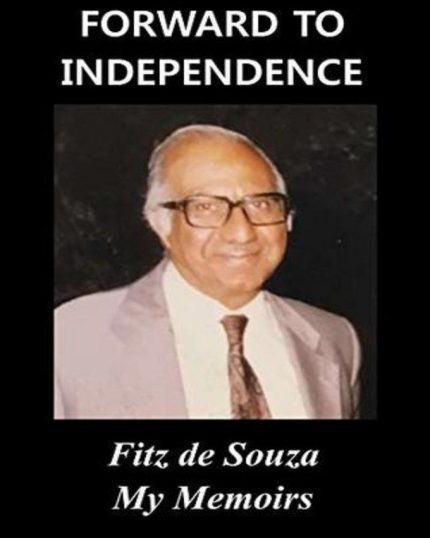
Forward to Independence by Fitz de Souza

KShs4,500.00 KShs3,500.00
Brief Summary Fitz de Souza's memoirs recount a political story woven through a personal account of migration and integration, with both the hardship and hope that this entailed. His account takes us from Asia to Africa and then to Europe before returning to East Africa where he lived for most of his life. It gives a flavour of lifestyles, moral codes, and politics as they were in early 20th century India, 1930s Zanzibar, and Europe after the war. Most importantly, it takes us to that formative time when the foundations were laid for an independent Kenya, giving the reader a window into those last decades of colonial Africa and those early years of the new nation. The transition was not a peaceful one. It was not a time when the "rule of law" was applied in an undiluted sense. The book gives the inside story of the colonial government's handling of the independence movement including the trial of the Kapenguria six, Jomo Kenyatta and fellow nationalists, and Operation Anvil, the round-up of the Mau Mau. It explains how agreement was eventually reached and compromises found, in particular through the Lancaster House conferences, that enabled a new country to be founded. It portrays the politicians of the time, before independence and after, some hugely idealistic, some charismatic, and others forever enigmatic, many of whose lives in those formative years ended in tragedy. Hilary Ng'weno, a highly regarded Kenyan journalist and editor, provided invaluable support: "I interviewed him many times, so that the interviews, which were recorded, could help him in writing his memoirs. That exercise was an eye opener for me. I had never met an elderly person who could remember so many details about his past. He was remembering personalities and events of the years before and soon after Kenya’s independence in 1963 and Fitz wasn’t just remembering events touching on his life. He was remembering Kenya’s history of which he was one of the great makers. The story you read in this book is not just about Fitz. It is a story about the foundations of the Kenya nation. And it is for that reason that I feel very strongly that Fitz Remedios Santana de Souza will forever remain a legend for many Kenyans." David Steel, The Rt Hon. the Lord Steel of Aikwood, a close personal friend, commented: ”This is a remarkable book, beautifully written and describing in graphic detail the author’s experience of the transition of Kenya from violence-torn colony to independence. Fitz de Souza speaks with authority as one active at the centre from lawyer to Jomo Kenyatta to Deputy Speaker in the Nairobi Parliament. His sketches of the participants are quite breath-taking and moving. His is a life lived to the full – I could not put it down and read it all in just two sittings.” In her introduction, Victoria Brittain, former foreign correspondent for The Guardian in East Africa, writes: "Fitz de Souza is a man of memories from his unique insider/outsider status in Kenya’s struggle for independence from Britain and the early days of its uncharted path under Jomo Kenyatta. A vanished world of optimism and idealism rooted in Goa, Zanzibar, Kenya’s Rift Valley, London’s Inns of Court, and the dying days of British colonial rule in Kenya is unveiled in his subtle understated book. De Souza was Deputy Speaker of the first Parliament of independent Kenya, a trusted friend to Kenyatta and of all the aspiring politicians of the moment, many of whom he knew well from the prisons and courtrooms of violent pre-independence days. He was a man who in those heady days of independent Kenya could have had any ministry he wanted, and was offered any stretches of farmland he wanted by Kenyatta. Unlike so many others he wanted none. The life he chose was a very different one of idealism, matter-of-fact self-sacrifice and extraordinary hard work.”

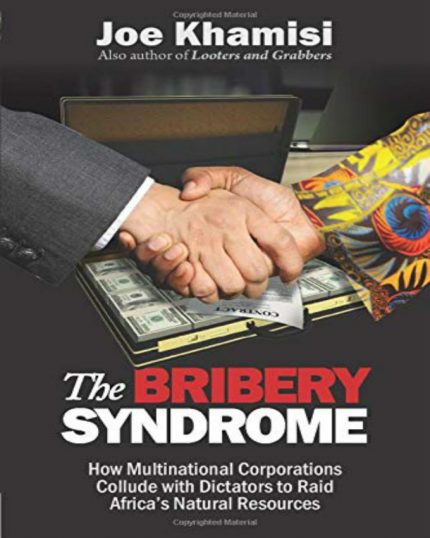
The Bribery Syndrome by Joe Khamisi

KShs2,500.00
The Bribery Syndrome: How Multinational Corporations Collude with Dictators to Raid Africa's Natural Resources. A shocking narration of how global multinationals make billions of dollars in profits by bribing corrupt African dictators and public officials to secure lucrative contracts in some of the most critical economic sectors in Africa. Dozens of foreign company executives have been jailed and/or fined heavily for violating the US Foreign Corrupt Practices Act and the UK Bribery Act. The book focuses on 28 corrupt leaders in sub-Saharan Africa who cozy up with company executives of some of the largest corporations in the world. Both the officials and the global conglomerates make huge amounts of money using kickbacks, bribery, and corruption while millions of Africans languish in poverty. The Bribery Syndrome is a compelling read.

The Soldiers Legacy The Kenya Army at...

KShs5,500.00 KShs5,000.00
The Soldiers Legacy: The Kenya Army at 55

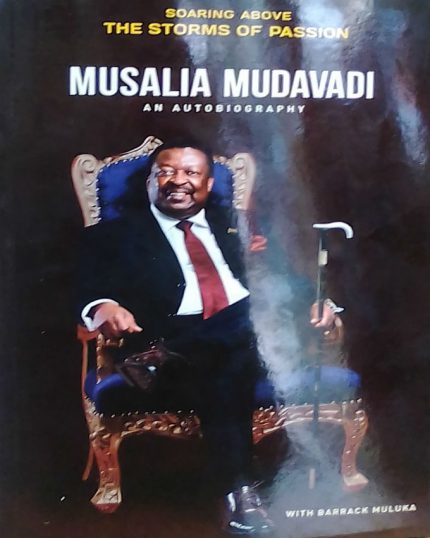
Soaring Above the Storms of Passion b...

KShs3,800.00 KShs3,390.00
Mudavadi’s memoir, Soaring Above the Storms of Passion, paints Odinga as a man under pressure who was willing to play tricks on both friend and foe to overcome the difficult situation before him. Some of Mudavadi’s claims have also corroborated what had already been written by exiled Kenyan activist Miguna Miguna who was part of Odinga’s team in the aftermath of August General Election. For instance, Mudavadi writes of the plan to have a parallel swearing in ceremony for Odinga. The plan received a lot of opposition from the international community and the ANC Party Leader says one Western country went as far as to cancel Odinga’s visa and that of many of his allies. Mudavadi was in the team of those who believed the Opposition chief should not have been sworn in but Odinga was also under a lot of pressure from the swearing in diehards who included Miguna Miguna, James Orengo, Jimmy Wanjigi, Raila Junior, among others. As the pressure mounted, Mudavadi, in consultation with Raila and the technical team decided to announce the postponement of the swearing in ceremony that had been expected to take place on December 12th 2018. Just before Mudavadi could make the announcement during a press conference at Okoa Kenya office, Raila became untraceable. Unknown to Mudavadi, the Opposition chief was holed up in Jimmy Wanjigi’s house in Muthaiga where the Okoa Kenya TV had planned to film a swearing in ceremony which would then be distributed on the internet. The team in Wanjigi’s house did not know that Raila had already directed the swearing in ceremony to be postponed, and kept asking Mudavadi why he was taking too long to make the announcement. "I learnt from people present that Raila seemed to have been very shocked to watch us on TV calling off the swearing in. He is reported to have said, "Oh they are calling it off?” At this point the swearing in at Muthaiga was called off. Before we left for the Okoa Kenya offices, he had called me to ask why we were taking long to make the announcement,” Mudavadi writes in his new book.