Showing all 2 results

Law of Corporate Finance in Kenya by ...

KShs5,299.00 KShs5,000.00
This book on the Law of Corporate Finance in Kenya, comprising twenty-five chapters, gives a detailed exposition on: a) Regulation of corporate decisions on the companies’ capital structure, capital raising rules and capital maintenance rules; b) Legal framework for debt finance in Kenya and the variants of that form of finance, comprising, loans and corporate debt securities; c) Capital Markets law in Kenya, particularly, equity finance raising in Kenya by companies, firstly, through private placement procedures of venture capital, private equity and crowd funding. Secondly, through issuing equity to the public by initial public offering and secondary equity offering by way of prospectus, and consequential regulation of trading of equity in secondary markets. Thirdly, liability enforcement mechanisms in capital markets for incorrect disclosures in prospectus; and d) Regulation of finance raising both by National Government at its parastatals, and by County Governments through public private partnerships (PPP), the typical model of project finance in Kenya.

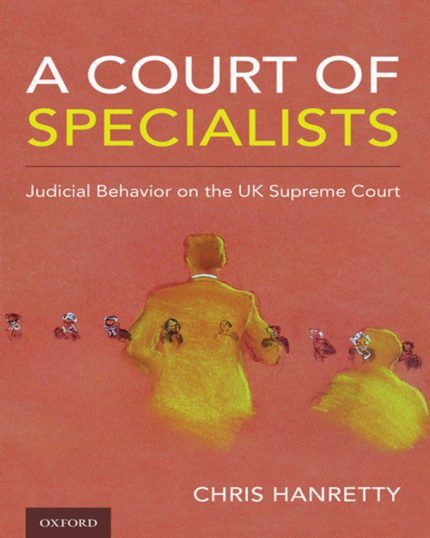
A Court of Specialists: Judicial Beha...

KShs12,000.00 KShs9,999.00
Brief Summary This book offers the first quantitative study of decision-making on the UK Supreme Court. Covering the court's first ten years, it examines all stages of the court's decision-making process -- from the permission to appeal stage to the decision on the final outcome. The analysis of these distinct stages shows that legal factors matter. The most important predictor of whether an appellant will succeed in the Supreme Court is whether they've been able to convince judges in lower courts. The most important predictor of whether a case will be heard *at all* is whether it has been written up in multiple weekly law reports. But ""legal factors mattering"" doesn't mean that judges on the court are simply identical expressions of the law. The nature of the UK's court system means that judges arrive on the court as specialists in one or more areas of law (such as commercial law, or family law), or even systems of law (the court's Scottish and Northern Irish judges). These specialisms markedly affect behaviour on the court. Specialists in an area of law are more likely to hear cases in that area, and are more likely to write the lead opinion in that area. Non-specialists are less likely to disagree with specialists, and so disagreement is more likely to emerge when multiple specialists end up on the panel. Although political divisions between the justices do exist, these differences are much less marked than the divisions between experts in different areas of the law. The best way of understanding the UK Supreme Court is therefore to see it as a court of specialists. ""--