














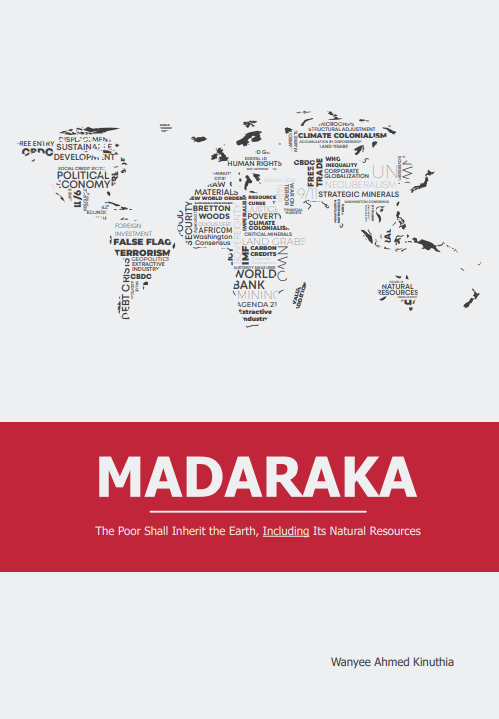
MADARAKA — the Swahili word for self-determination — is a powerful and deeply researched examination of who controls Africa’s land, minerals, natural resources and economic future. The book also discusses the relationship between multinational corporations, governments, communities and natural resources. Drawing on more than two decades of research, community engagement and experience in the extractive sector, the author uses Kenya’s titanium-mining experience as a lens through which to examine a much larger question: Can Africa achieve genuine economic development and self-determination while continuing to export its natural resources largely in raw form?
Part I, “The Titanium Issue,” examines the concept of “accumulation by dispossession” in the African context. It explores corporate globalization, the extractive industry, land and property rights, environmental impact assessment, community participation, access to information, licensing and the distribution of mineral benefits. The Kwale titanium project provides the central case study, while comparisons with Canada and other African experiences broaden the discussion. The section ultimately asks whether Africa can move beyond the export of raw materials towards value addition, industrialization and greater economic sovereignty.
Part II, “Undermining Africa,” widens the analysis from mining to the political economy of African development. The book revisits dependency theory, export-led growth and the role of foreign debt in constraining African policy choices. It examines the concept of “odious debt”, including its application to African experiences and Kenya’s development financing, and considers how debt, capital and natural-resource dependence can reinforce one another.
A supplementary section examines the relationship between economic globalization and geopolitics, while the Afterword, “Reassessing the ‘Climate Crisis’: ‘Accumulation by Decarbonization’,” extends the book’s central questions into the contemporary energy transition and the growing global demand for critical minerals.
Ultimately, MADARAKA argues for a different development trajectory: one in which Africa’s extraordinary natural-resource endowment becomes a foundation for local value creation, industrial development, economic diversification and self-determination, rather than perpetuating dependence on the export of raw materials. With Kenya’s mining sector, Africa’s critical-minerals potential and the global competition for natural resources becoming increasingly important, this book offers a timely African perspective on one of the defining questions of the twenty-first century: Who should benefit from Africa’s natural resources—and what would genuine resource sovereignty look like?
About the Author
Wanyee holds a Master’s degree in Globalization and International Development from the University of Ottawa, Canada. His extensive work with mining-affected communities in Canada provides him with a unique and critical perspective on the global extractive industry, particularly because Canada is home to about half of the world’s mining companies. His MA thesis has been cited in a number of journal articles and research papers, and is hosted on the repository of Library and Archives, Canada. He is also the Founder and Director of the Madaraka Centre for Natural Resource Governance and a Founding Director of the Kenyan Chapter of the African Sovereignty Coalition.





Reviews
Clear filtersThere are no reviews yet.