Brief Summary
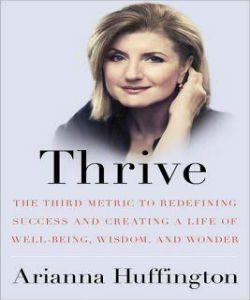
In Thrive, Arianna Huffington makes an impassioned and compelling case for the need to redefine what it means to be successful in today's world. Arianna Huffington's personal wake-up call came in the form of a broken cheekbone and a nasty gash over her eye -- the result of a fall brought on by exhaustion and lack of sleep. As the cofounder and editor-in-chief of the Huffington Post Media Group -- one of the fastest growing media companies in the world -- celebrated as one of the world's most influential women, and gracing the covers of magazines, she was, by any traditional measure, extraordinarily successful.
Yet as she found herself going from brain MRI to CAT scan to echocardiogram, to find out if there was any underlying medical problem beyond exhaustion, she wondered is this really what success feels like? As more and more people are coming to realize, there is far more to living a truly successful life than just earning a bigger salary and capturing a corner office. Our relentless pursuit of the two traditional metrics of success -- money and power -- has led to an epidemic of burnout and stress-related illnesses, and an erosion in the quality of our relationships, family life, and, ironically, our careers. In being connected to the world 24/7, we're losing our connection to what truly matters. Our current definition of success is, as Thrive shows, literally killing us. We need a new way forward.
In a commencement address Arianna gave at Smith College in the spring of 2013, she likened our drive for money and power to two legs of a three-legged stool. They may hold us up temporarily, but sooner or later we're going to topple over. We need a third leg -- a third metric for defining success -- to truly thrive. That third metric, she writes in Thrive, includes our well-being, our ability to draw on our intuition and inner wisdom, our sense of wonder, and our capacity for compassion and giving. As Arianna points out, our eulogies celebrate our lives very differently from the way society defines success. They don't commemorate our long hours in the office, our promotions, or our sterling PowerPoint presentations as we relentlessly raced to climb up the career ladder. They are not about our resumes -- they are about cherished memories, shared adventures, small kindnesses and acts of generosity, lifelong passions, and the things that made us laugh.
In this deeply personal book, Arianna talks candidly about her own challenges with managing time and prioritizing the demands of a career and raising two daughters -- of juggling business deadlines and family crises, a harried dance that led to her collapse and to her "aha moment." Drawing on the latest groundbreaking research and scientific findings in the fields of psychology, sports, sleep, and physiology that show the profound and transformative effects of meditation, mindfulness, unplugging, and giving, Arianna shows us the way to a revolution in our culture, our thinking, our workplace, and our lives."""
ISBN:2147483647
Author:Arianna Huffington




















bennetgalah –
About the Author.
Chimamanda Ngozi Adichie is a Nigerian writer, from the Igbo family (Enugu)
“The world was silent when we died.”
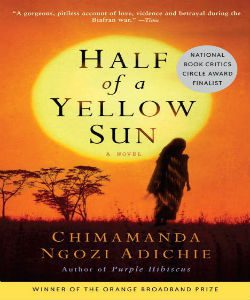
This casual statement he once heard is used as the title of a book written by one of the characters in this novel, in which Chimamanda Ngozi Adichie chronicles the birth, short and tortured life and death of the State of Biafra: born on the 30th of May, 1967 from Nigeria and forcefully annexed back by the parent state, after a bitter war in which a million died, in January 1970.
Most of us, I suspect, do not know about this short-lived country. Even Wikipedia calls the war between Biafra and Nigeria a “civil war”, thus denying legitimacy to the erstwhile nation: even though a number of countries recognised it. Since history is always written by the victors, the voice of the losers are often submerged in the general background noise.
I listened to a talk by the author – a very impressive one – about the danger of the “single story”: the one that has been foisted on the world by the erstwhile colonial powers and called “history”. These are opinions which are taught as facts, which tend to show an uncivilised “third world”, and the West’s “civilising” influence. This is so much bovine excrement. The colonial powers went into Asia and Africa to loot, and when the loot was finished, exited leaving miserable poverty and the flames of mutual hatred in the minds of people. This is the story which is not told.
Ms. Adichie also warns us about the “secondary story” in the speech; that is, starting the story from the second chapter, ignoring the first. Examples are plentiful – Palestinians attacking the peaceful state of Israel, without mentioning the death and displacement of thousand of Palestinians to create the said country; mutual hatred between India and Pakistan, without mentioning the hatred fomented by the British which resulted in the partition; endemic poverty and tribal violence in Africa, without mentioning the years of occupation by the West which created them. Up till recently, world history was made up of these secondary stories, which served as the “one story” which the former colonial powers wanted to propagate.
It is heartening to note that things are changing. People like Chimamanda are using the most powerful medium available to humans since the dawn of civilisation to bring about that change: the medium of the narrative. And it is here that the defeated people have an immense power which cannot be suppressed.
The world was silent when many died. But now it will have to listen, as the dead tell their story from beyond the grave.
As the British colonists left Nigeria, they did what they were expert at doing: drawing artificial national boundaries and inciting hatred in the minds of the people they ruled. So after a period of uneasy calm, Nigeria erupted in riots. The powerful Hausa people massacred the Igbo minority, whom they considered to be enjoying more benefits than was due them (see anything familiar here?), and the Igbo declared independence from Nigeria, and the state of Biafra was born. However, Nigeria could not let go of the oil-rich south: so war was declared. In a bitter battle which lasted two and a half years which left a million dead and the country devastated, Biafra was subjugated and wiped off the map.
Ms. Adichie passes the harsh white light of history through the prism of individual experience to create overlapping rainbows of narratives. In this, her style is similar to that of Paul Scott; however, whereas Scott’s narrative is an Indian tapestry where one has to search among the intricate coloured strands to see a pattern (or multiple conflicting patterns), Chimamanda’s work has all the blunt beauty of African art: the uncomplicated lines and the simple patterns which makes the medium all but transparent so that the narrator is talking directly to the listener. Scenes of utter despair and brutality are described very matter-of-factly, in almost Hemingway-esque prose. We are all sitting around a metaphorical campfire, listening to the author telling her story in uncomplicated prose.
But it does not mean that there are no nuances. The name, Half of a Yellow Sun, itself signifies separation, a paring; the fact that it is a reference to the Biafran flag makes it all the more significant. One of the three main characters through whose viewpoints we experience the tale, Olanna, is one of set of fraternal twins. Like twins in a fairy tale, the sisters are of diametrically opposite natures – Olanna is beautiful, revolutionary and optimistic; while her sister Kainene is plain, cynical and pessimistic. Of course, things are not so simple as they seem, and the sisters’ characters unfurl as the story progresses: showing us more and more layers, as the siblings move through their lives, facing love, hatred, betrayal, separation and loss against a nation that is slowly coming apart at the seams.
Another character through whose eyes we see the tragedy of Biafra is Richard Churchill, Kainene’s lover – an Englishman who has “gone native”. Richard is interested in Igbo pottery, and is ostensibly researching it. He is also trying to write a book which never seems to take shape – like character from a Kafka story, Richard plods on, reaching nowhere.
But for me, the character who holds the novel together is Ugwu, houseboy of Odenigbo, Olanna’s boyfriend. As we move across the Nigeria of the early sixties to the Biafra of the late sixties and then again, back to a unified Nigeria in 1970, Ugwu grows from child to man – in more ways than one. In the end, he becomes Richard’s spiritual heir of sorts, telling the story of the Igbo people of Nigeria, which Richard could never accomplish.
Themes of the Novel include:
1. Fertility of war
-The consequences of war
-unnecessary war
-Nothing is achieved after war
2. Love
-Love tested by disloyalty
-Colonization and oppression