














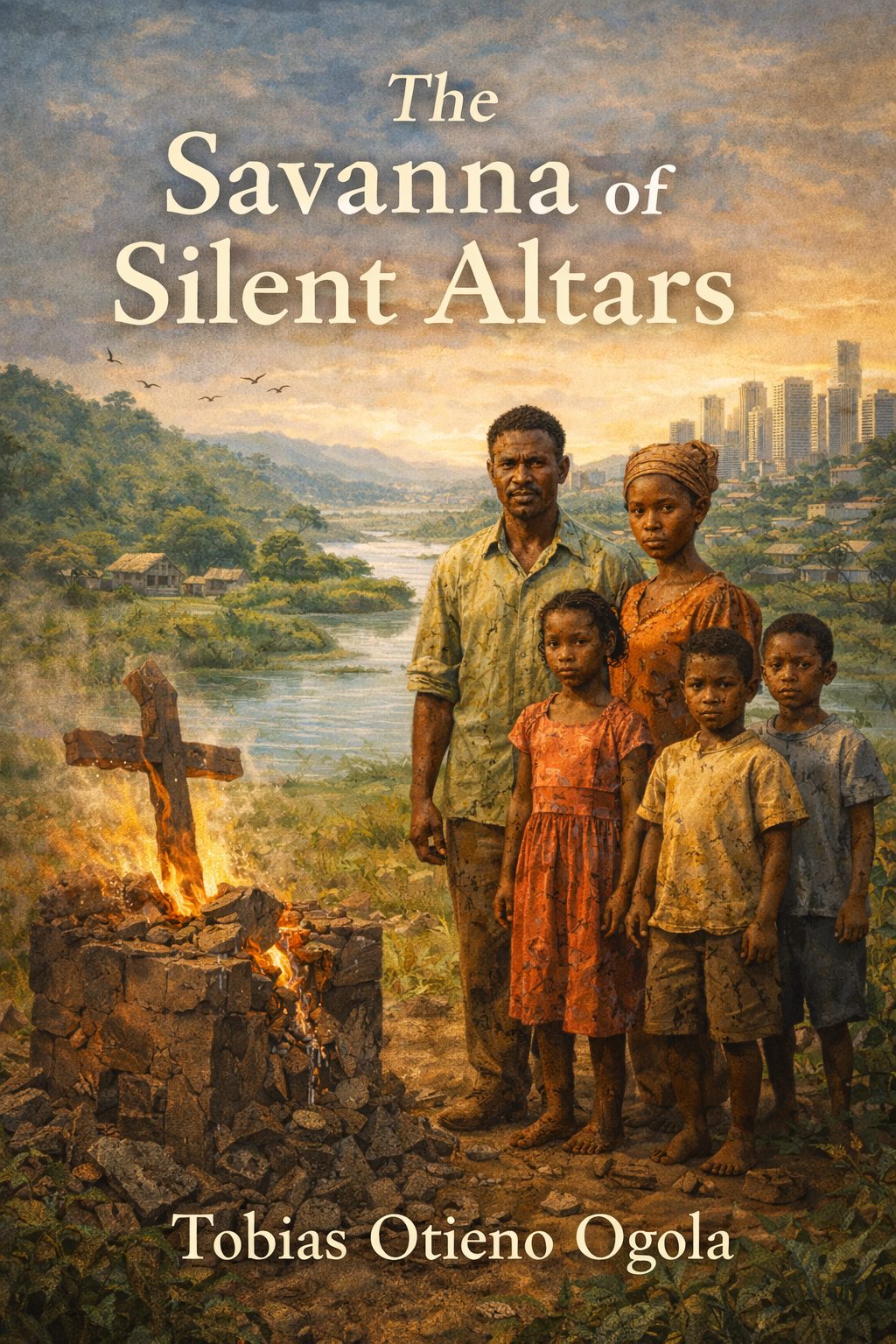


The Savanna of Silent Altars by Mr. Tobias Otieno Ogola is a sweeping, intimate novel about a family living at the intersection of faith, poverty, power, and endurance. Set across green rural landscapes, riverbanks, market towns, and restless cities, the story follows Kamau Otieno and Nyambura Beatrice as they raise their children amid scarcity, government absence, and belief systems that promise salvation while quietly demanding obedience.
Their world is shaped by movement between counties, between hope and disappointment, between tradition and change. Roads are broken, clinics are empty, schools are under-resourced, and help arrives rarely, if at all. In this vacuum, other forces rise. Faith circulates in whispers and emissaries, rituals are introduced as solutions, and altars some visible, others deeply embedded in daily life begin to shape decisions, bodies, and futures.
The children grow within this landscape, learning not through instruction but through observation. They notice how hunger sharpens compliance, how silence is rewarded, how devotion can be measured in sacrifice. Ordinary routines fetching water, attending school, sitting in evening conversations become spaces where power is negotiated and belief quietly tested. No one announces the danger; it arrives dressed as hope.
As the family moves between rural homesteads and urban centers, the contrast deepens. Cities promise opportunity but demand submission of a different kind. Rural spaces offer familiarity yet bind tightly to inherited expectations. Throughout, the family must decide how much to give, what to question, and what to endure in order to remain whole.
This is not a story of sudden rebellion or heroic victory. It is a novel of slow exposure and moral reckoning. It reveals how exploitation survives through normalcy, how communities participate in their own undoing, and how resistance often begins not in protest, but in doubt, silence, and refusal. Justice does not arrive cleanly. Answers remain incomplete. What changes instead is awareness.
The Savanna of Silent Altars is a literary exploration of belief under pressure, of survival shaped by unseen systems, and of the quiet courage required to live truthfully in a world that prefers obedience. Rooted in lived experience and carried by lyrical, observant prose, the novel speaks to anyone who has ever had to choose between inherited truths and lived reality between the safety of silence and the risk of seeing clearly.






















Reviews
Clear filtersThere are no reviews yet.