














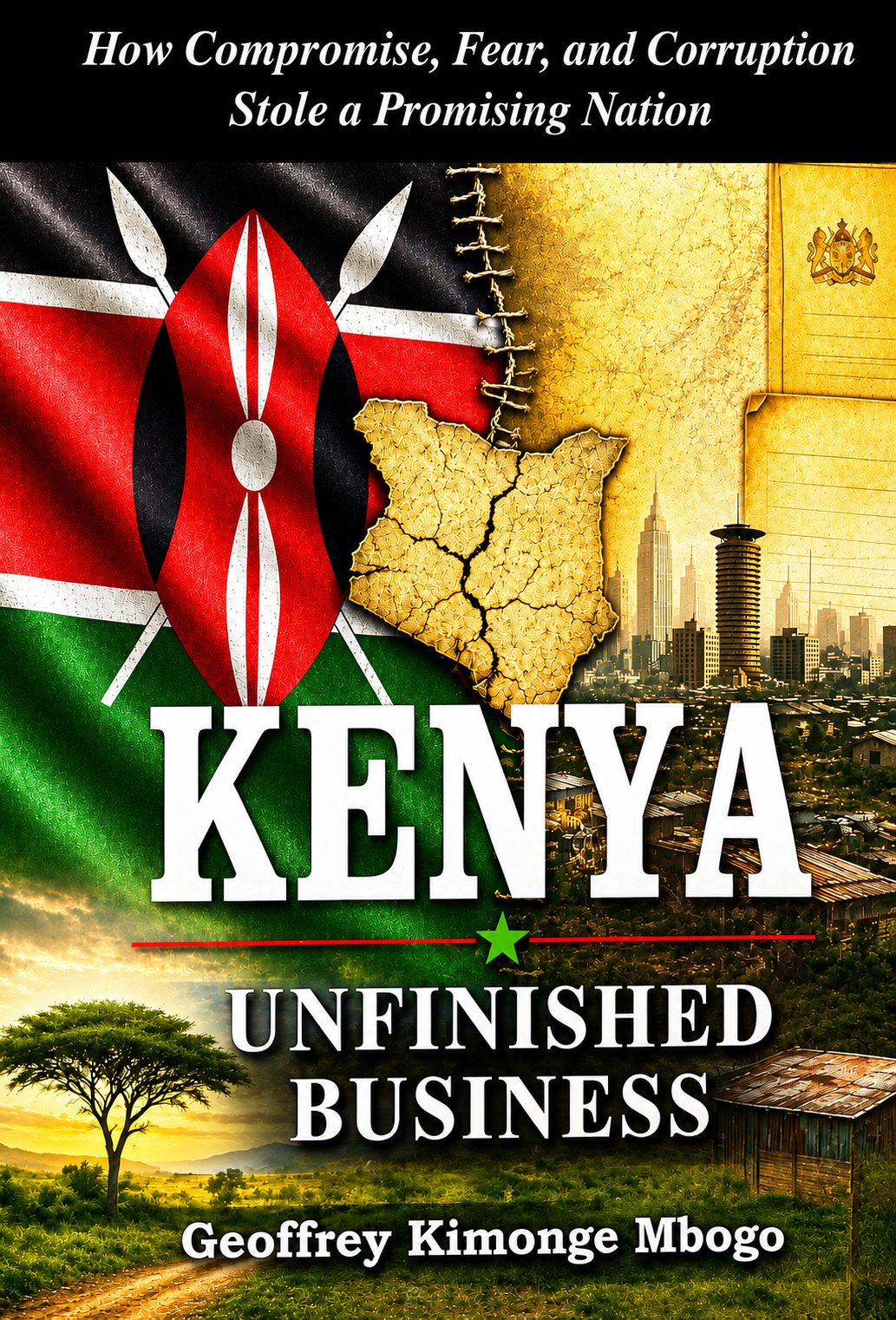

KENYA: UNFINISHED BUSINESS
How Compromise, Fear, and Corruption Stole a Promising Nation
By Geoffrey Kimonge
What if Kenya’s problems did not begin with corruption?
What if the real story began much earlier—at the moment Kenya became independent?
On the night of 12 December 1963, Kenya inherited something precious: political freedom and the power to determine its own destiny. There was enormous hope. Land would be restored. Opportunities would expand. Inequality would fall. A new nation would rise.
But independence changed the flag and the holders of power faster than it changed the structures beneath them.
That is where Kenya: Unfinished Business begins.
This is not simply a book about presidents, elections or scandals. It is a journey into the hidden architecture of Kenya’s past—the decisions, compromises, fears, omissions and institutional habits that quietly shaped the country that exists today.
The first question is uncomfortable:
What did Kenya actually do with independence?
The book takes the reader back to the Lancaster House negotiations, where the foundations of the new Kenya were being negotiated. Political independence was secured, but difficult questions about land, economic power and structural transformation were not fully resolved. Stability was chosen over deeper transformation. Political power changed hands while important economic structures largely survived.
Then came the land question.
A problem that could have been confronted at the beginning became a problem that Kenya repeatedly postponed. Land was not merely property; it was history, identity, economic opportunity and political power. The book traces how unresolved land inequality became one of the foundations upon which later inequalities were built.
But something even more profound happened.
Fear entered the system.
Political assassinations, detention without trial, torture, surveillance and the intimidation of dissent did not simply affect the people directly targeted. They created a culture in which questioning authority could become dangerous.
Universities—places where societies are supposed to challenge ideas—came under pressure. Intellectual curiosity could become caution. Institutions learned to survive rather than confront. And eventually, silence could become normal. The book argues that when a nation begins to constrain not only behaviour but the freedom to think, the economic consequences can be enormous: innovation declines, mistakes persist and corruption becomes harder to challenge.
Then the system learned another powerful trick:
It did not always have to act. Sometimes, it only had to look away.
The book examines how omission—failure to enforce rules, failure to prosecute, failure to confront wrongdoing—could gradually become a form of power. What begins as non-action can become impunity. Impunity can become expectation. And expectation can become culture.
From there, the story moves into informal power, conflicts of interest and institutional decay.
Corruption stops being presented merely as individual greed and begins to appear as something more disturbing: a system capable of reproducing itself.
The reader is taken through some of Kenya’s most consequential economic scandals, including Goldenberg and Anglo Leasing, and into the deeper question of why accountability repeatedly failed. The book follows the evolution from isolated wrongdoing to systems in which institutions themselves can become vulnerable to capture.
But the consequences do not stop in government offices.
They reach the factory floor.
They reach the classroom.
They reach the job seeker.
They reach the entrepreneur.
They reach the farmer.
They reach the taxpayer.
The book connects institutional weakness to deindustrialization, declining innovation, unemployment and economic stagnation, asking why a country with considerable human talent and economic potential has struggled to convert that potential into transformative development.
And then comes one of the book’s most provocative comparisons.
Kenya was not alone.
At roughly comparable historical moments, countries such as South Korea, Taiwan and Singapore faced serious constraints of their own. Yet they made different institutional and economic choices—particularly concerning land reform, state capacity, industrial policy, education and the alignment of public authority with economic transformation. Their trajectories began to diverge dramatically within a generation.
So the question changes.
It is no longer:
“Why is Kenya poor?”
It becomes:
“What choices produced the Kenya we have—and what different choices could produce the Kenya we want?”
The book does not argue that Kenya’s destiny was predetermined. Quite the opposite.
Its central message is that Kenya’s trajectory was constructed.
Decisions were made.
Other decisions were postponed.
Some institutions were redesigned.
Others were inherited.
Some injustices were confronted.
Others were deferred.
Some voices were encouraged.
Others were silenced.
And over decades, these choices accumulated into a national structure that became increasingly difficult to change.
The final chapters therefore turn from diagnosis to reconstruction.
The idea of a Second Republic is presented not simply as a change of political leadership, but as an opportunity for structural renewal: institutions that work, rules that are consistently enforced, public and private interests that are properly separated, an economy aligned toward production, education connected to capability, innovation freed from institutional constraints, debt connected to productivity and an informal economy brought into a more productive formal system.
And this is where the book becomes more than an examination of Kenya’s past.
It becomes a question for every Kenyan generation.
The generation of 1963 inherited one set of choices.
The present generation has inherited their consequences.
The next generation will inherit ours.
The book’s final challenge is therefore simple but profound:
Kenya’s story is unfinished.
The structures that produced today’s problems were built over time. They can therefore be understood, challenged and reconstructed.
The future is not guaranteed.
But neither is it lost.
Kenya has not run out of potential. Kenya has unfinished business.
And the question history now places before us is no longer merely:
“What did we do with independence?”
It is:
“What will we do with what remains unfinished?”












Reviews
Clear filtersThere are no reviews yet.