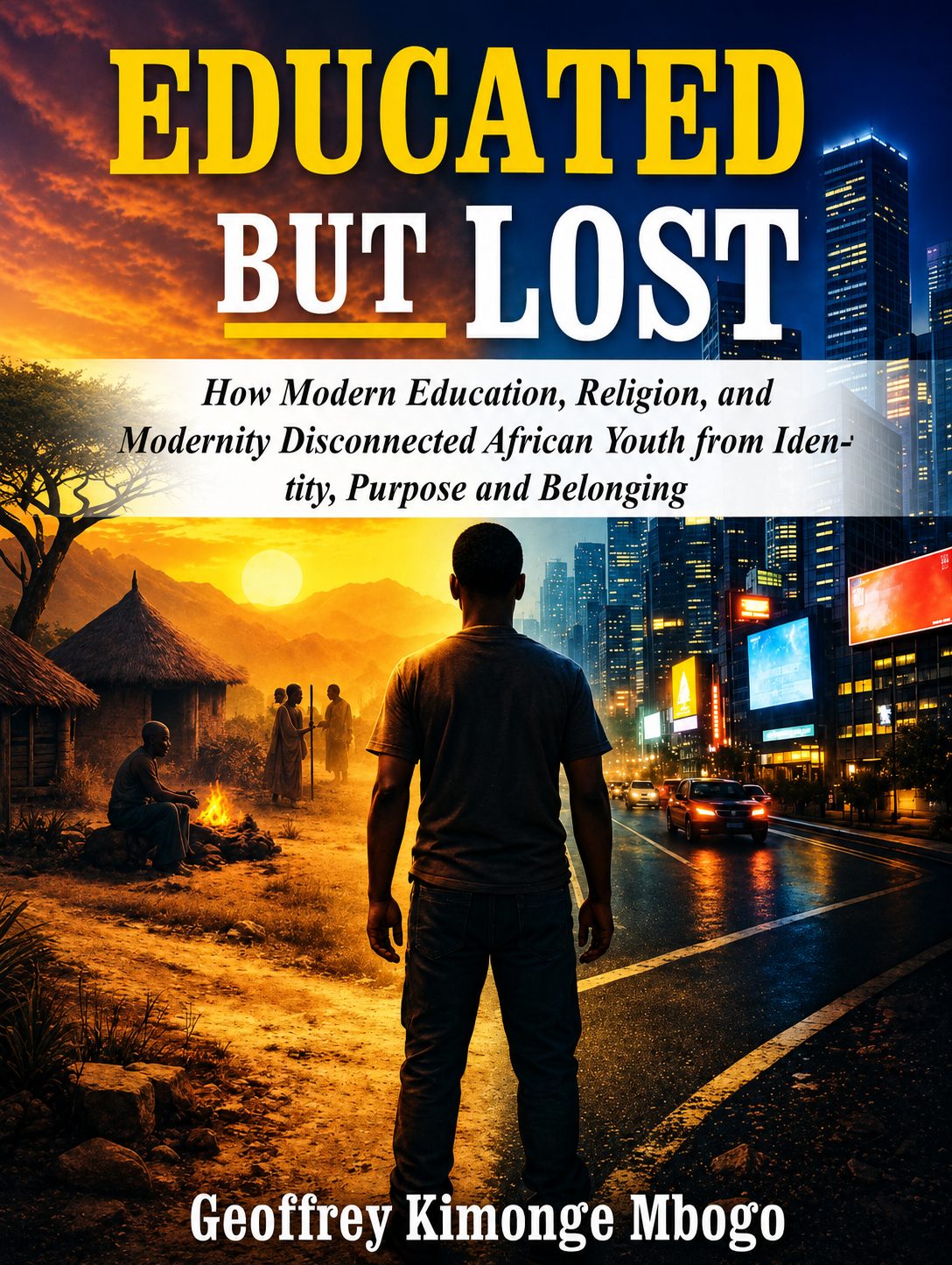
EDUCATED BUT LOST
By: Geoffrey Kimonge Mbogo
How Modern Education, Religion, and Modernity Disconnected African Youth from Identity, Purpose and Belonging
What if the greatest crisis facing African youth is not a lack of education—but a lack of formation?
Africa has never had a more educated, connected and globally exposed generation. Yet, beneath the qualifications, smartphones, ambitions and pursuit of success lies a troubling question:
Why are so many young people educated—but still searching for identity, direction, purpose and belonging?
In Educated but Lost, Geoffrey Kimonge Mbogo takes the reader on a provocative journey from the African village to the modern city, from the wisdom of elders to the influence of algorithms, and from traditional systems of becoming to today’s fragmented search for identity.
Using the Taita age-set system as a powerful African lens, the book reveals how earlier African societies deliberately formed people—giving them identity, responsibility, values, community and a recognized pathway into adulthood. Modern systems brought education, opportunity, religion, technology and global connectivity, but often failed to replace the deeper structures of formation they displaced.
The consequences are everywhere: educated but disoriented; connected but lonely; ambitious but unanchored; free but uncertain about who they are becoming.
But this is not a book of blame.
It does not tell Africa to reject education, abandon religion or run back into the past. Instead, it asks a much more exciting question:
Can Africa take the best of modernity without losing itself?
Through twelve thought-provoking chapters, Mbogo challenges conventional ideas about education, success, progress, spirituality, identity, culture, gender roles and technology. He argues that Africa’s future depends not simply on producing more graduates, building more cities or becoming more technologically advanced—but on rebuilding systems that form grounded, purposeful and responsible human beings.
The solution is not restoration of the past.
It is reconstruction of the future.
The book calls for a new African approach to formation—one that reconnects education with identity, technology with human connection, spirituality with character, success with contribution, and modern progress with cultural memory.
And its final message is deeply hopeful:
Africa is not empty.
Africa is not starting from zero.
Africa is not lost.
Africa is disconnected.
What has been interrupted can be rebuilt.
What has been forgotten can be remembered.
And what has been lost can become the foundation for something new.
Educated but Lost is more than a book about African youth. It is a mirror for a generation—and a challenge to parents, educators, leaders and societies to ask what kind of human beings we are actually producing.
Read it. Question it. Let it challenge you.
Because the most important question is not:
“What have you achieved?”
It is:
“Who have you become?”