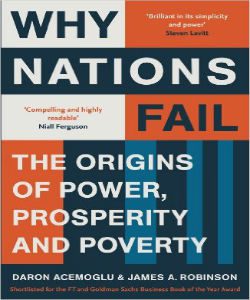
Brilliant and engagingly written, Why Nations Fail answers the question that has stumped the experts for centuries: Why are some nations rich and others poor, divided by wealth and poverty, health and sickness, food and famine? Is it culture, the weather, geography?
Perhaps ignorance of what the right policies are? Simply, no. None of these factors is either definitive or destiny. Otherwise, how to explain why Botswana has become one of the fastest growing countries in the world, while other African nations, such as Zimbabwe, the Congo, and Sierra Leone, are mired in poverty and violence?
Daron Acemoglu and James Robinson conclusively show that it is man-made political and economic institutions that underlie economic success (or lack of it). Korea, to take just one of their fascinating examples, is a remarkably homogeneous nation, yet the people of North Korea are among the poorest on earth while their brothers and sisters in South Korea are among the richest. The south forged a society that created incentives, rewarded innovation, and allowed everyone to participate in economic opportunities.
The economic success thus spurred was sustained because the government became accountable and responsive to citizens and the great mass of people. Sadly, the people of the north have endured decades of famine, political repression, and very different economic institutions—with no end in sight. The differences between the Koreas is due to the politics that created these completely different institutional trajectories.
Based on fifteen years of original research Acemoglu and Robinson marshall extraordinary historical evidence from the Roman Empire, the Mayan city-states, medieval Venice, the Soviet Union, Latin America, England, Europe, the United States, and Africa to build a new theory of political economy with great relevance for the big questions of today, including: - China has built an authoritarian growth machine.
Will it continue to grow at such high speed and overwhelm the West? - Are America’s best days behind it? Are we moving from a virtuous circle in which efforts by elites to aggrandize power are resisted to a vicious one that enriches and empowers a small minority? - What is the most effective way to help move billions of people from the rut of poverty to prosperity?
More philanthropy from the wealthy nations of the West? Or learning the hard-won lessons of Acemoglu and Robinson’s breakthrough ideas on the interplay between inclusive political and economic institutions? Why Nations Fail will change the way you look at—and understand—the world."




























Nancy Kemuma –
There’s something unsettling about a story that refuses to explain itself too early. ‘Deportee’ leans into that discomfort and makes it its backbone.
From the very beginning, you’re dropped into a world where connections exist, but clarity doesn’t. Kim, Brad, and Mothoni, meet in the United States under circumstances that feel deliberately blurred, almost like the author is daring you to sit with uncertainty instead of rushing toward answers.
And that’s where the book earns its keep.
At its core, ‘Deportee’ goes beyond migration and the physical act of being sent back. It’s majorly about unraveling. Relationships and histories unravel. Even identity begins to feel like something that can shift depending on what is revealed, and more importantly, what has been hidden.
The friendships themselves are intriguing because they feel layered. There is a sense that each character is holding something back, carrying private truths that don’t quite align with the version of themselves presented to the group. The author uses this tension effectively.
Then come the deportations.
One by one, the characters are forced out of the United States, and this is where the emotional weight of the story sharpens.
Deportation here is personal, disruptive, and deeply humbling. Each return feels less like a journey home and more like an exposure, as though the characters are being stripped of the lives they constructed and returned to versions of themselves they thought they had outgrown.
The reunion at the local drinking joint is particularly striking. There is tension, discomfort, and the realization that time and truth have changed these people in ways that cannot be undone.
One of the book’s strengths lies in its use of suspense and foreshadowing. There is a constant sense that something is coming, that certain details are not accidental.
The author plants questions early and lets them linger. Why did these individuals really come together? What binds them beyond surface-level friendship? And perhaps most compelling of all, what are they running from?
Equally powerful is the use of what could be described as narrative ”backtracking” or reflective revelation. Just when you think you understand a character or a moment, the story circles back and reframes it. New information sheds different light on past events, forcing you to reconsider your assumptions.
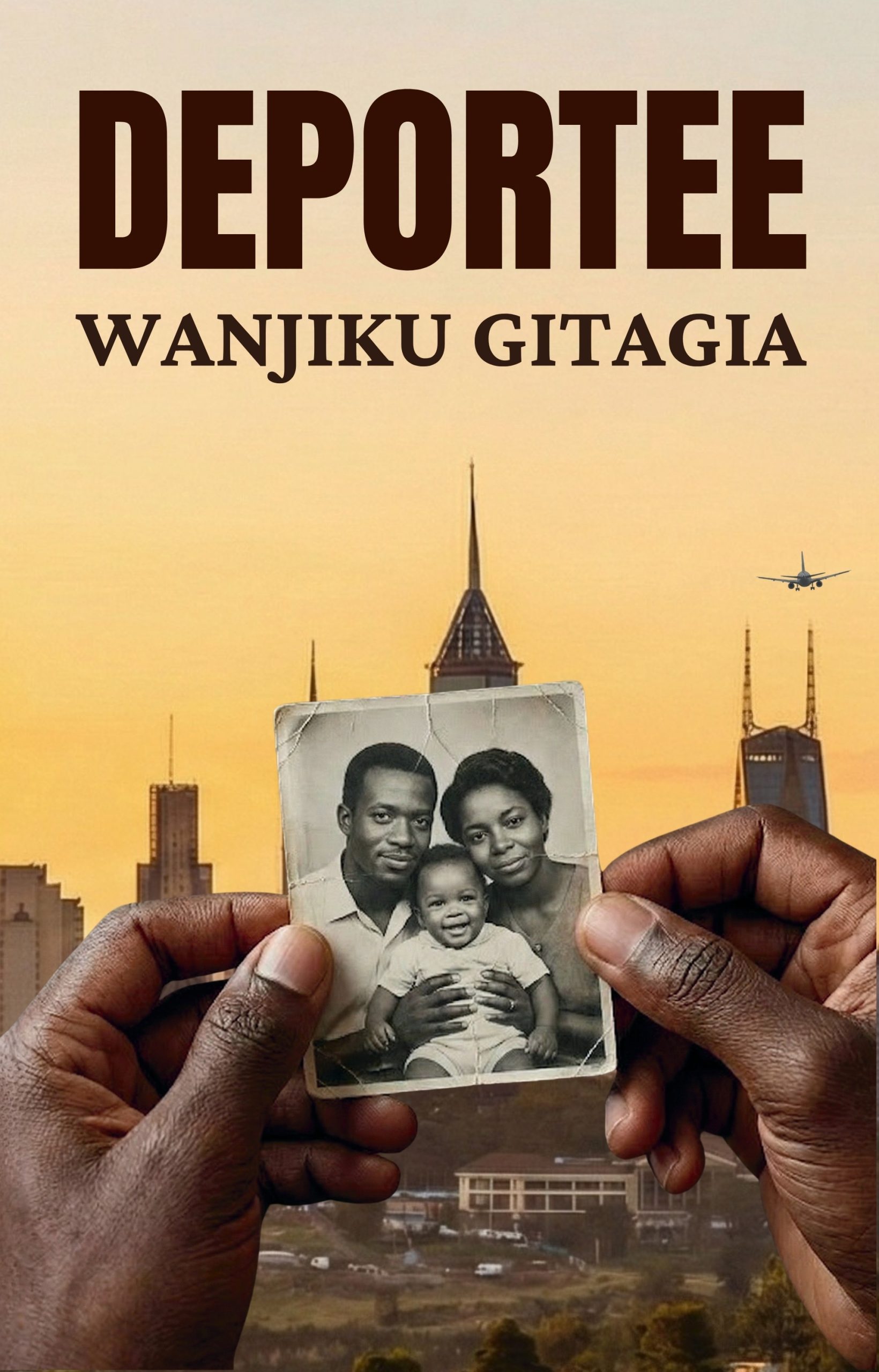
The mystery surrounding the people on the book’s cover is another thoughtful touch. It becomes part of the reading experience. Many times, I found myself glancing back at it, trying to match faces to personalities, searching for clues.
Bennet –
Who Are You When the Dream Dies?
There is a particular kind of grief that comes not from losing someone, but from losing the version of yourself you were supposed to become. Mary understands this grief intimately, and in Deportee, she excavates it with surgical precision.
Kim arrives back in Kenya the way no one wants to return not in triumph, but in the wreckage of a deported life. The American Dream, that seductive promise that has swallowed so many young Kenyans whole, has spat him out. And what waits for him at home is no consolation: a mother whose coldness is its own kind of abandonment, a country that has moved on without him, and a silence where his sense of self used to be.
Kim’s homecoming is not a healing not at first. It is a confrontation. The Kenya he returns to holds a mirror up to him, and the reflection is uncomfortable. Who is he without the ambition that defined him? Without the country he was building himself toward? Without the future he promised his family?
The answer, it turns out, is buried in the past.
What begins as a story of failure quietly transforms into something far more a mystery of origins. An old family photograph becomes the thread Kim pulls, and what unravels is a web of secrets, buried identities, and truths that the people closest to him chose, deliberately, to keep hidden.
His two friends serve as anchors in the chaos witnesses to a man reconstructing himself from pieces he didn’t know existed. Gitagia’s prose is restrained where it needs to be and visceral where it counts. She writes belonging not as a feeling but as a reckoning something you have to earn through the painful work of knowing where, and who, you actually come from.
Deportee asks a quiet but devastating question: what if the identity you’ve been chasing was never yours to begin with?
Mwangi T –
It’s an enjoyable read. It hits home with all the feels. It’ll thrill you and at some point it’ll depress you. Love, betrayal, crime, family dynamics, shattered dreams, drama and anything you can think of, you’ll find it there. Wanjiku weaves a story that will leave you yearning for a bit more when you turn that last page.
Alexander Mugi –
Honestly, I didn’t know what to expect when I first started reading it. The story twists and turns and had cliff hangers I frankly didn’t expect in the slightest. It’s a beautiful read and I highly recommend it to anyone who enjoys a good book.
Alexander Mugi –
Honestly, I didn’t know what to expect when I first started reading it. The story twists and turns and had cliff hangers I frankly didn’t expect in the slightest. It’s a beautiful read and I highly recommend it to anyone who enjoys a good book
Literature Guru –
Deportee is one of those stories that does not rush to impress you. It begins quietly, almost cautiously, and you might wonder where it is taking you. Then somewhere around Chapter Eight, everything shifts. The tension tightens. The revelations begin to unfold. And before you realize it, you are completely invested.
Wanjiku lets us see the world through Kim, and that choice makes the story deeply personal. Kim grows up in what looks like privilege, but inside his home there is grief, distance, and unspoken pain after his father’s death. His mother’s bitterness hangs in the air, shaping him in ways he does not even understand at first. You feel how that environment slowly builds the cracks in him.
When Kim leaves for the United States, it feels like escape and promise wrapped together. He carries ambition, expectation, and the quiet desire to prove himself. But life abroad is not kind. The pressure builds slowly. Loneliness creeps in. Depression settles over him like a weight he cannot shake off. Dropping out of college is not recklessness. It is the result of an internal battle he is losing day by day. That part of the story feels painfully real.
In the midst of this, he finds Muthoni and Brad. Their friendship is not shallow or convenient. Yes, it is born out of struggle, but it is genuine. Each of them is fighting his own demons. They understand one another without needing too many words. There is honesty in their bond, a kind of loyalty that only comes from shared hardship. Their connection gives the novel warmth in the middle of uncertainty.
When deportation happens, it feels like the final blow. Yet it becomes something else entirely.
Back in Kenya, Kim cannot run anymore. Family complications rise to the surface. Ambition collides with reality. Old wounds reopen. Wealth, inheritance, and quiet family power plays begin to unravel. The story shifts from survival abroad to confrontation at home.
At its heart, this is a story about the cost of becoming. It is about ambition and the weight it carries. It is about friendship that survives storms. It is about family, with all its complications and hidden battles. And most of all, it is about discovery. Discovering who you are when everything you leaned on falls away.
After taking us across countries and through a dramatic Nairobi, the novel settles in a luxurious hotel in Narok, overlooking the majestic Maasai Mara.
Highly recommended.
Wangari –
Raw, captivating, authentically Kenyan,a book that refuses to let you go