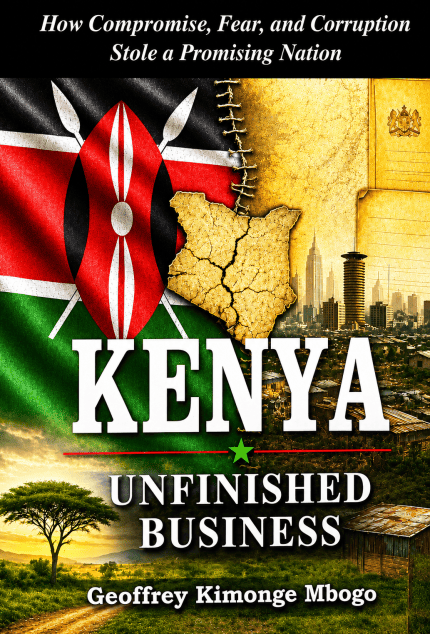
KENYA: UNFINISHED BUSINESS
How Compromise, Fear, and Corruption Stole a Promising Nation
By Geoffrey Kimonge
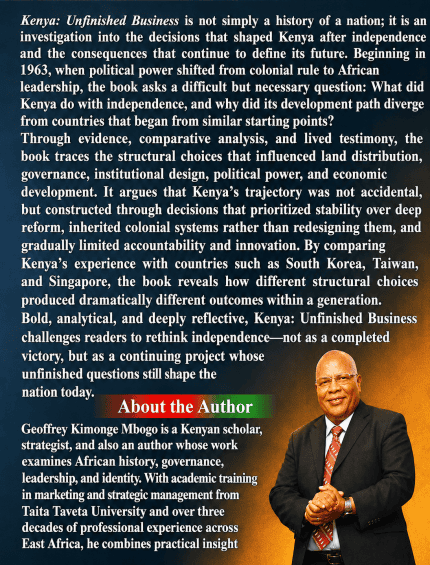
Kenya: Unfinished Business is a searching examination of Kenya’s journey from independence in 1963 to the present. Rather than offering another chronological account of political events or a catalogue of national failures, the book asks a deeper question: Why did Kenya follow the path it did, and why have many of its problems persisted despite decades of political change, economic growth and reform?
The book’s central argument is that Kenya’s trajectory was constructed—not accidental. Independence transferred political power, but it did not fundamentally transform many of the economic, institutional and administrative structures inherited from colonial rule. Early choices made in the name of stability, continuity and political survival created consequences that accumulated across generations.
At the heart of the analysis is the Kenya Structural Persistence Model (KSPM), which connects inherited structures, early policy choices, reinforcing institutional behaviours and long-term national outcomes. The book traces a chain beginning with the compromises surrounding independence and the Lancaster House settlement, followed by unresolved land inequality, political fear and repression, institutional omission, informal power, conflicts of interest, corruption, institutional decay, economic stagnation, deindustrialization, weakened innovation, political limitations and mounting debt.
A particularly important dimension of the book is its examination of fear as an economic and institutional force. Assassinations, detention, torture, surveillance and pressure on universities and other institutions did more than silence political dissent; the book argues that they constrained intellectual freedom, discouraged questioning and weakened the capacity for innovation and institutional correction.
The book also places Kenya in comparative perspective, particularly alongside South Korea, Taiwan and Singapore. These countries faced significant constraints at comparable stages of their development but made different choices concerning land reform, institutional design, state capacity, industrial policy and economic alignment. The comparison is used not to suggest that Kenya could simply copy Asia, but to demonstrate that different choices within difficult circumstances can produce dramatically different trajectories.
Yet Kenya: Unfinished Business is not a book about blame. It is a book about understanding. Its premise is that reforms aimed only at symptoms will remain incomplete unless the structures producing those symptoms are understood and confronted.
The final section turns from diagnosis to possibility. Kenya’s Second Republic, as envisioned in the book, requires structural reconstruction: credible institutions, consistent enforcement, productive alignment between government and the economy, cognitive freedom, disciplined development policy, responsible borrowing and the formalization of informal systems.
The book ultimately leaves Kenya with a generational question: What will we do with what remains unfinished? Its answer is neither despair nor easy optimism. Kenya’s past was constructed through choices, omissions and institutions—and therefore its future can also be reconstructed through deliberate choices, institutional discipline and political will.
Kenya: Unfinished Business is therefore both a diagnosis of how a promising nation drifted from its early possibilities and a call to understand the structures that must change if Kenya is to complete the promise of independence.