Synopsis of Educated but Lost
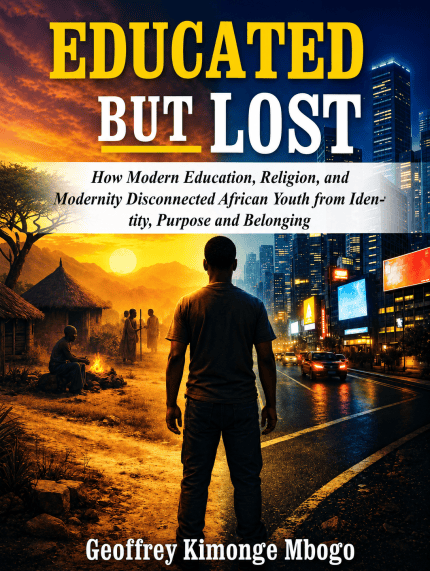
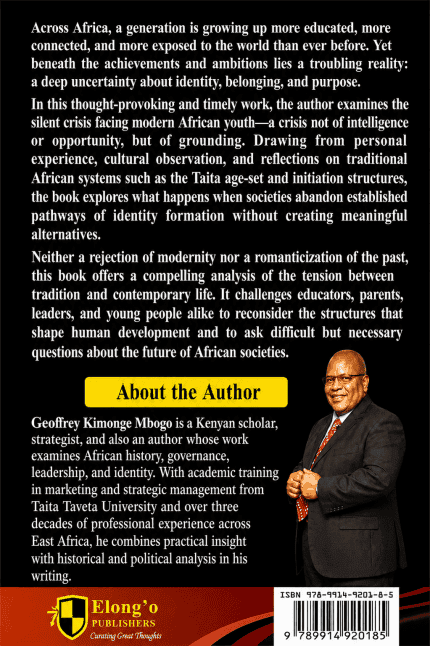
Educated but Lost: How Modern Education, Religion, and Modernity Disconnected African Youth from Identity, Purpose and Belonging is a searching examination of one of Africa’s most profound contemporary contradictions: a generation that is increasingly educated, connected and exposed to opportunity, yet increasingly uncertain about who it is, where it belongs and what it is becoming.
At the heart of Geoffrey Kimonge Mbogo’s argument is the distinction between growing and becoming. The book contends that African societies once possessed structured systems that deliberately guided young people from childhood into responsible adulthood. Using the Taita age-set system (irika) as its principal cultural lens, it shows how initiation, community responsibility, elder guidance and clearly defined stages of life provided young people with identity, purpose and belonging.
The disruption came through a combination of colonialism, modern education, institutional religion and the uncritical adoption of modernity. Schools increasingly replaced traditional systems of initiation; churches replaced indigenous forms of spiritual formation; individual achievement displaced communal identity; and, increasingly, digital platforms have taken the place of intergenerational guidance. Yet, the book argues, these modern replacements have not adequately supplied the formation systems they displaced. They provide information, belief, skills and opportunity—but often fail to provide identity, purpose and a structured transition into adulthood.
The result is the condition captured by the title: young Africans can be educated but disoriented, connected but lonely, and free but unanchored. Their restlessness, rebellion, withdrawal, addiction and identity struggles are therefore presented not simply as failures of individual character, but as symptoms of a deeper crisis of formation.
The book then examines the problem from several interconnected dimensions. It interrogates modern schooling as a potential form of cultural alienation; questions whether institutional religion always produces moral and personal transformation; explores the disappearance of initiation and the resulting phenomenon of “permanent adolescence”; and challenges the modern definition of success in which achievement, wealth and status can replace meaning, responsibility and contribution. Its broader chapters examine colonial mental reprogramming, the erosion of African value systems, the myth of modernity as automatic progress, social media and algorithmic identity, and the contemporary crisis surrounding masculinity, femininity and social roles.
Importantly, Educated but Lost is not an argument against education, religion or modernity. Nor is it a romantic call to return blindly to the past. Instead, it asks what can be learned from African systems of formation and how their underlying principles can be reconstructed for contemporary life. The book explicitly calls for critical engagement with both tradition and modernity.
Its proposed way forward is therefore reconstruction rather than restoration. The book advocates identity education, mentorship, stronger intergenerational relationships, purposeful transition into adulthood, education that integrates identity, renewed attention to African languages and cultural memory, a redefinition of success around identity and contribution, spirituality that genuinely forms character, and technology that serves human connection rather than becoming a substitute for it.
Ultimately, the book's message is one of hope and responsibility. Africa is not starting from nothing; it still possesses cultural memory, philosophical traditions and communal resources from which new systems of formation can be built. Progress, the author argues, should no longer be measured merely by speed, accumulation, infrastructure or technological advancement, but by alignment, stability, meaning and direction.
The closing message is powerful: Africa has not completely lost itself; it has become disconnected from many of the systems that once gave identity, meaning and direction. The task of the present generation is therefore not to abandon modernity, nor to live in the past, but to reconnect with its roots, critically reclaim what remains valuable, and intentionally build new systems capable of forming future generations.
In essence, Educated but Lost asks a deceptively simple question:
What good is education if it teaches us how to succeed in the world but never teaches us who we are, where we belong, why we exist, and what we should become?
And its answer is equally direct: Africa does not merely need more educated people. It needs systems that form whole human beings.