











ENJOY FREE DELIVERY WITHIN NAIROBI FOR ORDERS ABOVE 10,000
Nuria App
Kenyan Shilling (KSh)
  • Kenyan Shilling (KSh)
  • United States (US) dollar ($)
  • Pound sterling (£)
  • Ugandan Shilling (UGX)
0 Wishlist
Login / Register
  • Home
  • Shop
  • Kenyan Books
  • Rare Books
  • Gift Card
  • Blog
  • Contact Us
  • SELL ON NURIA
  • VENDOR LOGIN
Menu
0 items KShs0.00
Browse Categories
  • Kenya Books
  • Rare Books
  • International Bestsellers
  • Self Help & Motivation
  • Fiction
  • Autobiography
  • Business
  • Children’s Books
  • Kids & Teens
  • African Interest
  • Educational Books
  • Romances & Thrillers
HELP / SUPPORT

0794 233 261

0 items KShs0.00
-9%
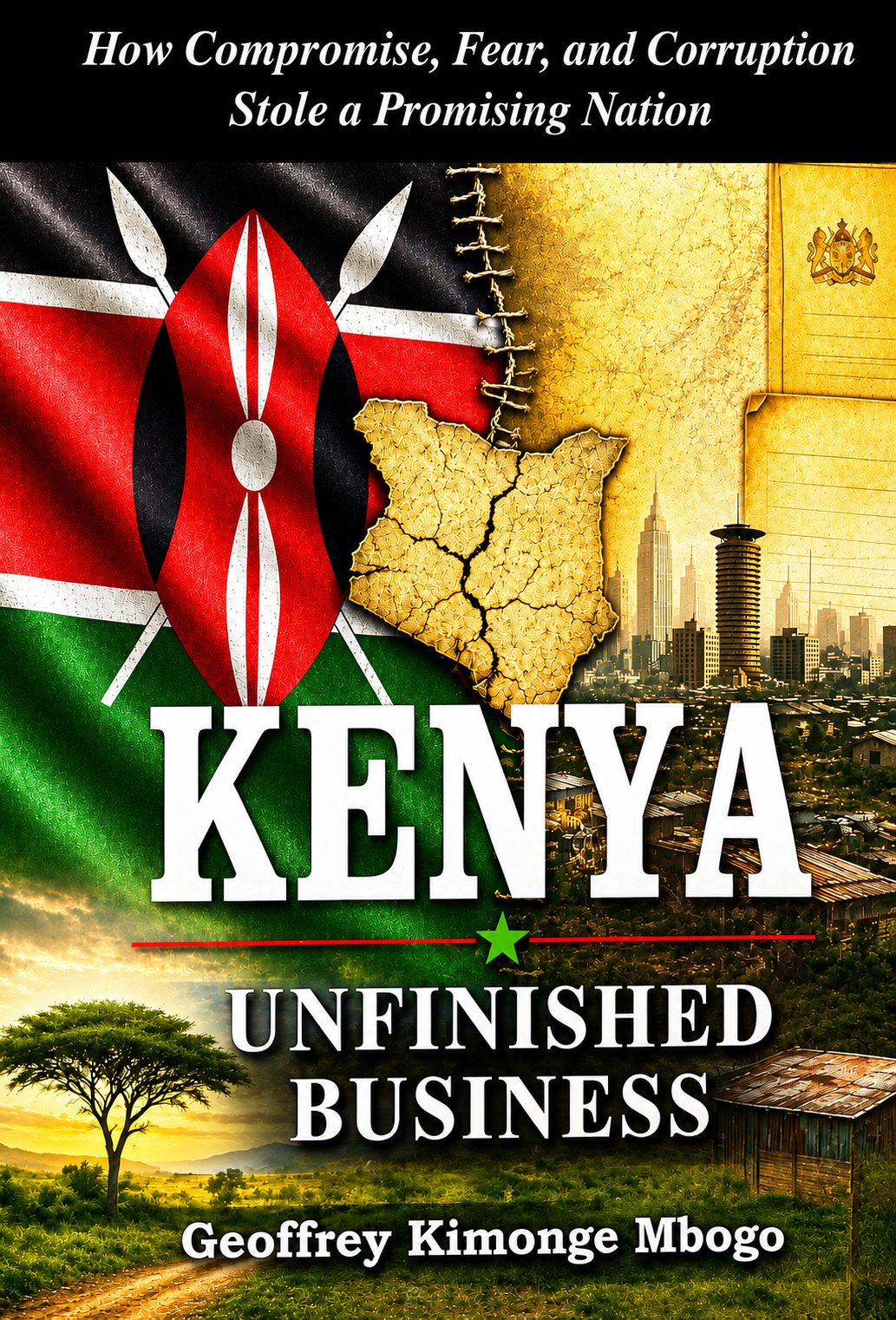
KENYA: UNFINISHED BUSINESS
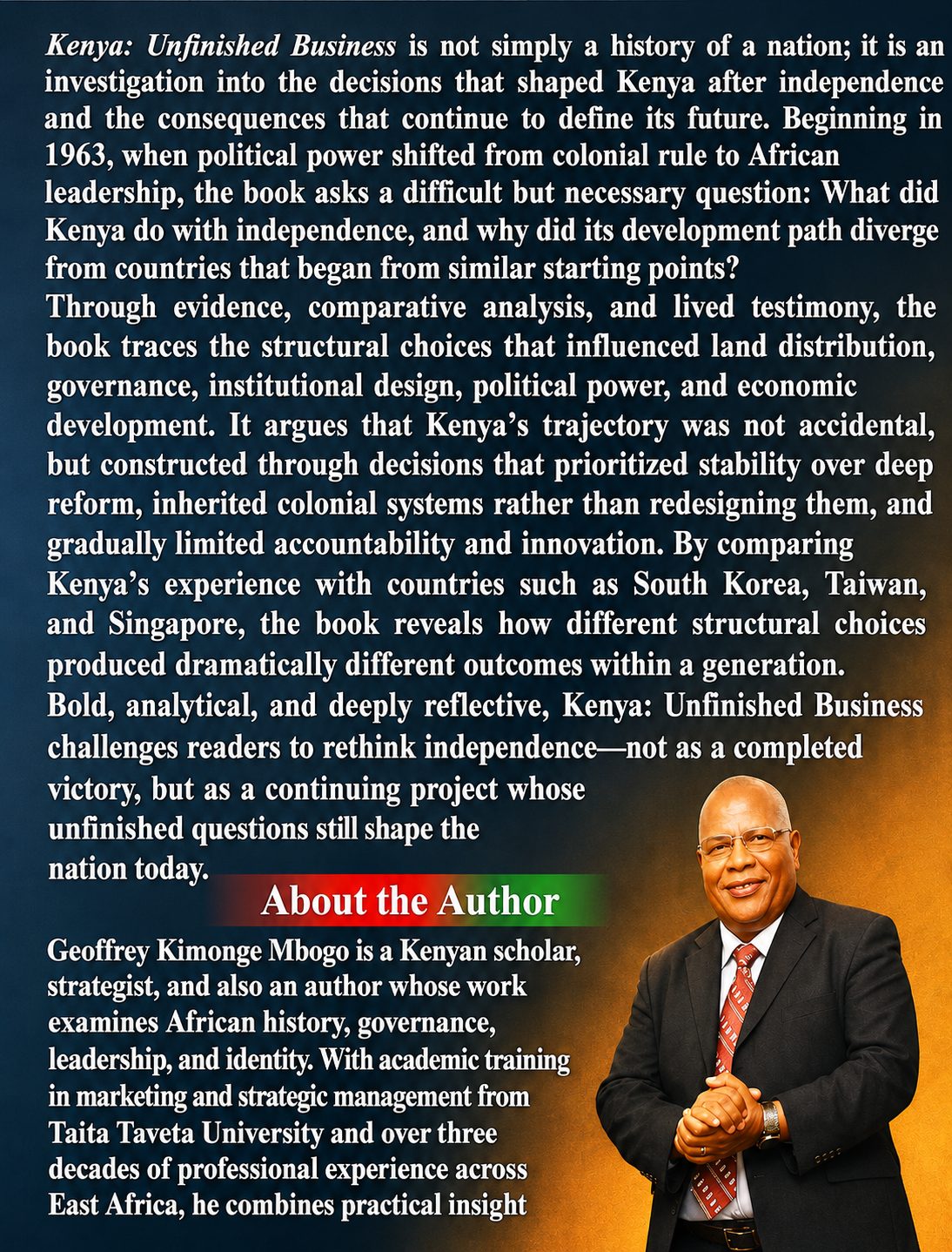
Back Cover
Click to enlarge
KENYA: UNFINISHED BUSINESS
Back Cover
Home Books Governance KENYA: UNFINISHED BUSINESS – How Compromise, Fear, and Corruption Stole a Promising Nation
Rooted: Life lessons from the Natural world by Carol Wanjeru KShs2,000.00
Back to products
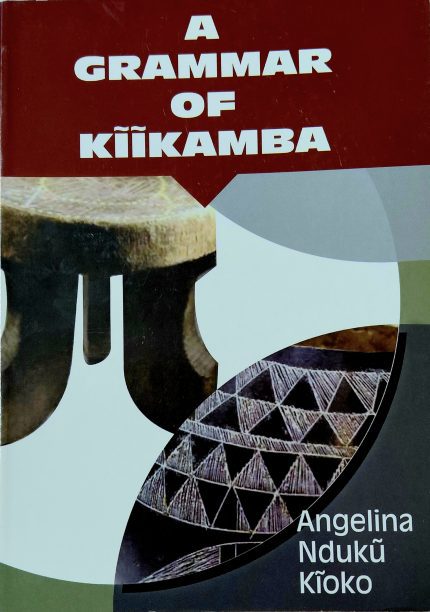
A Grammar Of Kiikamba By Angelina Nduku Kioko KShs850.00 KShs650.00

KENYA: UNFINISHED BUSINESS – How Compromise, Fear, and Corruption Stole a Promising Nation

KShs2,200.00 KShs2,000.00

Nuria Ranking: #88 in Governance

KENYA: UNFINISHED BUSINESS
How Compromise, Fear, and Corruption Stole a Promising Nation

By Geoffrey Kimonge

Kenya: Unfinished Business is a searching examination of Kenya’s journey from independence in 1963 to the present. Rather than offering another chronological account of political events or a catalogue of national failures, the book asks a deeper question: Why did Kenya follow the path it did, and why have many of its problems persisted despite decades of political change, economic growth and reform?

The book’s central argument is that Kenya’s trajectory was constructed—not accidental. Independence transferred political power, but it did not fundamentally transform many of the economic, institutional and administrative structures inherited from colonial rule. Early choices made in the name of stability, continuity and political survival created consequences that accumulated across generations.

At the heart of the analysis is the Kenya Structural Persistence Model (KSPM), which connects inherited structures, early policy choices, reinforcing institutional behaviours and long-term national outcomes. The book traces a chain beginning with the compromises surrounding independence and the Lancaster House settlement, followed by unresolved land inequality, political fear and repression, institutional omission, informal power, conflicts of interest, corruption, institutional decay, economic stagnation, deindustrialization, weakened innovation, political limitations and mounting debt.

A particularly important dimension of the book is its examination of fear as an economic and institutional force. Assassinations, detention, torture, surveillance and pressure on universities and other institutions did more than silence political dissent; the book argues that they constrained intellectual freedom, discouraged questioning and weakened the capacity for innovation and institutional correction.

The book also places Kenya in comparative perspective, particularly alongside South Korea, Taiwan and Singapore. These countries faced significant constraints at comparable stages of their development but made different choices concerning land reform, institutional design, state capacity, industrial policy and economic alignment. The comparison is used not to suggest that Kenya could simply copy Asia, but to demonstrate that different choices within difficult circumstances can produce dramatically different trajectories.

Yet Kenya: Unfinished Business is not a book about blame. It is a book about understanding. Its premise is that reforms aimed only at symptoms will remain incomplete unless the structures producing those symptoms are understood and confronted.

The final section turns from diagnosis to possibility. Kenya’s Second Republic, as envisioned in the book, requires structural reconstruction: credible institutions, consistent enforcement, productive alignment between government and the economy, cognitive freedom, disciplined development policy, responsible borrowing and the formalization of informal systems.

The book ultimately leaves Kenya with a generational question: What will we do with what remains unfinished? Its answer is neither despair nor easy optimism. Kenya’s past was constructed through choices, omissions and institutions—and therefore its future can also be reconstructed through deliberate choices, institutional discipline and political will.

Kenya: Unfinished Business is therefore both a diagnosis of how a promising nation drifted from its early possibilities and a call to understand the structures that must change if Kenya is to complete the promise of independence.

Add KShs10,000.00 worth of products to your cart for free delivery within Nairobi!
Add to wishlist
Categories: Books, Governance Tags: App Only, E-Book
Share:
Close
  • Description
  • Shipping
  • Reviews (0)
  • Vendor Info
  • More Products
Description

 KENYA: UNFINISHED BUSINESS

How Compromise, Fear, and Corruption Stole a Promising Nation

By Geoffrey Kimonge

What if Kenya’s problems did not begin with corruption?

What if the real story began much earlier—at the moment Kenya became independent?

On the night of 12 December 1963, Kenya inherited something precious: political freedom and the power to determine its own destiny. There was enormous hope. Land would be restored. Opportunities would expand. Inequality would fall. A new nation would rise.

But independence changed the flag and the holders of power faster than it changed the structures beneath them.

That is where Kenya: Unfinished Business begins.

This is not simply a book about presidents, elections or scandals. It is a journey into the hidden architecture of Kenya’s past—the decisions, compromises, fears, omissions and institutional habits that quietly shaped the country that exists today.

The first question is uncomfortable:

What did Kenya actually do with independence?

The book takes the reader back to the Lancaster House negotiations, where the foundations of the new Kenya were being negotiated. Political independence was secured, but difficult questions about land, economic power and structural transformation were not fully resolved. Stability was chosen over deeper transformation. Political power changed hands while important economic structures largely survived.

Then came the land question.

A problem that could have been confronted at the beginning became a problem that Kenya repeatedly postponed. Land was not merely property; it was history, identity, economic opportunity and political power. The book traces how unresolved land inequality became one of the foundations upon which later inequalities were built.

But something even more profound happened.

Fear entered the system.

Political assassinations, detention without trial, torture, surveillance and the intimidation of dissent did not simply affect the people directly targeted. They created a culture in which questioning authority could become dangerous.

Universities—places where societies are supposed to challenge ideas—came under pressure. Intellectual curiosity could become caution. Institutions learned to survive rather than confront. And eventually, silence could become normal. The book argues that when a nation begins to constrain not only behaviour but the freedom to think, the economic consequences can be enormous: innovation declines, mistakes persist and corruption becomes harder to challenge.

Then the system learned another powerful trick:

It did not always have to act. Sometimes, it only had to look away.

The book examines how omission—failure to enforce rules, failure to prosecute, failure to confront wrongdoing—could gradually become a form of power. What begins as non-action can become impunity. Impunity can become expectation. And expectation can become culture.

From there, the story moves into informal power, conflicts of interest and institutional decay.

Corruption stops being presented merely as individual greed and begins to appear as something more disturbing: a system capable of reproducing itself.

The reader is taken through some of Kenya’s most consequential economic scandals, including Goldenberg and Anglo Leasing, and into the deeper question of why accountability repeatedly failed. The book follows the evolution from isolated wrongdoing to systems in which institutions themselves can become vulnerable to capture.

But the consequences do not stop in government offices.

They reach the factory floor.

They reach the classroom.

They reach the job seeker.

They reach the entrepreneur.

They reach the farmer.

They reach the taxpayer.

The book connects institutional weakness to deindustrialization, declining innovation, unemployment and economic stagnation, asking why a country with considerable human talent and economic potential has struggled to convert that potential into transformative development.

And then comes one of the book’s most provocative comparisons.

Kenya was not alone.

At roughly comparable historical moments, countries such as South Korea, Taiwan and Singapore faced serious constraints of their own. Yet they made different institutional and economic choices—particularly concerning land reform, state capacity, industrial policy, education and the alignment of public authority with economic transformation. Their trajectories began to diverge dramatically within a generation.

So the question changes.

It is no longer:

“Why is Kenya poor?”

It becomes:

“What choices produced the Kenya we have—and what different choices could produce the Kenya we want?”

The book does not argue that Kenya’s destiny was predetermined. Quite the opposite.

Its central message is that Kenya’s trajectory was constructed.

Decisions were made.

Other decisions were postponed.

Some institutions were redesigned.

Others were inherited.

Some injustices were confronted.

Others were deferred.

Some voices were encouraged.

Others were silenced.

And over decades, these choices accumulated into a national structure that became increasingly difficult to change.

The final chapters therefore turn from diagnosis to reconstruction.

The idea of a Second Republic is presented not simply as a change of political leadership, but as an opportunity for structural renewal: institutions that work, rules that are consistently enforced, public and private interests that are properly separated, an economy aligned toward production, education connected to capability, innovation freed from institutional constraints, debt connected to productivity and an informal economy brought into a more productive formal system.

And this is where the book becomes more than an examination of Kenya’s past.

It becomes a question for every Kenyan generation.

The generation of 1963 inherited one set of choices.

The present generation has inherited their consequences.

The next generation will inherit ours.

The book’s final challenge is therefore simple but profound:

Kenya’s story is unfinished.

The structures that produced today’s problems were built over time. They can therefore be understood, challenged and reconstructed.

The future is not guaranteed.

But neither is it lost.

Kenya has not run out of potential. Kenya has unfinished business.

And the question history now places before us is no longer merely:

“What did we do with independence?”

It is:

“What will we do with what remains unfinished?”
Shipping
Reviews (0)
Rated 0 out of 5
0 reviews
Rated 5 out of 5
0
Rated 4 out of 5
0
Rated 3 out of 5
0
Rated 2 out of 5
0
Rated 1 out of 5
0

Reviews

Clear filters

There are no reviews yet.

Be the first to review “KENYA: UNFINISHED BUSINESS – How Compromise, Fear, and Corruption Stole a Promising Nation” Cancel reply

Your email address will not be published. Required fields are marked *


Vendor Info

Vendor Information

  • Store Name: Geoffrey Kimonge Mbogo
  • Vendor: Geoffrey Mbogo
  • No ratings found yet!
More Products
-10%
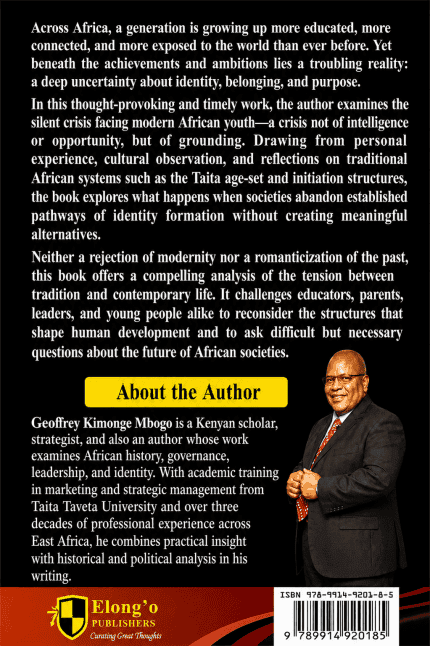
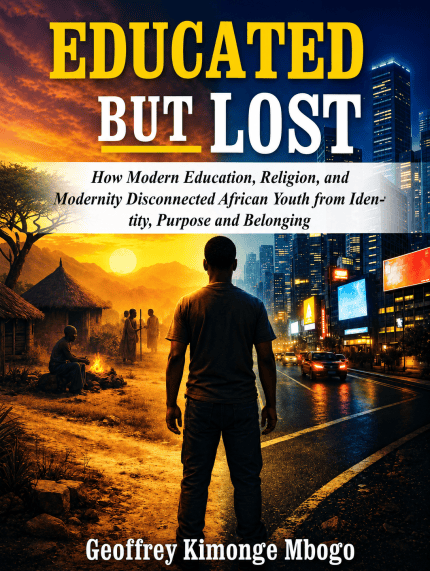
EDUCATED BUT LOST
Back Cover

EDUCATED BUT LOST – How Mordern Education, Religion, and Modernity Disconnected African Youth from Identity, Purpose and Belonging

African Interest
KShs2,000.00 KShs1,800.00
Synopsis of Educated but Lost Educated but Lost: How Modern Education, Religion, and Modernity Disconnected African Youth from Identity, Purpose and Belonging is a searching examination of one of Africa’s most profound contemporary contradictions: a generation that is increasingly educated, connected and exposed to opportunity, yet increasingly uncertain about who it is, where it belongs and what it is becoming. At the heart of Geoffrey Kimonge Mbogo’s argument is the distinction between growing and becoming. The book contends that African societies once possessed structured systems that deliberately guided young people from childhood into responsible adulthood. Using the Taita age-set system (irika) as its principal cultural lens, it shows how initiation, community responsibility, elder guidance and clearly defined stages of life provided young people with identity, purpose and belonging. The disruption came through a combination of colonialism, modern education, institutional religion and the uncritical adoption of modernity. Schools increasingly replaced traditional systems of initiation; churches replaced indigenous forms of spiritual formation; individual achievement displaced communal identity; and, increasingly, digital platforms have taken the place of intergenerational guidance. Yet, the book argues, these modern replacements have not adequately supplied the formation systems they displaced. They provide information, belief, skills and opportunity—but often fail to provide identity, purpose and a structured transition into adulthood. The result is the condition captured by the title: young Africans can be educated but disoriented, connected but lonely, and free but unanchored. Their restlessness, rebellion, withdrawal, addiction and identity struggles are therefore presented not simply as failures of individual character, but as symptoms of a deeper crisis of formation. The book then examines the problem from several interconnected dimensions. It interrogates modern schooling as a potential form of cultural alienation; questions whether institutional religion always produces moral and personal transformation; explores the disappearance of initiation and the resulting phenomenon of “permanent adolescence”; and challenges the modern definition of success in which achievement, wealth and status can replace meaning, responsibility and contribution. Its broader chapters examine colonial mental reprogramming, the erosion of African value systems, the myth of modernity as automatic progress, social media and algorithmic identity, and the contemporary crisis surrounding masculinity, femininity and social roles. Importantly, Educated but Lost is not an argument against education, religion or modernity. Nor is it a romantic call to return blindly to the past. Instead, it asks what can be learned from African systems of formation and how their underlying principles can be reconstructed for contemporary life. The book explicitly calls for critical engagement with both tradition and modernity. Its proposed way forward is therefore reconstruction rather than restoration. The book advocates identity education, mentorship, stronger intergenerational relationships, purposeful transition into adulthood, education that integrates identity, renewed attention to African languages and cultural memory, a redefinition of success around identity and contribution, spirituality that genuinely forms character, and technology that serves human connection rather than becoming a substitute for it. Ultimately, the book's message is one of hope and responsibility. Africa is not starting from nothing; it still possesses cultural memory, philosophical traditions and communal resources from which new systems of formation can be built. Progress, the author argues, should no longer be measured merely by speed, accumulation, infrastructure or technological advancement, but by alignment, stability, meaning and direction. The closing message is powerful: Africa has not completely lost itself; it has become disconnected from many of the systems that once gave identity, meaning and direction. The task of the present generation is therefore not to abandon modernity, nor to live in the past, but to reconnect with its roots, critically reclaim what remains valuable, and intentionally build new systems capable of forming future generations. In essence, Educated but Lost asks a deceptively simple question: What good is education if it teaches us how to succeed in the world but never teaches us who we are, where we belong, why we exist, and what we should become? And its answer is equally direct: Africa does not merely need more educated people. It needs systems that form whole human beings.
Add to wishlist
Read more
Quick view

Related products

-15%

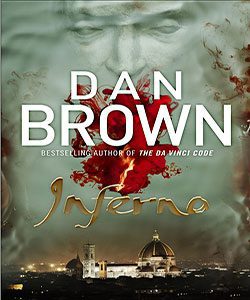
INFERNO BY DAN BROWN

Books, International Bestsellers
KShs1,990.00 KShs1,690.00
In his international blockbusters The Da Vinci Code, Angels & Demons, and The Lost Symbol, Dan Brown masterfully fused history, art, codes, and symbols. In this riveting new thriller, Brown returns to his element and has crafted his highest-stakes novel to date. In the heart of Italy, Harvard professor of symbology Robert Langdon is drawn into a harrowing world centered on one of history’s most enduring and mysterious literary masterpieces . . . Dante’s Inferno. Against this backdrop, Langdon battles a chilling adversary and grapples with an ingenious riddle that pulls him into a landscape of classic art, secret passageways, and futuristic science. Drawing from Dante’s dark epic poem, Langdon races to find answers and decide whom to trust . . . before the world is irrevocably altered." ISBN:804171540 Author:Dan Brown
Add to wishlist
Add to basket
Quick view
-5%

Trusted Advice Your New Baby

Books, Parenting
KShs999.00 KShs950.00
Brief summary Caring for your newborn during the first six months From parenting Guru Dr Miriam Stoppard comes the Trusted Advice series; providing warm and reassuring advice and guidance for every step of the way. With a fresh, contemporary feel and affordable price, these books are perfect for reading cover to cover or to dip in and out of for quick reference. Clear, concise directions show you how to feed, bathe, hold and deal with your baby in a reassuring way. Featuring step-by-step illustrations and photo demonstrations, this book presents essential information as clearly as possible. As well as dealing with key issues such as sleeping, going out and comforting your baby, the book includes information on how girls and boys develop differently and how to adapt care for their individual needs. " ISBN:9781405356527 Author:Miriam Stoppard
Add to wishlist
Add to basket
Quick view
-10%

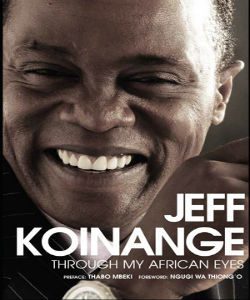
Through My African Eyes by Jeff Koinange

Books, African Interest
Rated 5.00 out of 5
KShs3,890.00 KShs3,500.00
"Through My African Eyes!” is a concise narrative covering some of the major players in 20th century African politics. The book is rich with insights into the personal and intellectual underpinnings of many historical events in Africa. Chronicles of some pretty interesting Africans from warlords, soldiers, victims and politicians lend insight into Jeff’s celebrated journalistic style. Through his eyes we are made to understand the role of journalist’s as binders of our social fabric. "Through My African Eyes” is very informative and quite humorous, utilizing a modern quick precise narrative style. He is able to describe complex global geopolitical issues with incisive analysis. The book surf’s one through the experience with speed and historical accuracy. We see the visual the words impart, rather than being stuck in prose. The best part is being able to walk the journey informed by a largely Kenyan perspective. Jeff outlines clearly how biased reportage can splinter any society and promote its disintegration by pandering to people’s lowest instincts. The narrative draws out lesser-known aspects of his life. Jeff’s unblinking examination of his grandfather’s life is historically illuminating and serves as a symbolic bridge between the beginning and the end of colonialism. Jeff is the first African ever to win a Television Emmy and a George Foster Peabody. He merited the Vernon Jarrett Award as well as the prestigious! ‘Prix Bayeux’ for reportage that arrested global crises."
Add to wishlist
Add to basket
Quick view
-5%

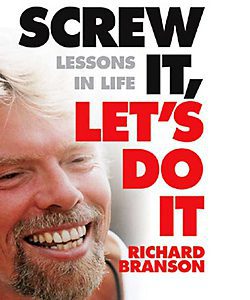
Screw It, Let’s Do It Expanded

Books, Self Help & Motivation
KShs1,495.00 KShs1,421.00
Throughout my life I have achieved many remarkable things. In Screw It, Let's Do It, I will share with you my ideas and the secrets of my success, but not simply because I hope they'll help you achieve your individual goals. Today we are increasingly aware of the effects of our actions on the environment, and I strongly believe that we each have a responsibility, as individuals and organisations, to do no harm. I will draw on Gaia Capitalism to explain why we need to take stock of how we may be damaging the environment, and why it is up to big companies like Virgin to lead the way in a more holistic approach to business. In Screw It, Let's Do It I'll be looking forwards to the future. A lot has changed since I founded Virgin in 1968, and I'll explain how I intend to take my business and my ideas to the next level and the new and exciting areas - such as launching Virgin Fuels - into which Virgin is currently moving. But I have also brought together all the important lessons, good advice and inspirational adages that have helped me along the road to success. Ironically, I have never been one to do things by the book, but I have been inspired and influenced by many remarkable people. I hope that you too might find a little inspiration between these pages." ISBN:753511497 Author:Richard Branson
Add to wishlist
Add to basket
Quick view
-9%

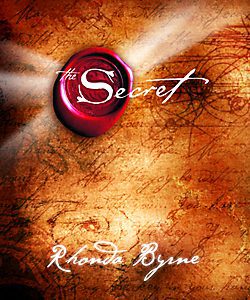
The Secret by Rhonda Byrne

Books, Self Help & Motivation
KShs3,490.00 KShs3,190.00
For the first time, all the pieces of The Secret come together in an incredible revelation that will be life-transforming for all who experience it. In this book, you'll learn how to use The Secret in every aspect of your life -- money, health, relationships, happiness, and in every interaction you have in the world. You'll begin to understand the hidden, untapped power that's within you, and this revelation can bring joy to every aspect of your life. The Secret contains wisdom from modern-day teachers -- men and women who have used it to achieve health, wealth, and happiness. By applying the knowledge of The Secret, they bring to light compelling stories of eradicating disease, acquiring massive wealth, overcoming obstacles, and achieving what many would regard as impossible.
Add to wishlist
Add to basket
Quick view
-5%Sold out

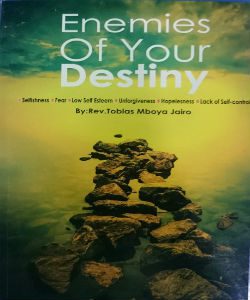
Enemies of your Destiny

Books, Religion & Spiritual
KShs650.00 KShs618.00
The journey towards your destiny is riddled by pretty big challenges. Rising to these challenges and navigating your way through the rough waters of life is the way you discover who you truly are as a person, so that you can decide who you want to be. This book captures two main challenges we all go through. The challenge to find our purpose and the challenge to use our purpose to save lives. Joseph’s life brings to our attention that life is about losing something in order to gain something better. ISBN:2147483647 Author:Rev. Tobias Jairo
Add to wishlist
Read more
Quick view
-6%Sold out

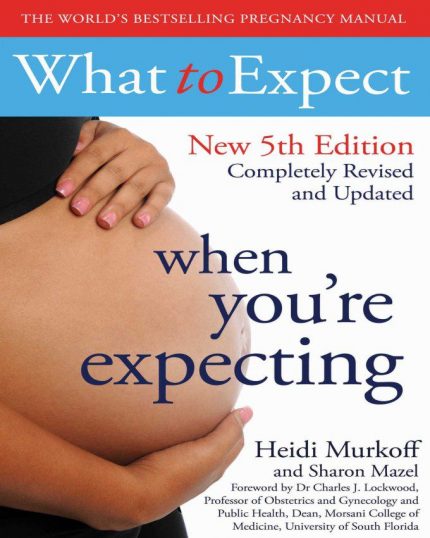
What to Expect When You’re Expecting by Heidi Murkoff

Books, Parenting
KShs3,500.00 KShs3,290.00
Announcing a brand new, cover-to-cover revision of America's pregnancy bible. What to Expect When You're Expecting is a perennial New York Times bestseller and one of USA Today's 25 most influential books of the past 25 years. It's read by more than 90% of pregnant women who read a pregnancy book--the most iconic, must-have book for parents-to-be, with over 14.5 million copies in print. Now comes the Fourth Edition, a new book for a new generation of expectant moms--featuring a new look, a fresh perspective, and a friendlier-than-ever voice. It's filled with the most up-to-date information reflecting not only what's new in pregnancy, but what's relevant to pregnant women. Heidi Murkoff has rewritten every section of the book, answering dozens of new questions and including loads of new asked-for material, such as a detailed week-by-week fetal development section in each of the monthly chapters, an expanded chapter on pre-conception, and a brand new one on carrying multiples. More comprehensive, reassuring, and empathetic than ever, the Fourth Edition incorporates the most recent developments in obstetrics and addresses the most current lifestyle trends (from tattooing and belly piercing to Botox and aromatherapy). There's more than ever on pregnancy matters practical (including an expanded section on workplace concerns), physical (with more symptoms, more solutions), emotional (more advice on riding the mood roller coaster), nutritional (from low-carb to vegan, from junk food–dependent to caffeine-addicted), and sexual (what's hot and what's not in pregnant lovemaking), as well as much more support for that very important partner in parenting, the dad-to-be. Overflowing with tips, helpful hints, and humor (a pregnant woman's best friend), this new edition is more accessible and easier to use than ever before. It's everything parents-to-be have come to expect from What to Expect... only better.
Add to wishlist
Read more
Quick view
-11%

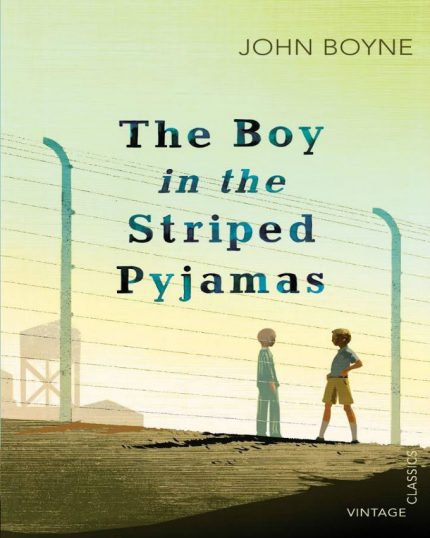
The Boy in the Striped Pyjamas by John Boyne

Books, Fiction and Non Fiction
KShs1,900.00 KShs1,690.00
Berlin 1942 When Bruno returns home from school one day, he discovers that his belongings are being packed in crates. His father has received a promotion and the family must move from their home to a new house far far away, where there is no one to play with and nothing to do. A tall fence running alongside stretches as far as the eye can see and cuts him off from the strange people he can see in the distance. But Bruno longs to be an explorer and decides that there must be more to this desolate new place than meets the eye. While exploring his new environment, he meets another boy whose life and circumstances are very different to his own, and their meeting results in a friendship that has devastating consequences.  
Add to wishlist
Add to basket
Quick view
-5%Sold out

Essential Swahili Dictionary : Swahili

Books, Dictionaries & References
KShs1,695.00 KShs1,611.00
With more than 14,000 definitions, including everyday idioms and expressions, this dictionary helps you understand what the people of East Africa are really saying Don t be intimidated by Swahili! "Essential Swahili Dictionary" contains the most frequently used Swahili words and reflects contemporary usage of the language. Inside you ll find the words you need for work, school, and your lifestyle; the vocabulary comes from a wide variety of contexts--including the media and information technology. Features: One, five and ten-minute introductions to key principles to get you started Author insights for lots of instant help with common problems and quick tips for success, based on the author s many years of experience Useful vocabulary, easy to find and learn, to build a solid foundation for speaking Extra online articles at teachyourself.com to give you a richer understanding of the culture and history of the East Africa region ISBN:1444104080 Author:PERROTT.D.V
Add to wishlist
Read more
Quick view
-5%

HERO

Books, Self Help & Motivation
KShs1,695.00 KShs1,611.00
Twelve successful people today took seemingly impossible journeys to success. Each of us was born with everything we need to live our greatest dream, fulfill our missions and change the world. You too can be a hero. ISBN:1471133442 Author:BRYNE RHONDA
Add to wishlist
Add to basket
Quick view
-5%

Piano Manual Buying Using and Maintaining a Piano by John Bishop and Graham Barker

Books, Music Books
KShs4,499.00 KShs4,275.00
Brief Summary Haynes manuals are now being published on a wide range of subjects, including musical instruments – and here comes coverage of one of the most popular and versatile instruments of all. This manual explains the essentials of buying a piano before moving on to the meat of the book – the care and maintenance of a piano. A trouble-shooting section explains how to check condition and diagnose common piano ailments, and then three maintenance chapters follow, detailing different levels. The ‘easy’ section covers routine tasks that anyone can and should do; ‘moderate’ looks at maintenance and repair that someone with good DIY skills can achieve; and ‘advanced’ covers work that is usually best left to professionals but that it’s nonetheless good to know about. ISBN:9781844254859 Author:John Bishop and Graham Barker
Add to wishlist
Add to basket
Quick view
-5%

Hot Flat and Crowded by Thomas Friedman

Books, Energy
KShs1,699.00 KShs1,615.00
Brief Summary Hot, Flat, and Crowded: Why We Need a Green Revolution – and How It Can Renew America In this brilliant, essential book, Pulitzer Prize-winning author Thomas L. Friedman speaks to America's urgent need for national renewal and explains how a green revolution can bring about both a sustainable environment and a sustainable America. Friedman explains how global warming, rapidly growing populations, and the expansion of the world’s middle class through globalization have produced a dangerously unstable planet--one that is "hot, flat, and crowded." In this Release 2.0 edition, he also shows how the very habits that led us to ravage the natural world led to the meltdown of the financial markets and the Great Recession. The challenge of a sustainable way of life presents the United States with an opportunity not only to rebuild its economy, but to lead the world in radically innovating toward cleaner energy. And it could inspire Americans to something we haven't seen in a long time--nation-building in America--by summoning the intelligence, creativity, and concern for the common good that are our greatest national resources. Hot, Flat, and Crowded is classic Thomas L. Friedman: fearless, incisive, forward-looking, and rich in surprising common sense about the challenge--and the promise--of the future. ISBN:9780374166854 Author:Thomas Friedman
Add to wishlist
Add to basket
Quick view
-17%

DIARY OF A WIMPY KID CABIN FEVER

Books, Kids & Teens
KShs1,190.00 KShs990.00
The authorities are closing in, but when a surprise blizzard hits, the Heffley family is trapped indoors. Greg knows that when the snow melts he's going to have to face the music, but could any punishment be worse than being stuck inside with your family for the holidays? ISBN:141343006 Author:KINNEY JEFF
Add to wishlist
Add to basket
Quick view
-14%

Divergent by Roth Veronica

Books, Kids & Teens
KShs1,390.00 KShs1,190.00
Paperback features over fifty pages of bonus materials, including a sneak peek of Insurgent, an author Q&A, a discussion guide, a Divergent playlist, faction manifestos, and more! In Beatrice Prior's dystopian Chicago world, society is divided into five factions, each dedicated to the cultivation of a particular virtue—Candor (the honest), Abnegation (the selfless), Dauntless (the brave), Amity (the peaceful), and Erudite (the intelligent). On an appointed day of every year, all sixteen-year-olds must select the faction to which they will devote the rest of their lives. For Beatrice, the decision is between staying with her family and being who she really is—she can't have both. So she makes a choice that surprises everyone, including herself. During the highly competitive initiation that follows, Beatrice renames herself Tris and struggles alongside her fellow initiates to live out the choice they have made. Together they must undergo extreme physical tests of endurance and intense psychological simulations, some with devastating consequences. As initiation transforms them all, Tris must determine who her friends really are—and where, exactly, a romance with a sometimes fascinating, sometimes exasperating boy fits into the life she's chosen. But Tris also has a secret, one she's kept hidden from everyone because she's been warned it can mean death. And as she discovers unrest and growing conflict that threaten to unravel her seemingly perfect society, she also learns that her secret might help her save those she loves . . . or it might destroy her. Veronica Roth is the New York Times bestselling author of Divergent, the first in a trilogy of dystopian thrillers filled with electrifying decisions, heartbreaking betrayals, stunning consequences, and unexpected romance."  
Add to wishlist
Add to basket
Quick view
-5%

How To Write

Books, Dictionaries & References
KShs1,899.00 KShs1,805.00
Are you sometimes unsure of how to write a business letter or a social note? Do you come up blank when you have to compose a press release, a complaint, a request for a credit check, or a wedding invitation? Now there’s help. Every form of written correspondence has its own protocol, and this authoritative yet easy-to-use reference book presents the best advice on writing all of them. How to Write It includes models and advice for virtually any situation, ranging from direct-mail pieces to party invitations, resumes to collection letters, proposals to notes of congratulation, product orders to thank-you notes. Your complete guide to everything you need to write, this indispensable volume also includes: A time-saving compendium of over 250 samples that can be used as templates to suit any situation. Grammar and punctuation guides An appendix on bias-free language for the new millennium How to adapt traditional forms of communication to e-mail and the Internet without losing any clarity of expression. Forms of address for everyone from your next-door neighbor to royalty. How to Write It deals with every type of letter and document, from the ones we enjoy writing to the ones we dread. Indexed for immediate answers, this quick-reference guide is an invaluable tool for every home, business, or classroom writer. ISBN:1607740322 Author:LAMB SANDRA E.
Add to wishlist
Add to basket
Quick view
-10%

Why Nations Fail by Daron Acemoglu and James A. Robinson

Books, Governance
KShs3,000.00 KShs2,690.00
Brilliant and engagingly written, Why Nations Fail answers the question that has stumped the experts for centuries: Why are some nations rich and others poor, divided by wealth and poverty, health and sickness, food and famine? Is it culture, the weather, geography? Perhaps ignorance of what the right policies are? Simply, no. None of these factors is either definitive or destiny. Otherwise, how to explain why Botswana has become one of the fastest growing countries in the world, while other African nations, such as Zimbabwe, the Congo, and Sierra Leone, are mired in poverty and violence? Daron Acemoglu and James Robinson conclusively show that it is man-made political and economic institutions that underlie economic success (or lack of it). Korea, to take just one of their fascinating examples, is a remarkably homogeneous nation, yet the people of North Korea are among the poorest on earth while their brothers and sisters in South Korea are among the richest. The south forged a society that created incentives, rewarded innovation, and allowed everyone to participate in economic opportunities. The economic success thus spurred was sustained because the government became accountable and responsive to citizens and the great mass of people. Sadly, the people of the north have endured decades of famine, political repression, and very different economic institutions—with no end in sight. The differences between the Koreas is due to the politics that created these completely different institutional trajectories. Based on fifteen years of original research Acemoglu and Robinson marshall extraordinary historical evidence from the Roman Empire, the Mayan city-states, medieval Venice, the Soviet Union, Latin America, England, Europe, the United States, and Africa to build a new theory of political economy with great relevance for the big questions of today, including: - China has built an authoritarian growth machine. Will it continue to grow at such high speed and overwhelm the West? - Are America’s best days behind it? Are we moving from a virtuous circle in which efforts by elites to aggrandize power are resisted to a vicious one that enriches and empowers a small minority? - What is the most effective way to help move billions of people from the rut of poverty to prosperity? More philanthropy from the wealthy nations of the West? Or learning the hard-won lessons of Acemoglu and Robinson’s breakthrough ideas on the interplay between inclusive political and economic institutions? Why Nations Fail will change the way you look at—and understand—the world."
Add to wishlist
Add to basket
Quick view
delivery

QUICK DELIVERY

Swift dispatch

ONLINE PAYMENT

Multiple options

EXPERT SUPPORT

Help when you need it

WIDE VARIETY

Thousands of books

GLOBAL SHIPPING

Worldwide delivery

  • TALK TO US
    • 0794 233261 / 0724 670194
    • nuriakenyabookstore@gmail.com
    • The Bazaar Building, 1st Floor
  • About Nuria
    • Our Story
    • Blog
    • Contact Us
  • VENDORS
    • Sell on Nuria
    • Vendor Login
    • Privacy Policy
  • USEFUL LINKS
    • Delivery Policy
    • Returns
    • Gift Card Balance
digitals-app-store-button
google-play-button

We Accept

2023 NURIA KENYA All rights reserved
  • Menu
  • Categories
  • Kenya Books
  • Rare Books
  • International Bestsellers
  • Self Help & Motivation
  • Fiction
  • Autobiography
  • Business
  • Children’s Books
  • Kids & Teens
  • African Interest
  • Educational Books
  • Romances & Thrillers
  • Home
  • Shop
  • Gift Card
  • About Us
  • Nuria App
  • Contact Us
  • Wishlist
  • Login / Register
Shopping cart
Close
Sign in
Close

Lost your password?

No account yet?

Create an Account
Shop
Sidebar
0 Wishlist
0 items Cart
My account