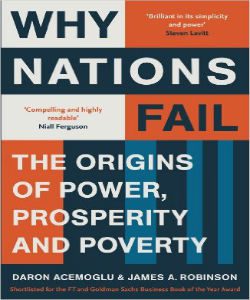
Brilliant and engagingly written, Why Nations Fail answers the question that has stumped the experts for centuries: Why are some nations rich and others poor, divided by wealth and poverty, health and sickness, food and famine? Is it culture, the weather, geography?
Perhaps ignorance of what the right policies are? Simply, no. None of these factors is either definitive or destiny. Otherwise, how to explain why Botswana has become one of the fastest growing countries in the world, while other African nations, such as Zimbabwe, the Congo, and Sierra Leone, are mired in poverty and violence?
Daron Acemoglu and James Robinson conclusively show that it is man-made political and economic institutions that underlie economic success (or lack of it). Korea, to take just one of their fascinating examples, is a remarkably homogeneous nation, yet the people of North Korea are among the poorest on earth while their brothers and sisters in South Korea are among the richest. The south forged a society that created incentives, rewarded innovation, and allowed everyone to participate in economic opportunities.
The economic success thus spurred was sustained because the government became accountable and responsive to citizens and the great mass of people. Sadly, the people of the north have endured decades of famine, political repression, and very different economic institutions—with no end in sight. The differences between the Koreas is due to the politics that created these completely different institutional trajectories.
Based on fifteen years of original research Acemoglu and Robinson marshall extraordinary historical evidence from the Roman Empire, the Mayan city-states, medieval Venice, the Soviet Union, Latin America, England, Europe, the United States, and Africa to build a new theory of political economy with great relevance for the big questions of today, including: - China has built an authoritarian growth machine.
Will it continue to grow at such high speed and overwhelm the West? - Are America’s best days behind it? Are we moving from a virtuous circle in which efforts by elites to aggrandize power are resisted to a vicious one that enriches and empowers a small minority? - What is the most effective way to help move billions of people from the rut of poverty to prosperity?
More philanthropy from the wealthy nations of the West? Or learning the hard-won lessons of Acemoglu and Robinson’s breakthrough ideas on the interplay between inclusive political and economic institutions? Why Nations Fail will change the way you look at—and understand—the world."























Grace Murugi –
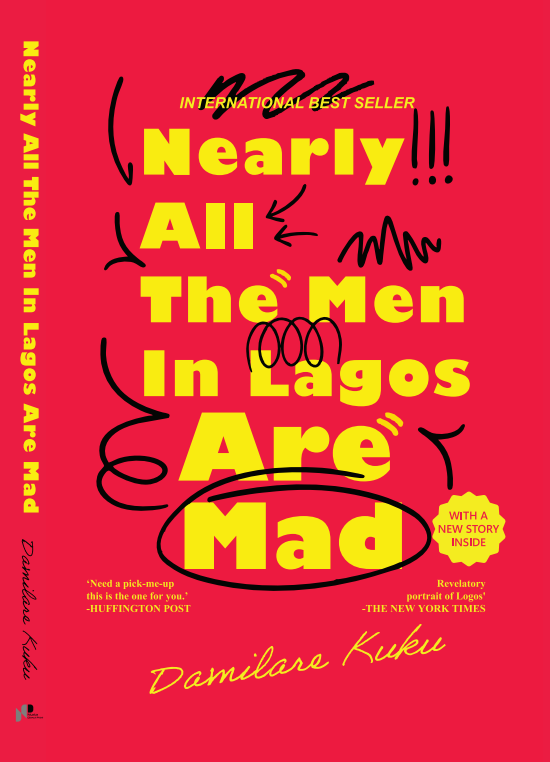
I honestly thought they were exaggerating when they named the book Nearly All the Men in Lagos Are Mad, but it’s as true as it gets. They truly are mad, if the stories in this book are anything to go by. The book had me laughing, cringing, getting annoyed and, at some point, reflecting on the men at home, in Nairobi. It’s interesting that nearly all the men in Nairobi are also mad.
What I loved most was how familiar some of the stories felt. The characters and situations are exaggerated in some places, but there’s always that uncomfortable little moment when you realise, “I actually know men like these.” And that’s what makes the book so entertaining.
There are some elements of humour, but underneath that, there’s quite a bit to think about: relationships, dating, marriage, expectations, gender roles and the very interesting ways men and women navigate each other. The Lagos setting also gives the whole thing its own flavour. You can almost hear the conversations and feel the chaos. The local dialect and accents, I could almost hear them in my mind while reading the book. The Nigerian films I watched as a young girl gave me a vivid sense of the events unfolding.
I also liked that the book doesn’t try too hard to make everything neat and pretty. Some of the characters are frustrating, some are ridiculous, and some are downright stupid. But all that felt very real to me.
Is every man in Lagos mad? I do not know. I have not been to Lagos, and these experiences are not at all inviting. But after reading this book, I can understand why someone might make the argument. Isn’t it interesting how we, as humans, have almost similar experiences when it comes to love and dating, regardless of geographical location? It reminds me of a TikTok comment I saw that said there’s really no unique experience as a human.
I audibly gasped at some of the scenes, and I really like that a text could evoke that kind of physical reaction in me.
The book is an easy, entertaining read, but it also leaves you with enough to discuss afterwards, which, for me, is always a sign of a good book.
Grace Matheka –
I honestly thought they were exaggerating when they named the book Nearly All the Men in Lagos Are Mad, but it’s as true as it gets. They truly are mad, if the stories in this book are anything to go by. The book had me laughing, cringing, getting annoyed and, at some point, reflecting on the men at home, in Nairobi. It’s interesting that nearly all the men in Nairobi are also mad.
What I loved most was how familiar some of the stories felt. The characters and situations are exaggerated in some places, but there’s always that uncomfortable little moment when you realise, “I actually know men like these.” And that’s what makes the book so entertaining.
There are some elements of humour, but underneath that, there’s quite a bit to think about: relationships, dating, marriage, expectations, gender roles and the very interesting ways men and women navigate each other. The Lagos setting also gives the whole thing its own flavour. You can almost hear the conversations and feel the chaos. The local dialect and accents, I could almost hear them in my mind while reading the book. The Nigerian films I watched as a young girl gave me a vivid sense of the events unfolding.
I also liked that the book doesn’t try too hard to make everything neat and pretty. Some of the characters are frustrating, some are ridiculous, and some are downright stupid. But all that felt very real to me.
Is every man in Lagos mad? I do not know. I have not been to Lagos, and these experiences are not at all inviting. But after reading this book, I can understand why someone might make the argument. Isn’t it interesting how we, as humans, have almost similar experiences when it comes to love and dating, regardless of geographical location? It reminds me of a TikTok comment I saw that said there’s really no unique experience as a human.
I audibly gasped at some of the scenes, and I really like that a text could evoke that kind of physical reaction in me.
The book is an easy, entertaining read, but it also leaves you with enough to discuss afterwards, which, for me, is always a sign of a good book.
Mbata –
Nearly All the Men in Lagos Are Mad: Stories
by Damilare Kuku
Nearly All the Men in Lagos Are Mad is raunchy.
Picture this: a perfectly calm, hardworking wife places a knife somewhere her husband will never forget and makes him a promise so ice cold it sends him scrambling to call a family meeting the very next morning. His family. Not hers. And she? She does not even flinch. Because she does not need them. That single scene alone is worth the price of the book.
Meet a married woman who has had enough of her lazy, hypocritical husband and decides to make her point in the most unforgettable way imaginable. Watch another woman play three dimensional chess to protect her cheating pastor husband’s reputation, not out of weakness, but pure strategic brilliance.
Witness a group of wealthy, deceived wives band together in a WhatsApp group called the Virtuous Wives Guild because nothing says “we will not be silenced” quite like a group chat with a threatening name. And then there’s the woman so done with Nigerian men that she swears off them entirely for oyibos only to discover, with devastating hilarity, that foolishness has no passport.
Literature Guru –
People often talk about Luo men. Well, meet the Lagos men.
Nearly All the Men in Lagos Are Mad is a collection of intriguingly realistic stories. Each one is captivating, humorous at times, shocking in places, and occasionally heartbreaking.
These stories explore the dating landscape in Lagos, where the men are either victims or perpetrators. From pastors to the beard gang, from married men to baby daddies, name them. Every story carries a fresh revelation, peeling back layers of ego, deception, vulnerability, and survival.
The book is gripping and will keep you company from one story to the next. Most of the narratives revolve around romance, not the fairytale kind, but the kind used to expose deeper truths about relationships, power, and desire.
It is witty. It is bold. It is unsettlingly honest.
And above all, it is entertaining.
Esther –
From the cheating husband to the closeted gay hiding under the shadows of straight marriage, the man living a double life that revealed madness in its different colours, the Mummy GO in denial, the frenemy and the backstabber that showed the different levels of madness. Every single story was worth it.