














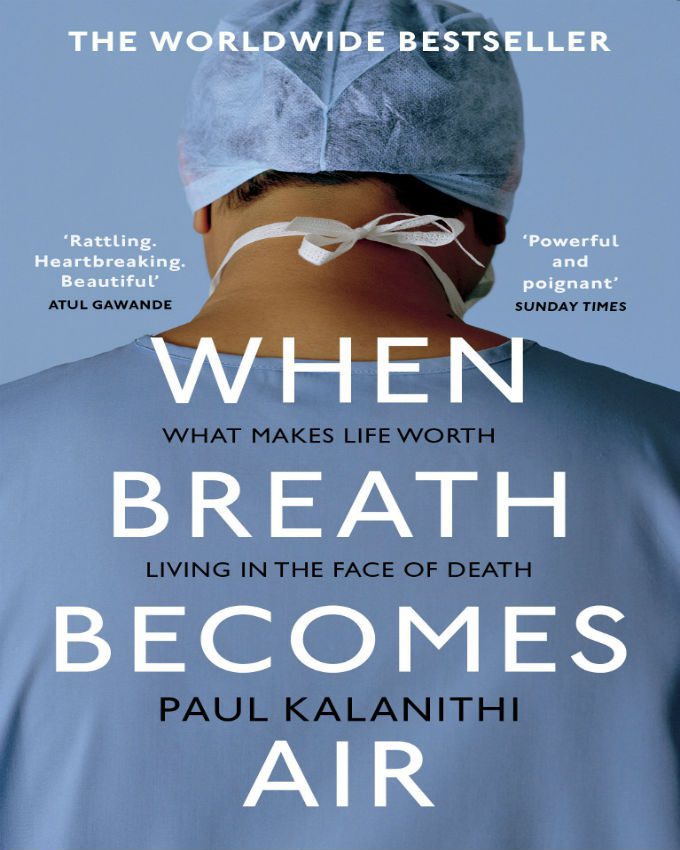
For readers of Atul Gawande, Andrew Solomon, and Anne Lamott, a profoundly moving, exquisitely observed memoir by a young neurosurgeon faced with a terminal cancer diagnosis who attempts to answer the question What makes a life worth living?
At the age of thirty-six, on the verge of completing a decade’s worth of training as a neurosurgeon, Paul Kalanithi was diagnosed with stage IV lung cancer. One day he was a doctor treating the dying, and the next he was a patient struggling to live. And just like that, the future he and his wife had imagined evaporated. When Breath Becomes Air chronicles Kalanithi’s transformation from a naïve medical student “possessed,” as he wrote, “by the question of what, given that all organisms die, makes a virtuous and meaningful life” into a neurosurgeon at Stanford working in the brain, the most critical place for human identity, and finally into a patient and new father confronting his own mortality.
What makes life worth living in the face of death? What do you do when the future, no longer a ladder toward your goals in life, flattens out into a perpetual present? What does it mean to have a child, to nurture a new life as another fades away? These are some of the questions Kalanithi wrestles with in this profoundly moving, exquisitely observed memoir.
Paul Kalanithi died in March 2015, while working on this book, yet his words live on as a guide and a gift to us all. “I began to realize that coming face to face with my own mortality, in a sense, had changed nothing and everything,” he wrote. “Seven words from Samuel Beckett began to repeat in my head: ‘I can’t go on. I’ll go on.'” When Breath Becomes Air is an unforgettable, life-affirming reflection on the challenge of facing death and on the relationship between doctor and patient, from a brilliant writer who became both.






Grace Murugi –
I really enjoyed When Breath Becomes Air. It was a very emotional read, and somewhere along the way, I found myself warming up to Paul Kalanithi. By the time I finished the book, I felt like I wanted to know him in person. I immediately looked him and his wife up on YouTube, which probably says more about how much the book had gotten to me than anything else.
Paul comes across as a sweet, thoughtful man who was very much in touch with his emotions. I particularly liked the way he spoke about his patients. There was something very personal about the way he viewed them, not simply as illnesses to diagnose or cases to treat, but as people.
His writing made me appreciate life a little more. It made me want to do more with the life I have here on earth and to be more conscious of the fact that our time here is limited.
What stayed with me most was his willingness to continue living and serving his patients even after his own diagnosis. He knew what was happening to his body, yet he continued to show up for the work he had devoted his life to. There was something incredibly moving about that.
The fact that his wife, Lucy, finished part of the book after his death made me very emotional. There was something about knowing that the story could not be completed by the person who started it, and that someone who loved him had to carry it to the end.
I thought about this book for several days after finishing it. That, for me, is always significant. Some books entertain you while you’re reading them. Others stay with you after you’ve closed them. This was the latter.
Paul was a gift to humanity. He used his gifted hands to make an impact on other people’s lives, even when he knew his own time was running out.
When I closed the book, I was left thinking about how fleeting life is, and how mortal we really are. And perhaps that is what I took from it most: the reminder to actually live the life we have while we have it.
I would 100% recommend this book. In fact, everyone should read it.