














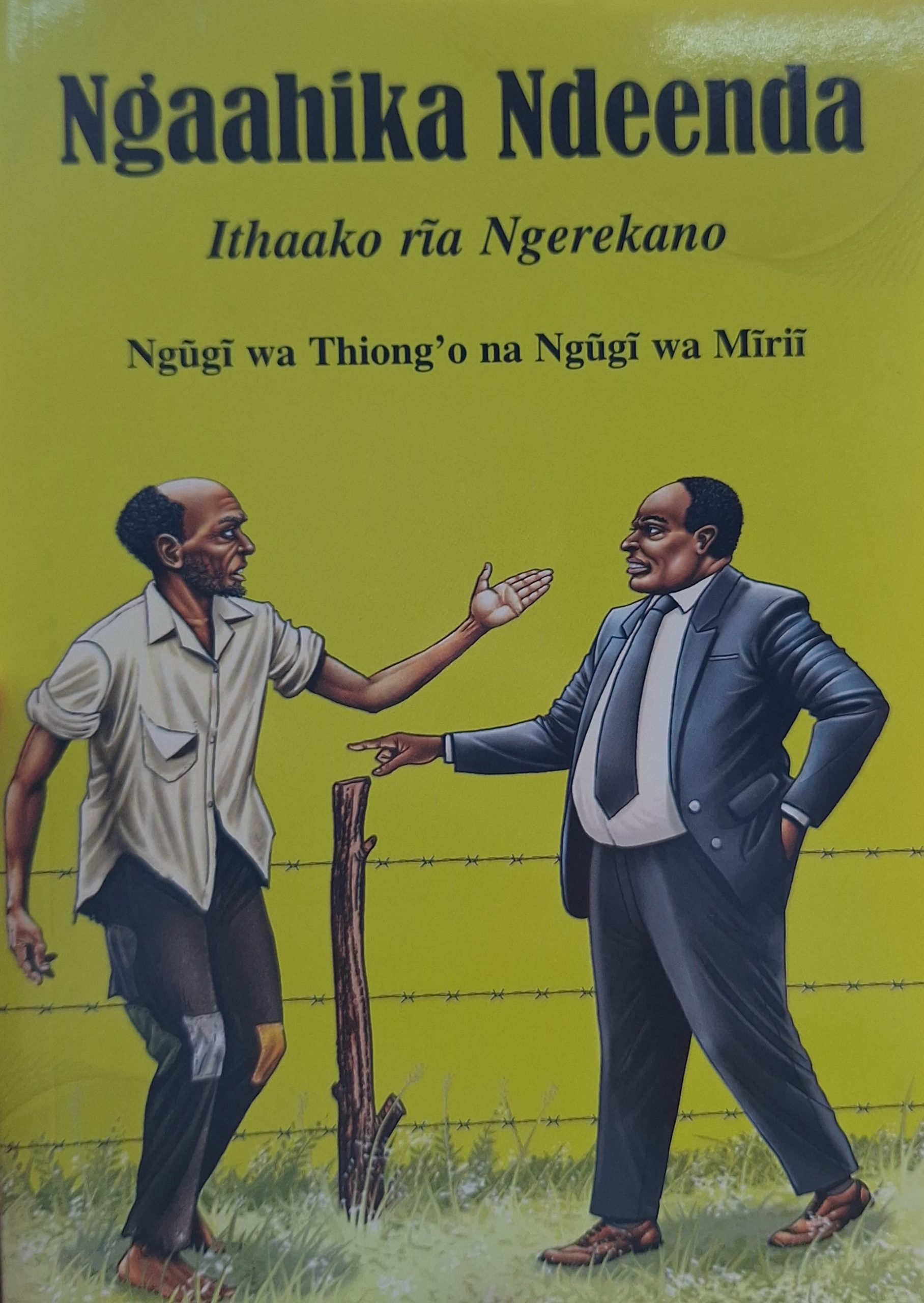

Set in post-independence Kenya, the play is a searing look at the legacies of colonialism and the difficulties Kenyans faced at the time. It was performed at Kamiriithu for six continuous weeks before it was shut down by the government.
Both playwrights were arrested and detained in December 1977. They were released in December 1978, and fled into exile shortly after. Ngugi wa Mirii fled to Zimbabwe, while Ngugi wa Thiong’o fled to the UK, and then to the United States.
Plot
The storyline of the play centres on a peasant farmer, Kiguunda and his wife, Wangechi, and their daughter, Gathoni. Kiguunda’s most highly prized possession is a 1+1⁄2-acre piece of land whose title deed he keeps carefully and often fingers gingerly and tenderly. The family are expecting a rare visit from the wealthy farmer and businessman, Ahab Kĩoi wa Kanoru and his wife, Jezebel. Kĩgũũnda works on one of Ahab’s farms. The aim of this visit is a puzzle as it is unprecedented and they belong to different social classes.
But on recalling that the Kĩois’ son, John Mũhũũni, has shown some amorous tendencies towards their daughter, they surmise that the purpose of the visit could be either to warn that the two don’t see each other again, or to ask for Gathoni’s hand in marriage. When it occurs to the two that the purpose of the visit could be to ask for Gathoni’s hand in marriage, they reminisce about the days of their youthfulness and courtship, teasing each other in the process. But Kĩgũũnda recalls also that both Ahab and his business partner, Ikuua wa Nditika are local directors of an international company that manufactures insecticides and Ikuua has written to ask Kĩgũũnda for his one and a half acres land in order to build a factory. This, he thinks, could also be the reason for this visit.

















Reviews
Clear filtersThere are no reviews yet.