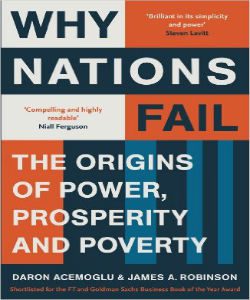
Brilliant and engagingly written, Why Nations Fail answers the question that has stumped the experts for centuries: Why are some nations rich and others poor, divided by wealth and poverty, health and sickness, food and famine? Is it culture, the weather, geography?
Perhaps ignorance of what the right policies are? Simply, no. None of these factors is either definitive or destiny. Otherwise, how to explain why Botswana has become one of the fastest growing countries in the world, while other African nations, such as Zimbabwe, the Congo, and Sierra Leone, are mired in poverty and violence?
Daron Acemoglu and James Robinson conclusively show that it is man-made political and economic institutions that underlie economic success (or lack of it). Korea, to take just one of their fascinating examples, is a remarkably homogeneous nation, yet the people of North Korea are among the poorest on earth while their brothers and sisters in South Korea are among the richest. The south forged a society that created incentives, rewarded innovation, and allowed everyone to participate in economic opportunities.
The economic success thus spurred was sustained because the government became accountable and responsive to citizens and the great mass of people. Sadly, the people of the north have endured decades of famine, political repression, and very different economic institutions—with no end in sight. The differences between the Koreas is due to the politics that created these completely different institutional trajectories.
Based on fifteen years of original research Acemoglu and Robinson marshall extraordinary historical evidence from the Roman Empire, the Mayan city-states, medieval Venice, the Soviet Union, Latin America, England, Europe, the United States, and Africa to build a new theory of political economy with great relevance for the big questions of today, including: - China has built an authoritarian growth machine.
Will it continue to grow at such high speed and overwhelm the West? - Are America’s best days behind it? Are we moving from a virtuous circle in which efforts by elites to aggrandize power are resisted to a vicious one that enriches and empowers a small minority? - What is the most effective way to help move billions of people from the rut of poverty to prosperity?
More philanthropy from the wealthy nations of the West? Or learning the hard-won lessons of Acemoglu and Robinson’s breakthrough ideas on the interplay between inclusive political and economic institutions? Why Nations Fail will change the way you look at—and understand—the world."






























Givens Njoki –
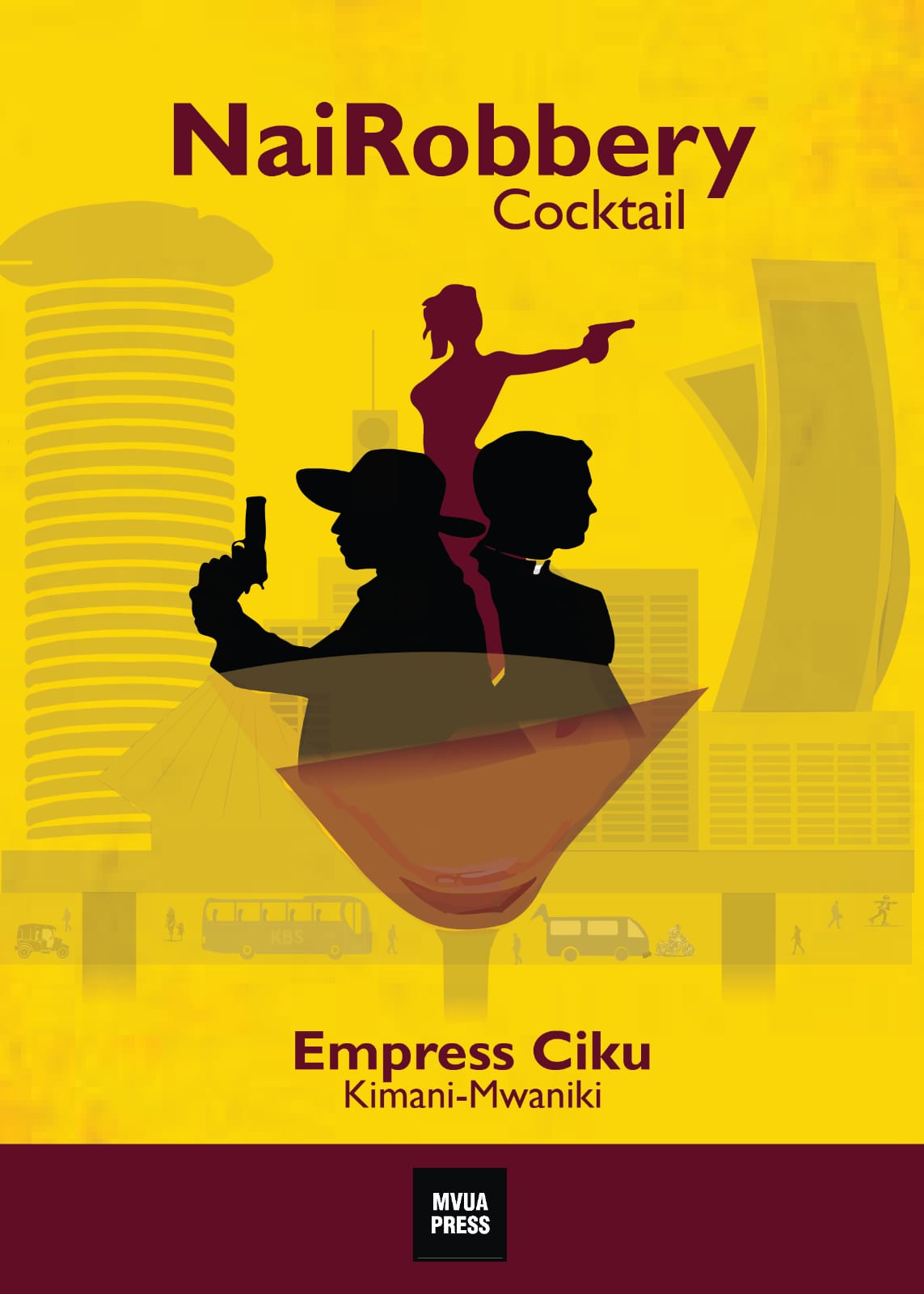
I loved the book, the plot, the thrill but not the ending. I feel like Kanja and Naliaka were robbed of something they should have had as in their own way they loved each other through the storm. However, Naliaka was always looking out for herself and needs and never fully put Kanja first as he did her. Noticed a few errors here and there but well not everything can be perfect. Overrally enjoyed my read.
Grace Murugi –
I really enjoyed Nairoberry Cocktail. It reminded me a lot of John Kiriamiti’s action-packed books, the kind that pull you into the story and keep you moving from one scene to the next.
The plot was really good, and more importantly, I found myself invested in the characters. I was rooting for some of them to succeed, worrying about what would happen to others, and occasionally wondering why on earth they were making certain choices. But then again, my work as a reader is to read, not judge.
The book was suspenseful enough that I genuinely didn’t want to put it down and sit there wallowing in suspense. I needed to know what was going to happen next. It wasn’t particularly funny, but it was thrilling, and I think that’s what worked for me. There was enough action and uncertainty to keep me engaged.
I also really liked the main character. I didn’t agree with all their choices, but I liked following their journey and watching how everything unfolded around them.
What I found especially interesting was how the book made me look at Nairobi differently. I started thinking about undercover agents moving around the city, blending into ordinary life, and now I’m not sure I’ll ever look at a beggar or grocery seller in Nairobi quite the same way again.
Nairoberry Cocktail was my first read by the author, and I’m glad I picked it up. I finished the book feeling satisfied, which, for me, is one of the simplest signs that I enjoyed a story.
A good plot, compelling characters, suspense, action and enough Nairobi chaos to keep things interesting. I enjoyed this one.
Literature Guru –
*Book Review: *Nairobbery* by Ciku Kimani*
“When he slid into her, she nearly screamed. When she hit her orgasm, she screamed so did he.”
Those are not my words, but Ciku Kimani’s powerful closing lines in Nairobbery a bold and unapologetic finish to an unforgettable read.
*Nairobbery* is arguably one of the best Kenyan crime thrillers of our time. Ciku Kimani proves herself a master of vivid, emotive storytelling. The characters are so well crafted, every page carries weight gripping you with emotion, tension, and humanity.
But this isn’t just a story about a heist. It’s a layered narrative of survival, love, betrayal, childhood trauma, and resilience. It also offers unexpected glimpses of kindness from unlikely places.
When you read it, you’ll find yourself drawn to the heart of the story and maybe even wanting to meet the real boss.
A powerful, moving read. Highly recommended.
Daisy –
Empress,,,
I’m here wondering what happened finally between Kanja and Naliaka. Who was Samwel really? Just an undercover… Ain’t no way we’re done with the book. There’s a part two no?
Being a Nairobian, I related to everything here. Now I’m walking at Kirinyaga road suspecting everyone Lmao 🤣
Good work there gal 👏