














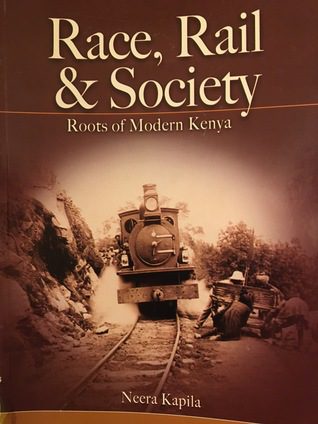

Race, Rail & Society: Roots of Modern Kenya is a historical work by Kenyan author Neera Kapila that examines how the construction of the Uganda Railway — popularly known as the “Lunatic Express” — shaped the racial, social, and political landscape of what would become modern Kenya.
The book explores the deep interplay between three forces: the iron rails laid from Mombasa to Lake Victoria, the racial hierarchies imposed by British colonialism, and the diverse communities that were brought together or set against each other in the process.
Key Themes
The Railway as Nation-Builder
The Uganda Railway, constructed between 1896 and 1901, is treated not merely as an engineering feat but as the foundational infrastructure of Kenya’s modern identity. The railway from Mombasa to Lake Victoria is widely regarded as the project that effectively created modern Kenya. Roger Farnworth
Race and Colonial Society
The book traces how the railway entrenched a rigid racial order among three groups — Europeans (settlers and administrators), South Asians (Indians), and Africans — each occupying distinct and unequal roles in colonial society. South Asians saw themselves as the makers of modern Kenya; their capitalists recruited, fed, and housed the 40,000 laborers who built the railway, they developed urban property, and their agents enabled Africans to participate in the cash economy.
A significant thread of the book is the largely overlooked role of the Indian community — both the indentured laborers who physically built the railway and the merchants and professionals who built the economy around it.
African Displacement and Resistance
The construction of the railway cut through the lands of various ethnic groups including the Kikuyu, Maasai, Kamba, and Luo, and the railway’s path through the Rift Valley opened up what would become “White Man’s Country” to European settler farming. The book examines how this dispossession planted the seeds of nationalist resistance. Retrospect Journal
Colonial Politics and Inequality
Kapila situates the railway within the broader politics of British imperialism, showing how land alienation, racial segregation, and economic exploitation were all intertwined with the railway’s expansion.
Significance
The book is notable for offering a multi-racial perspective on Kenya’s colonial history, giving voice to the South Asian diaspora’s role in building East Africa while also centering African experiences of dispossession. It is widely used in Kenyan university curricula and is held in several East African academic libraries, including Karatina University. It was reviewed in the journal South Asian Diaspora (Vol. 4, No. 2, 2012), reflecting its relevance to diaspora studies as well as Kenyan history.























Reviews
Clear filtersThere are no reviews yet.