














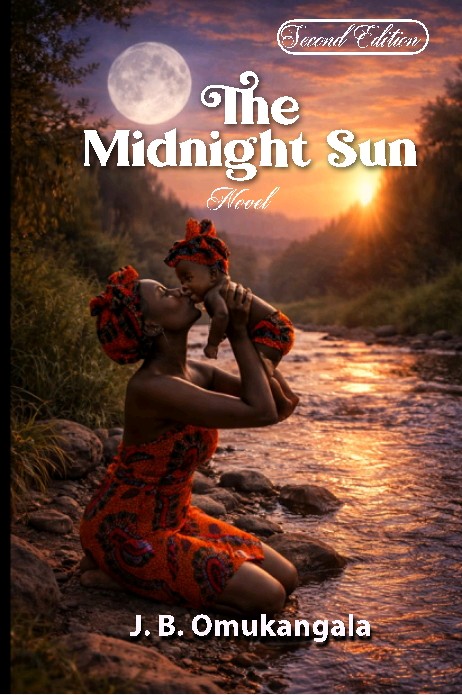
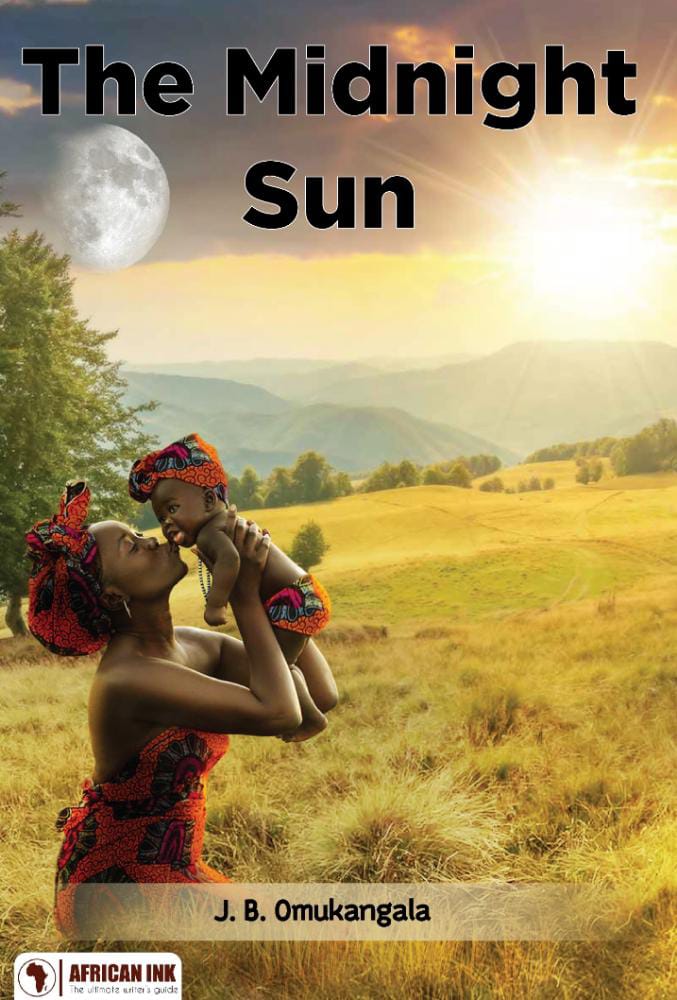
This is a riveting story of a lady who conceived while in the city before becoming a single mother upcountry. It highlights the plight of single motherhood.







QUICK DELIVERY
Swift dispatch
KShs900.00 KShs800.00
In stock
This is a riveting story of a lady who conceived while in the city before becoming a single mother upcountry. It highlights the plight of single motherhood.
This is a riveting story of a lady who conceived while in the city before becoming a single mother upcountry. It highlights the plight of single motherhood.
Swift dispatch
No account yet?
Create an Account
Wafula Khisa –
Of Love & Hope: A Tale of Pain & Triumph – A Reading of J. B Omukangala’s “The Midnight Sun”
What exactly does one expect when they give their heart to another? Laughter, tears or endless praises? For a long time, it has been proven that what one invests in a union, marriage or relationship, is not exactly what they harvest back. Many have fallen in love with great expectations and ended up broken and disappointed. Love (or is it life?) is not a bed of roses. It is more like a battlefield; you march into it armed with feelings and fantasies expecting to win and come out defeated. This is what JB Omukangala’s ‘The Midnight Sun’ is about.
In the book, Omukangala tells us the tragic love story of Cynthia Nasirumbi, a beautiful young lady studying nursing and her boyfriend, Michael Ejakait, an engineering student at the Technical University of Kenya. Both of them come from poor families and, it seems, their entry into the university is their hope for a better life – for them and their families back home.
In her first year, Nasirumbi “… would comfortably eat two bananas, take a glass of water and sleep because she understood her background… On extremely hard days, she took a glass of water and hoped for a better tomorrow…” Pg 9. This proves that her family is poor.
On his part, Ejakait, aware of his family’s financial inadequacy, lives in Kibra slums and runs a spare parts and scrapes kiosk to earn a living and sustain himself in college. He starts the business with his Helb loan. Pg 12
They meet at Nairobi Cinema during a performance that Nasirumbi is part of. Ejakait is moved by her beautiful voice, dancing moves and fleshy body- especially when her dress slips upwards. Every man is attracted to a woman because of something- a beautiful smile, big nyash or exemplary character. She is also struck by his handsomeness and that is the day that their affair begins.
Months later, Ejakait takes her to his house after completing their exams. It is at that time that she conceives too. Things go south for them when he is involved with Lucy Stinger, a beautiful and gorgeous white lady who stings him with cash and love.
It is interesting that what begins as a casual business agreement or deal takes a U-turn and becomes something else. That is where the rain starts beating them.
It is important to note that one golden rule of business is that as a business owner, you do not eat the client or the stock. The day you taste any of them is the day you fall. That is what befalls Ejakait when he falls for Lucy and her money, leaving Nasirumbi to suffer.
Lucy first ensnares him by giving him a car for free, merely on condition that he will be servicing hers (or is it her?) for free. She also leaves him with her own car when she flies out of the country. In addition to this, she promises to buy more stock for him from Germany!
Naturally, a man’s sense of vision and reason is impaired when a woman comes into picture. Ejakait loses focus, forgets his purpose and abandons Nasirumbi. This is what Ali Kiba refers to when he says “…unatema bigiji kwa karanga za kuonjeshwa…” in his popular song ‘Mapenzi Yanarun Dunia’.
Ejakait and Nasirumbi separate in a messy and chaotic manner. She, with her pregnancy, is unable to continue with her studies. She returns home but her father, angry and disappointed, beats her and chases her away. She later finds refuge at her aunt’s place.
For nearly four years, her life, as a jobless single mother, is hell. She is tormented and humiliated. She struggles with the burden of rejection from her family and boyfriend. She is even nearly raped by her aunt’s husband, Okware. She is approached by several men for marriage but their relationships do not last. In fact, one of them whom she trusts so easily, runs away with her hard-earned money. She endures all these as a strong woman.
Eventually, she re-unites with Ejakait who, after separating with Lucy, has ended up lonely and ashamed to face her. This is the happiest moment of her life as it re-unites her with her family too.
In this book, Omukangala draws our attention to several pertinent issues. One is that love is an extremely painful thing. It hurts and breaks us. It steals our joy and sets us against those care about us. Ideally, people fall in love to break up, agonize and evaluate their decision for ever trusting each other in the first place. Interestingly, we seek it everyday. And we can sacrifice or defy even the gods to be in love. And since man loves what kills him, many choose love. If love can kill, surely there is no need to take poison. That is what Nasirumbi goes through with Ejakait. She suffers when he impregnates and leaves her for Lucy.
We also learn that anger does not solve problems. Instead, it causes more suffering. In the story, Nasirumbi’s father is angry and mad at her when she becomes expectant and drops out of college. He throws her out of his house to seek refuge at her aunt’s house. This feeling of rejection and being unwanted torments her. It makes her weak and vulnerable. Here, Omukangala reminds us that naturally, children are born to disappoint their parents. They break their hearts and mess up their lives, that is if they do not kill them. But they need to be tolerated, corrected and guided. Not to be chased away like stray dogs and be hated like the devil the way Nasirumbi is treated by her father. Probably, since fathers are the givers of blessings, his hatred for Nasirumbi could be the cause of all her suffering. It is worth noting that once he opens up his heart for her and forgives her, she finds peace and joy. She even re-unites with her boyfriend.
Omukangala also tells us that for a society to thrive peacefully and prosper, forgiveness is paramount. We need to be forgiven by the people that we hurt and forgive those that hurt us. This will break the chains of hatred, fear and set us free to move forward. That is what Nasirumbi’s father does. That is what Nasirumbi does to Ejakait. And that is what Ejakait looks Nasirumbi for. It is evident that after forgiveness, they seem to be happier than before.
Also, it is important to note that one’s destiny can be delayed but it can never be changed. This is what can be said about Nasirumbi and Ejakait’s love affair. From the start, they seem to be naturally fashioned for each other; they bond easily and get along together well. No drama. No witchcraft! Unlike most hungry modern girls, Nasirumbi is not attracted to Ejakait because of his money. No. He does not have any. Their ship of love hits an iceberg of betrayal and greed and sinks when Ejakait stupidly falls for Lucy. His association with her compels him to drop Nasirumbi.
Obviously, nobody can successfully roast two pieces of meat at the same time. One has to burn into ashes. And that, sadly, is Nasirumbi. This poses another disturbing question: What is the best choice for a man when it comes to women? How do we know that we are making the best choice when we are merely acting on the dictates of our heart, brain or body? What if our best choice turns out to be the worst? And why does choosing the best, from the available options, cause pain to others and us later? Such things are what makes a man’s life hard. In fact, being a man is a huge burden that one has to live with.
While in the village, Nasirumbi tries to move on with other men, hoping to find peace and comfort. Unfortunately, she fails terribly. One, Judas Eliokoi, steals from her and runs. Another, Kasiba, acts like a headless chicken as he listens to his mother before making decisions about his life. There is something else that makes his union with Nasirumbi impossible. Alung’at, Nasirumbi’s child. His irreducible minimum is to marry Nasirumbi alone, not with her child. No young man fancies buying a cow with a rope from the market. It is a huge inconvenience and burden. As Nasirumbi’s uncle, Kujeje, argues: it would be unfair to make the young man a step father before becoming a father. It is even worse for Kasiba because Alung’at despises him. Being a step father is very painful and unrewarding. This tells us that it is very hard for a woman with a child (of another man) to get married. If it happens, because miracles do happen, the road ahead is rough and bumpy. One needs a safety belt or helmet to survive.
Eventually, through hope and prayer, Nasirumbi reunites with Ejakait. This definitely underscores the fact that what God has put together, no man or woman can put asunder.
Omukangala also raises interesting and intriguing issues. First, after being jilted and left to starve, without child support, Nasirumbi readily and easily accepts Ejakait back. No questions. No explanation. Just like that! How is this possible in the current dispensation? Does it mean that a woman (in love) is that weak and desperate? Can a man do a woman dirty, sleep around and run back to her open arms without a problem? Since when did women stop holding men to account? Is forgiveness this cheap or free? Or broken women just run out of options?
Second, Ejakait leaves Nasirumbi for Lucy because of her resources. She gives him a car and promises to support his business by purchasing some items for him from Germany. Does this imply that a modern man also wants a woman who brings something to the table? Moreover, Nasirumbi’s boyfriend, Eliokoi, scams her when he requests her to contribute money for them to buy land. He disappears with it to eat with another woman. Now, what does this reveal about a man’s position and fate in the wake of women empowerment? Is a broke man weak and easily manipulated by a woman with resources? Have men become that useless and less aggressive to the point of stealing from women or eating from their pockets? How can a man be a man if he is fed, clothed and controlled by a woman? This, sadly, is also the case of Kasiba. His mother runs his life. He cannot stand up on his feet and decide whether to move forward or backwards.
Finally, Omukangala succeeds in weaving a tale of love and hope in the midst of betrayal, rejection and misery. He laces it with a fair dose of humour, wise sayings, flashback and irony among other styles. He takes us to different places and times to experience, feel and empathize with various characters. His simple language, meticulously blended with local words, enables us to easily access meaning and understand some aspects of Teso culture and history. This, undoubtedly, depicts Omukangala as a formidable writer of our time.
Do not deny yourself the pleasure of reading this wonderful book.
Ann Ngugi –
I have read many books but non has captivated me like the Midnight Sun. God bless the writer.
Vivian Sharon –
“If your baby is raised by you alone how will you convince her that marriage is good, what marriage advice will give you her when she will be of your age? your so-learned generation is a great threat to marriage and the subsequent generations,” Ajuma was furiously dogged to drive her point home.
The Midnight Sun is a beautifully woven story about two young Teso lovers-Ejakait and Nasirumbi. They meet when they’re both in college, but their love is soon tested and they break up at a time when Nasirumbi need Ejakait most.
The story is so rich in Iteso culture. I literally felt like I was drinking Akipi from Teso land. The author brings out heated issues surrounding girl child education, single motherhood, feminism and marriage.
What does an educated, single mother in a deeply rooted traditional culture got to do? Agree to marry anyone because it is shameful to have a child and stay unmarried? Leave her child to her parents because the man intending to marry her is doing her a favor and doesn’t want the burden of bringing up a child he didn’t sire?
The role of education in marriage is also greatly contested in the book. At some point I felt angry at the author’s perspective, carefully placed in dialogues. I won’t tell you why. But you can get a copy and make your own judgement.