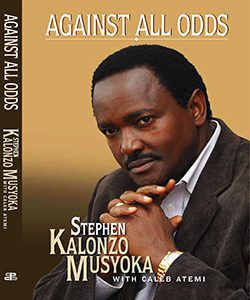
AGAINST ALL ODDS: THE STORY OF STEPHEN KALONZO MUSYOKA, is tale of hope, courage, resilience, determination and faith. It is a story of a village boy who rose from the ashes of poverty in the dry, thirsty and forsaken part of rural Kenya into political stardom.
Musyoka, the son of a peasant farmer-cum-shopkeeper, grew up in Mwingi district in Kenya’s Eastern province. His place of birth was and still remains one of the remotest regions in Kenya.
The book tells the story of the journey of his life, so far. It finds its beginnings in the local village in Mwingi, where he was born. It traverses time and space to see him through the village school, high school and university, even as it gives a rendition of the various vicissitudes that informed his formative years.
From there, it travels on to his early experiments with building a career in legal practice, before plunging into the mud of politics, the world of diplomacy and the challenges of statehood and statesmanship.
Being his mother’s only son, Musyoka grew up under the gunfire, and terror of the Shifta bandits. His mother lived in constant fear of witchcraft. The evil eye, she thought, would take her son away.
The biography tells of Musyoka’s struggles to gain meaningful education, overcome poverty and eventual entry into Kenyan politics. It narrates his rise to stardom, trials and tribulations and his strong Christian faith.
It documents his crucial role as a peacemaker since his schooldays. The impact he had on the Sudanese and Somali peace negotiations. His fears, anxieties and survival instincts.
It is a tale of respect for elders. A tale of a man determined to walk the straight path of truthfulness, honesty and integrity. It is a tale of a loving husband and father.
It tells of his loyalty, his desire for a Kenya that is not just God fearing but free from want, poverty, corruption and hunger. His eyes are set on a country whose economy will one day compete with those of the developed world; a country whose people will walk and live free from fear of insecurity; a nation whose people will enjoy a free, high quality education, social security and good health.
The biography details his political ambitions to ascend to Kenya’s presidency; his dreams, his hopes and his aspirations for Kenya.
Caleb Atemi is a renowned writer, communications and public relations consultant. Atemi, a former News Editor with the Nation Media Group and journalism lecturer, is working on other biographies detailing the life and times of prominent Kenyan personalities.
"
ISBN:2147483647
Author:Kalonzo Musyoka and Caleb Atemi

















Caroline Makario –
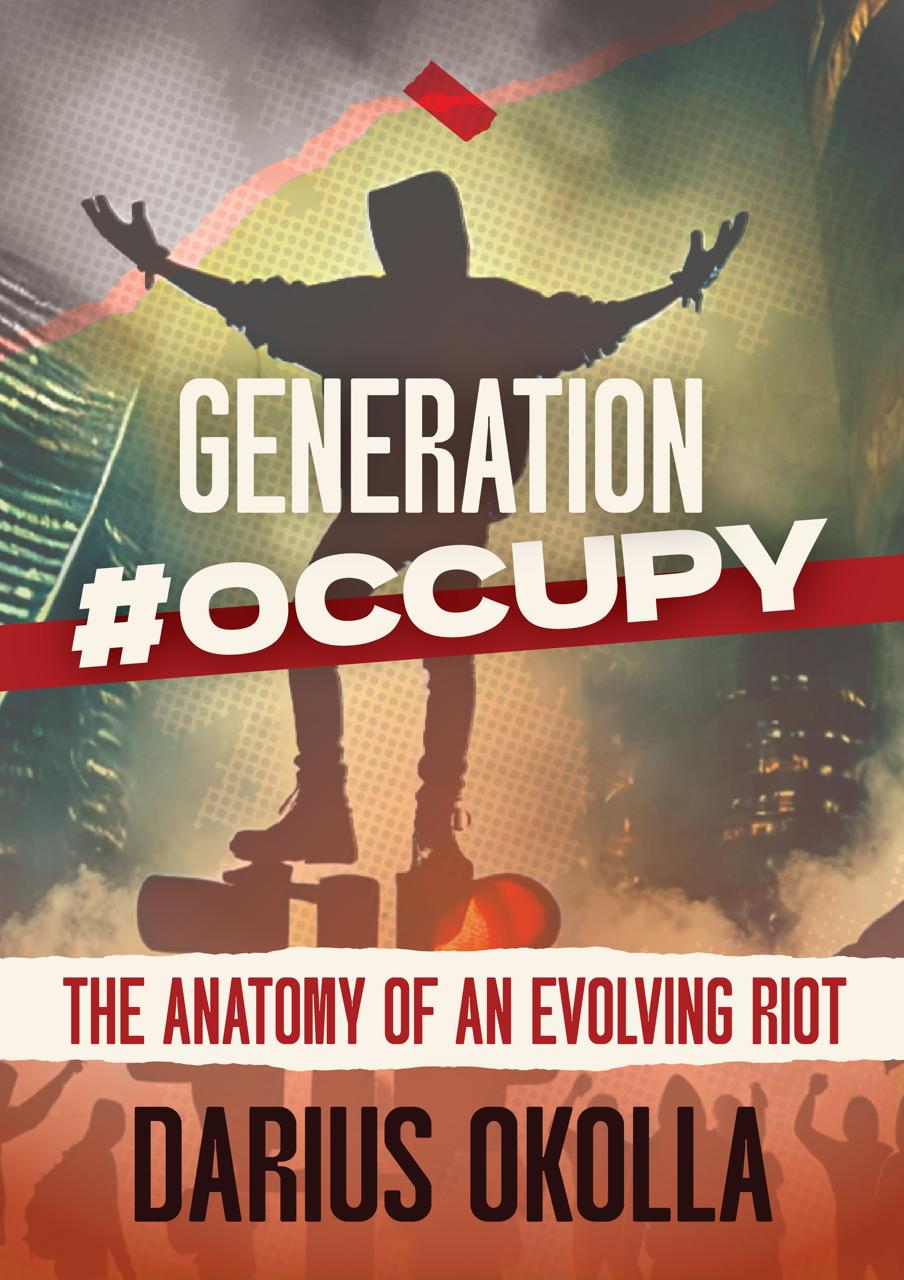
Generation #Occupy by Darius Okolla…or How to do a Protest
By Eddy Ashioya
“You belong to the streets” was once a pejorative term, denoting one’s lack of proper upbringing, indicating that they are better off as outcasts, living with other degenerates of society. Yet as is the world’s buzzword, Gen Z “reclaimed” that term, and made it cool, so cool everyone went to the streets. Leaderless. Tribeless. That was the rallying cry of the Gen Z movement that descended on the nation and left politicians feeling like they ran over a black cat on their wrong-lane morning drive to empty the coffers.
The 25 June 2024 breach of Parliament, Kenya’s highest law-making organ, was an electric jolt delivered straight to the superior vena cava of the nation. If no one was listening to the whispers, they were now hearing the screams. And in Darius Okolla’s Generation #Occupy, he plays mortician, using words to cut through the bone of Kenya’s uprising, all the time digging and ripping the skeleton from the flesh.
The book posits that June 25 2024 served as the reverse Damascene Moment, like Paul converting back to Saul, like Mohamed Bouazizi, that unemployed (self-employed?) fruit vendor who had his wares confiscated by the Tunisian Kanjo, setting himself on fire, a revolutionary act of such magnitude that it acted as a negative catalytic convertor, ultimately sparking the Arab Spring that led to the ousters of the autocratic regimes of Presidents Zine al-Abidine Ben Ali (Tunisia), Hosni Mubarak (Egypt), Ali Abdullah Saleh (Yemeni, was also later killed), Muammar Gaddafi (Libya, killed)—who had ruled for a collective hundred and seventeen years. President Bashar al-Assad of Syria survived and quashed the spring, going to war with his people. Well, at least until late 2024 when he was overrun. That revolution was delayed, but it could not be denied.
In Generation Occupy, Darius notes, the Kenyan revolution wqs leaderless; there were no politicians or political leaders leading the pack, nor was it associated with any political party; and two, perhaps most crucially it was driven largely on and by social media from X to TikTok and Facebook [Yes, Facebook still exists].
June 25, 2024 served as the epic convulsion, whose nauseous Okolla captures in Generation #Occupy. The Generation of Uncertainty meets the Generation of Action is Okolla’s leitmotif. But as far as definitions go, Gen Z, is not an age range, at least not in this book. We are all Gen Zs. As argued by Okolla, a generation congeals as an identity when members of an age cluster develop an actual peer bond, thanks to a specific event of a certain type that knits them together into largely observable mindsets and world views. Based on this premise, the construction of a generational identity has some merit.
Yet while this is a political book, it is not essentially a book about politics. It offers a potent tonic against the elixir of Panglossian broligarchs, as seen by how Ruto does his politics—when a hustler gets into government and turns hustlers into his hustle. When the revolution becomes the establishment. But you can only be avant-garde for so long before you become garde.
Whilst Okolla is dissatisfied with the political economy of Kenya, he bankrupts President Ruto’s policies, which he falls short of calling “crazy.” President Ruto’s aggressive IMF-led finance bill met pushback from the populace, a populist president who had wooed with charm, and energy levels of an Olympic swimmer, yet the people rejected it, and buried in that subtext, the people rejected him. Like a father promises a child the world to shut him up, the child had believed the father and was now demanding he live up to his words. Ruto wouldn’t. Couldn’t. A grandiose leader, Ruto, and I say this loosely, may have fallen into believing his hype, believing that he won this election as a miracle, and that he was the messiah (and mess-maker). Desperation breeds a desire for saviours, and why not one of our own? A chicken seller who rose to become the ultimate cock of the walk. And while Netflix wouldn’t be fighting to option the movie rights of that film, holes quickly started perforating within months of getting into office. Turns out, there’s an actual difference between campaigning and governing a country (shocker). Ruto, according to Okolla, had fashioned himself as an outsider, waging a class war, Hustler Vs Dynasty that would plant a seed of faith in even the most ardent of sceptics. But we have seen this movie before. Yet this one was particularly fitting: a bright start, followed by a bleak fall.
Kenya, East Africa’s most stable democracy couldn’t fall, as Nanjala Nabola once wrote, “a stable Kenya is crucial to Western geopolitics, yet Western institutions are also central to destabilising the country.” He [Ruto] ordered (or was ordered) to retract the finance bill, whether by IMF or the sugar daddies who don’t take kindly to being told no, but not before calling protestors “criminal elements”, a badge they have since worn with pride. Famously obdurate, the West/powers that be splashed Kenya’s strife internationally, grounding a president who till then had been footloose, making over 60 international trips before his second year, like a tourist with a bucket list, and a budget.
It is not hard to see Okolla’s influences. In one of the most crashing chapters, Okolla assumes the role of an elder and offers a damning indictment, an extract from The Reddykulass Generation by Parselelo Kantai: “At a book launch in Nairobi in April 2006, Kenya’s most famous historian, Professor Bethwel A. Ogot stood up and declared that Project Kenya was dead. The ideals that the nationalists had stood for were bankrupt. Kenya, he said, had never been more distant an idea than it was now at the beginning of the 21st century. Nationhood no longer existed. It had been replaced by sub-nationalism: the tribe, in effect, had eaten up the country.” It’s overdue an update: nationhood has been hustled to death.
Adjunct to Okolla’s thesis is the belief that the Kenyan government, and political class irrespective of political persuasion, tends to move out of touch and irrelevant to the majority of the populace. He terms this as the political failure of the imagination, delivering a blow straight to the jugular: “Corruption in Kenya isn’t just an anomaly, but an inbuilt founding ideal of the country.” Further, “this defective contraption called Kenya has borne a primitive class who keep inventing new ways of driving economic carnage, and sabotage.”
Okolla postulates that Gen Z has challenged the status quo and forced us to re-evaluate our values and idées reçu. He rejects (hehe) the notion that this is a one-off, positing instead this is an entree into a larger conversation. It is a high-stakes, staring contest. You blink; you lose. The state blinked. And that’s all Gen Z needed.
Uncontrolled economic volatility, perpetual insecurity, rampant inequality, and a burgeoning unemployed youth are heading us into a dangerous period of prolonged crisis that will become the “cause du guerre” of many more protests. The government has not entirely quashed the dissent. Hundreds of peaceful protesters and online activists have been arrested; others have simply disappeared. There are many who remain sanguine about the future. “As long as governments deny people basic justice and dignity, people will rise up.” That revolution, too, will be televised.
Okolla’s book is less a prophylactic and more an MRI scan showing us how far the cancerous tumour has developed without prescribing any mitigating measures. The cancer is spreading, the book seems to say to the political class, put your affairs in order.