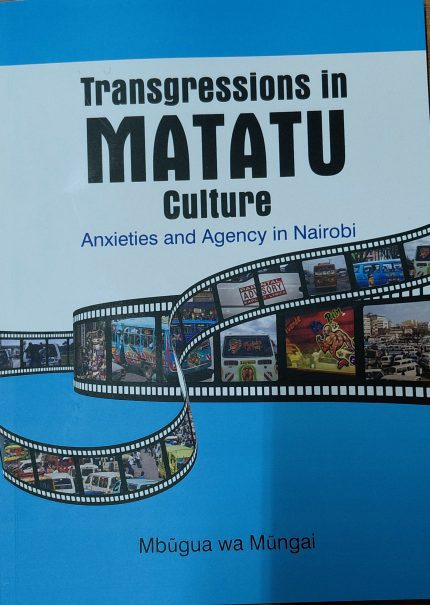
Only in a matatu can you find flat-broke ex-government ministers, thieves, teachers, madmen, school children and nuns sharing the same space. To understand the matatu is to begin to understand Kenya. Many stories are performed and told within the experience of a matatu ride- but why are they enacted? What are they about and whose perspectives inform the telling? Transgressions in Matatu Culture explores the positioning of different actors in the collective performance of matatu travel experience, identifying discussions that take place in and around these vehicles and linking them to broader discourses on gender, economics, politics and power in Kenyan society and further afield in global popular culture.
Deployed from multiple perspectives, some depicting clear contradictions with the lived experiences of the men (mostly) who crew these matatu, the incessant signification on the vehicles is central to the telling of stories about Nairobi. Taken together, the loud music, catchy slogans, boisterous display, and Sheng-the Kiswahili-based urban dialect that constitutes the predominant register of matatu work-among other aspects, tell us as much about matatu men as they present ideas about Kenya, and specific ways of being in Nairobi.
These men have over time created and purveyed what is arguably one of postcolonial Kenya's most visible, uniquely defined and vibrant subcultural expressions. In their practices, matatu men force even the most passive observers to (re-)examine their own complex relations with them. Trying to apprehend the similarities between matatu men and their compatriots, who are assumed to be unlike them, is one way of trying to comprehend some of the workings of contemporary Kenya and Nairobi is a productive pointer to some of the transgressive processes at play. This book presents a version of the many possible stories about matatu men's resilient occupational subculture, taken as a


































Reviews
Clear filtersThere are no reviews yet.