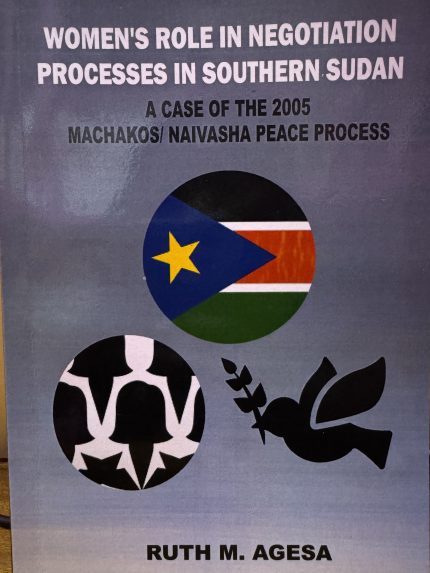
In this book the author states that despite bearing the highest brunt of
violence, it is improper to relegate all women to the status of victims of war
and conflict. Consequently, she argues that women play a major role in
peace making processes much as they bear the brunt of violence. They
deserve a place at the table, actively involved in decision making to ensure
peaceful coexistence. It is on this background that the author investigated
the main contributions of women to negotiation processes with regard to
South Sudan by examining the case of the Machakos and Naivasha peace
processes. The main finding in the book is that peace agreements, post-
conflict reconstruction and governance can do better when women are
involved. In essence, it is established that women who were involved in the
Machakos and Naivasha peace building processes contributed
considerably to the Comprehensive Peace Agreement. Despite the many challenges they
were faced with, they continue to be instrumental in the implementation of
the Agreement.