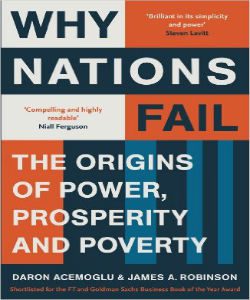
Brilliant and engagingly written, Why Nations Fail answers the question that has stumped the experts for centuries: Why are some nations rich and others poor, divided by wealth and poverty, health and sickness, food and famine? Is it culture, the weather, geography?
Perhaps ignorance of what the right policies are? Simply, no. None of these factors is either definitive or destiny. Otherwise, how to explain why Botswana has become one of the fastest growing countries in the world, while other African nations, such as Zimbabwe, the Congo, and Sierra Leone, are mired in poverty and violence?
Daron Acemoglu and James Robinson conclusively show that it is man-made political and economic institutions that underlie economic success (or lack of it). Korea, to take just one of their fascinating examples, is a remarkably homogeneous nation, yet the people of North Korea are among the poorest on earth while their brothers and sisters in South Korea are among the richest. The south forged a society that created incentives, rewarded innovation, and allowed everyone to participate in economic opportunities.
The economic success thus spurred was sustained because the government became accountable and responsive to citizens and the great mass of people. Sadly, the people of the north have endured decades of famine, political repression, and very different economic institutions—with no end in sight. The differences between the Koreas is due to the politics that created these completely different institutional trajectories.
Based on fifteen years of original research Acemoglu and Robinson marshall extraordinary historical evidence from the Roman Empire, the Mayan city-states, medieval Venice, the Soviet Union, Latin America, England, Europe, the United States, and Africa to build a new theory of political economy with great relevance for the big questions of today, including: - China has built an authoritarian growth machine.
Will it continue to grow at such high speed and overwhelm the West? - Are America’s best days behind it? Are we moving from a virtuous circle in which efforts by elites to aggrandize power are resisted to a vicious one that enriches and empowers a small minority? - What is the most effective way to help move billions of people from the rut of poverty to prosperity?
More philanthropy from the wealthy nations of the West? Or learning the hard-won lessons of Acemoglu and Robinson’s breakthrough ideas on the interplay between inclusive political and economic institutions? Why Nations Fail will change the way you look at—and understand—the world."

















John Akello –
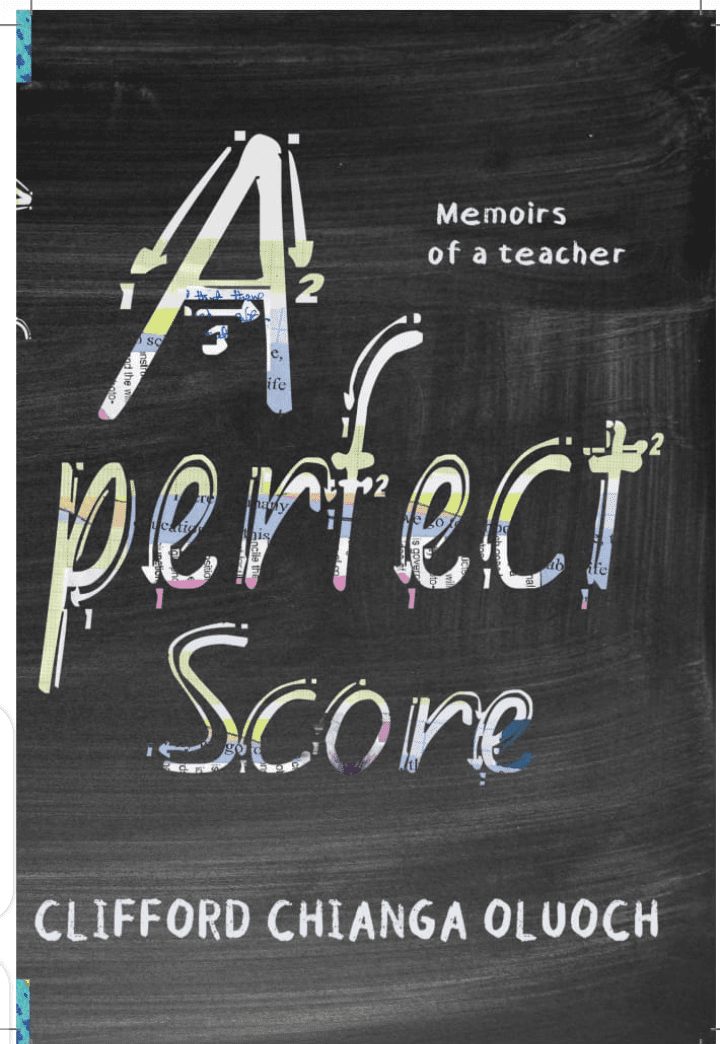
“I never knew English, now English knows me” Clifford Oluoch.
The above mentioned caption is a great introduction to the prowess, articulation and command of the English language Clifford has, as he articulates the various stories of his life.
The beauty of this book is that is an non-chronological diarisation of his life experiences that reveal the humane side to such a Stoic figure in the teaching industry. This makes it excitingly unpredictable and variant compared to other linear forms of writing, this made me totally engrossed and wanted to progress with the book every opportunity I got.
His vulnerability in expressing his fears, concerns ,hope, joy and the deep connections he illustrates with the people he portrays in the book, not only showcases his passion for his craft as teacher, but also the deeps seated truth of find a Job you love and you might never work a day in your life.
I will definitely be reading this in the near future and thank you for the great work you do with your feeding program.
Valentine Robai –
The narration about his experiences as a teacher were great! I gave it a 2 star because I read it right after reading Viola Davis’s Finding Me and found this quite hollow. Comparatively, I felt left hanging. The passion for his work as a teacher and philanthropist was missing like what I found in Viola’s book. Clifford and Viola were born 2 years apart and had almost the same lives. The passion and depth in Violas book was missing here. I wish he has told us more about his childhood, his parents, his sisters & brothers, children & wife. Most of the details were hanging with no known source. I had to fill up the gaps. I did enjoy his connections with his pupils and their parents. It was an OK read..
Riri (verified owner) –
I read this book so quickly, wanting to know what happened next after every page. No spoilers…but each encounter and narration left me wondering and yearning for more information. After reading this book, I truly want to sit down with the writer and ask him to continue the tales about his experiences in life. It was a great read, of a Kenyan normal jamaa who has navigated this life with incredible experiences to share. I recommend it to anyone who loves real-life stories.
Sheila –
Truly enjoying this read guys. It feels like a sharing stories with friends. It’ll you shock you, tickle you and draw you into it. I love it!