














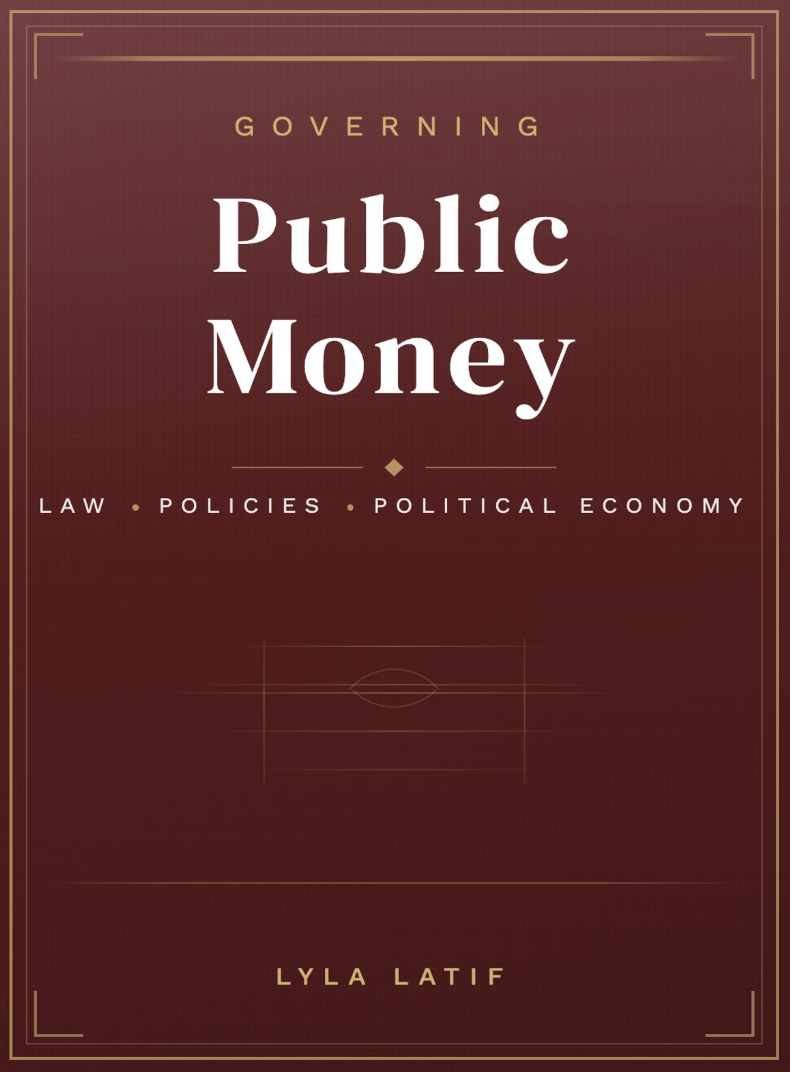

That pothole destroying your car? A fiscal decision. The clinic without medicine? A budget line. The debt your grandchildren will repay? Contracted in your name, without your consent.
Public money is not government money. It is yours.
This book shows you where it goes.
Drawing on a decade of experience across thirty-two countries and the training of over five thousand practitioners, Lyla Latif dismantles the technical fog surrounding public finance and reveals the power relations underneath. How colonial fiscal systems were designed to extract, not serve, and still do. How international tax rules drain African resources through architectures built without African voices. How debt becomes a weapon. How budgets betray. How corruption thrives in complexity.
But also: how it can be different.
From constitutional foundations to tax law, from sovereign borrowing to budget execution, from devolution to digital transformation, this book covers the full terrain of public finance management law. Its final chapter recovers what colonialism erased, this being the Islamic fiscal institutions that governed economies for centuries before being declared invisible.
Kenya is the lens. Africa is the context. The implications are global.
Rigorous. Accessible. Unflinching.
Because understanding public money is not optional. It is how citizens stop being subjects.












Abdikadir Ismail –
Alxamdulillah I had the opportunity to read your book, Governing Public Money: Law, Policies and Political Economy. Although I had to balance it with my work commitments, I found it deeply insightful and highly resonant with my experience working in the public service sector.
The eleven chapters provided me with a comprehensive understanding of public finance from multiple dimensions—legal, institutional, and political. Many of the issues you raised strongly connected with the realities we face in my country, especially in the area of public procurement. At times, it felt as though you were describing the Somali context directly.
Some of the key reflections that stood out to me include:
· The idea that constitutional guarantees of rights remain aspirational without fiscal means.
· The central role of public procurement as the link between budget allocations and actual service delivery.
· The need to rethink fiscal contract frameworks in contexts where governments rely less on taxation.
· The importance of revenue generation as a foundation for effective governance.
· The risks associated with unsustainable debt and its impact on social services.
· The critical role of procurement planning and how technical details—such as specifications and evaluation committee composition—affect integrity and outcomes.
· The persistent gap between regional commitments and implementation.
· The tension between digital efficiency and privacy in tax administration.
· The challenges of corruption, particularly pre-tender manipulation and selective enforcement.
· The potential role of Islamic fiscal instruments such as zakat within modern public finance systems.
I intend to revisit the book during my annual leave in order to engage with it more deeply and absorb its insights in a more focused way.
If I have the opportunity to visit Kenya in the future, I would be honored to reach out and possibly meet you, insha Allah.
Thank you once again for your valuable contribution through your book. It has truly been an enlightening experience.
Kind regards,
Abdikadir Ismail
Ali Adow –
I buy this book and I bring it to Somalia with me so I can learn from it and apply what I learn to help my country.
Afshin –
This book is a must-have to understand public finance. Simple language, logical flow, excellent breakdown of ideas – the book is a delight to read and teaches a lot! The context is also well explained and it is incredibly helpful that the book adopts not just a legal lens, but also a political economy one. It is suitable and engaging even for those who are not well versed with the subject. Highly recommend getting a copy.
Afshin –
This book is a must-have to understand public finance. Simple language, logical flow, excellent breakdown of ideas – the book is a delight to read and teaches a lot! The context is also well explained and it is incredibly helpful that the book adopts not just a legal lens, but also a political economy one. It is suitable even for those who are not well versed with the subject. Highly recommend getting a copy.
Samantha –
Got this book yesterday and I am learning a lot. Good thing about it is that you dont have to read from the start you can start from any chapter and the discussion is very engaging.
Moses Musisi –
The author donated some books to the law school library and I am on chapter one and totally hooked.