














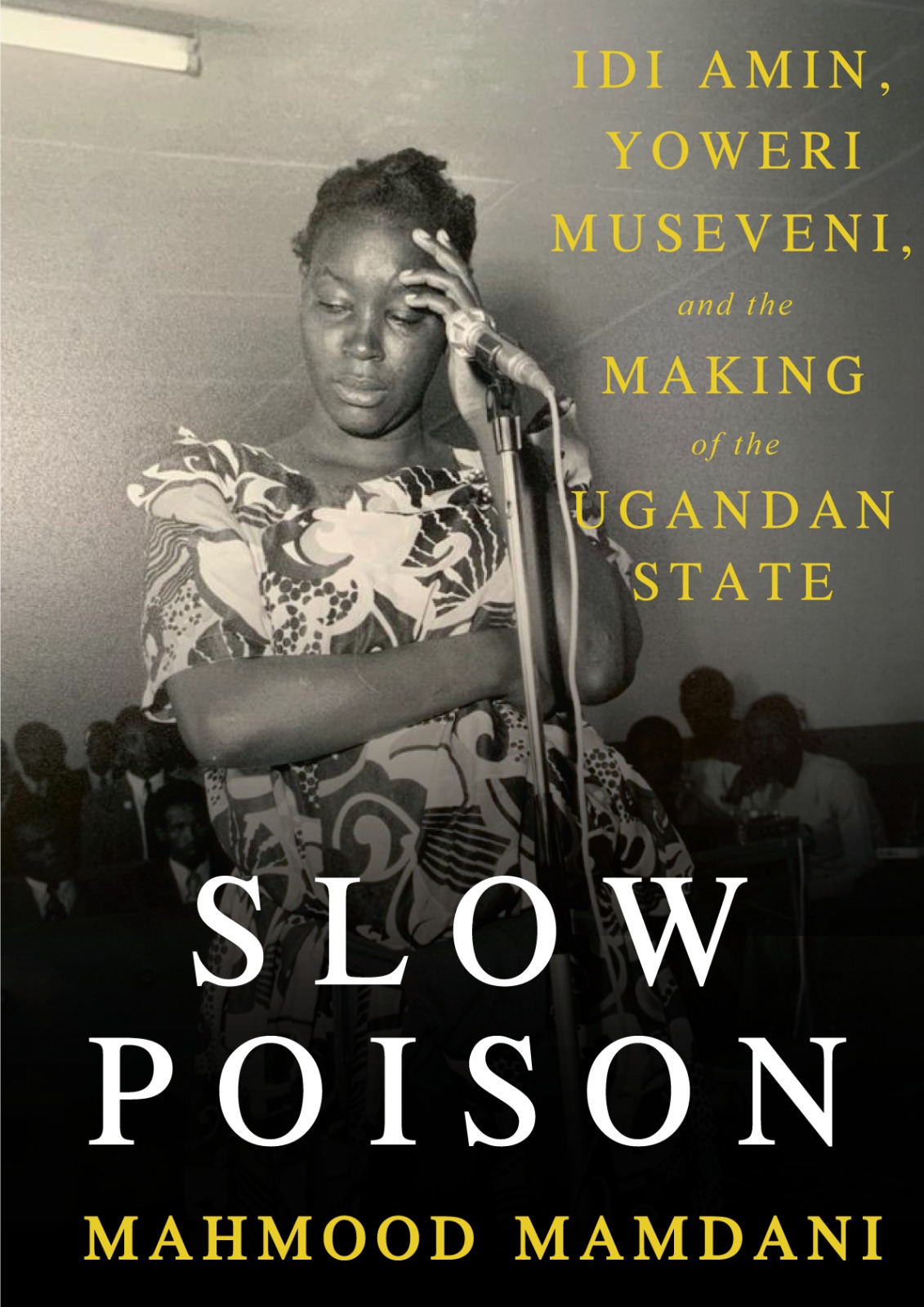


A leading public intellectual gives his authoritative and personal account of the tragic postcolonial fate of Uganda, his homeland.
In 1972, when Mahmood Mamdani came home to Uganda, he found a country transformed by “an orgy of violence.” Two years earlier, with support from the colonial powers of Great Britain and Israel, Idi Amin had forcefully cemented his rule. He soon expelled Uganda’s Indian minority in hopes of fostering a nation for Black Ugandans. The plan backfired. Amin was followed by Yoweri Museveni, who has now ruled for nearly four decades. Whereas Amin tried to create a Black nation out of the majority, Museveni sought to fragment this majority into multiple ethnic minorities, re-creating a version of colonial indirect rule.
Slow Poison is Mamdani’s firsthand report on the tragic unraveling of his country’s struggle for decolonialization. A witness to East Africa’s endlessly intricate power plays, and one of the most insightful political philosophers of his generation, Mamdani casts a learned and wary eye on Amin, internationally depicted as a buffoon; the radical scholar Museveni; and the global heavyweights that exploited and manipulated Uganda before and after its independence.
Each leader made violence central to his project, but Mamdani sees a signal difference between Amin, who retained popular support to the end, and Museveni, who has not. The Asian expulsion made Amin a monster in the eyes of the West. In contrast, Museveni was hailed as standard bearer of the “war on terror” in Africa and was protected from accountability for far greater crimes. In exchange for adopting the package of neoliberal reforms known as the Washington Consensus, he became Africa’s poster child. Amin, who aimed to create a nation of Black millionaires, never became one himself. Meanwhile, Uganda’s surrender to privatization has brought Museveni’s family immense wealth, even as the country remains one of the world’s poorest.




















Gabriel Oguda –
“Among these were two East African-Asian photographers, Mohinder Dhillon and Mohamed Amin, as well as the scholar Ali Mazrui.
Ali Mazrui’s public break came in February 1978 in his testimony before the subcommittee on Africa of the US House of Representatives. Mazrui distinguished between dictatorship and anarchy in his testimony.
He attributed the murders of Chief Justice Benedicto Kiwanuka and Makere University Vice Chancellor Frank Kalimuzo in 1972, as well as the 1977 murders of Archbishop Janani Luwum and two Cabinet ministers, to the prevailing anarchy. Many civilian deaths, Mazrui argued, may not all be at the hands of Idi Amin, as there were many cases of “decentralized brutality – of individual soldiers ‘executing’ a man behind a dance hall in order to ‘inherit’ his girlfriend for the night, or of civilian criminals wearing army uniforms on loan from real soldiers as a strategy of extorting money.
Mazrui was not the only one wary of being misinformed by a powerful and ubiquitous propaganda machine. In a widely circulated email on the death of Mohinder Dhillon in March 2020, the Ugandan Asian academic Vali Jamal recalled Dhillon confessing how he had in the past been fooled by the anti-Amin machinery and its key architect, the British journalist David Martin. He particularly regretted taking the bait about the infamous de-breasting of seventy-seven girl students at Makerere University and the murder of tens, all published in ‘The Observer’ (London).
Mohinder Dhillon had gone to Kampala after the fall of Idi Amin. He recalled the Vice Chancellor of Makerere University telling him and other journalists as he welcomed them to the university, “Gentlemen, sorry, but I have no girl students to produce for you with scars.” He added that only one Makerere University student had been killed during the life of the regime and that had happened off campus.
Mohamed Amin, the other photojournalist from Kenya, had covered Idi Amin “from very up close,” in Vali’s own words. Fond of Mo Amin, Idi Amin used to call him “Junior”; Mohamed Amin went to Jeddah in Saudi Arabia to interview Idi Amin after his fall.
Vali suggests that Mohamed Amin likely met Idi Amin in Jeddah to atone for the innumerable stories he had put out on Amin, including those testifying to “the president’s taste in flesh.” When Mohamed Amin asked about Idi’s son, Moses, who reportedly had been killed by his own father, Idi “did reluctantly bring out Moses and allowed Mohamed Amin to take a photograph.”
Decades later, I was asked to be a consultant on the 2021 Netflix Documentary “How to Become a Tyrant.” I obliged, spending an entire morning at the Netflix -rented studio in Brooklyn, only to realize months later that Netflix had used but one sentence from what had been at least one-hour, face-to-face interview. The reason was not difficult to guess: nothing I said or narrated fit their preconceived notions of Amin.
Among those who understood that the figure of Amin had been racialized by the media was the actor Forest Whitaker. When he was making ‘The Last King of Scotland (2006)’, he asked Mira, my wife, if he could come and talk to me about Amin. I said yes. Whitaker and I sat in the garden of our home for several hours.
He was agitated, and disturbed, by the picture of Amin he had gathered from the filmmakers and from those they had suggested he talk to about Amin. He was looking for a credible, believable picture of Amin. The endeavour took us several hours.”
– Slow Poison: Idi Amin, Yoweri Museveni, and the Making of the Ugandan State (2025) / Mahmood Mamdani (pp 113-115). Jahazi Press, Nairobi Kenya.